We have now have 4 active teams organized and developing their immersive media projects in Phnom Penh. They are exploring a great range of environmental concerns through immersive media projects. In the week of workshop exercises we played through the production and experience of augmented and virtual reality. Combining this technology with the aim of supporting environmental sustainability has led to some amazing project concepts.
“We Destroy Our Own Planet” (Global Warming)
This group has developed an infographic poster that will trigger 19 separate overlay video segments via augmented reality. The challenge is investigated in three phases: Human Activity that is causing global warming, the Risks we all experience as a result of the effects, and the Solutions we can employ to avoid the on-coming collision of wasteful prosperity with environmental destruction.
“Bring the Forests to Bophana” (Deforestation)
A second group is travelling to three separate Cambodia forests to document them as 360 images and sounds. These will be built into interactive VR experiences and a map-based app. The goal is to connect the residents of Phnom Penh, particularly the young, with the diverse biosphere that is at risk of destruction.
“Trash Is Not Bad” (Plastic Waste)
Statues of a traditional Cambodian dancer and the god, Hanuman, made out of recycled plastic bottles emerge from piles of trash. Images on these sculptures will trigger augmented reality 3D models of the miraculous modern materials we are able to create, but then treat without respect. Hanuman saved the world once upon a time. Can we all join him in this current epic quest to return the earth to health?
“Along the Water” (Water Pollution)
A fourth group is producing a 360 video about people living in floating houses on the river. They are also planning to have a sculpture with a projection on it as part of the exhibition. Living with the water pollution at Tom Nub Korb Srov in Phnom Penh will exemplify the adage that “what goes around, comes around.” How can we take care of that which sustains us?

We are underway with the American Arts Incubator — Cambodia workshop at Bophana Center!
In our workshop we have done a series of exercises working with the Aurasma augmented reality app. One group of students created an “aura” that uses the image of a skull-and-crossbones landmine warning sign as a trigger for an augmented reality overlay — a video they shot of discarded plastic bottles and other trash on the street. At first there were comments that the landmine warning was too extreme for this association with trash. But then as we discussed it, we began to wonder if future generations might look back on us with the same terror and concern. Is all this careless waste laying new treacherous mine fields for our children to cross? The documentary, A Plastic Ocean, screened at the American Corner at Paññāsāstra University of Cambodia last week revealing to us the tragic impacts of the flood of indestructible waste that pours from our consumer lifestyles.

In an effort to do our part, NRG Solutions - Kruosar Solar has completed a soft install of the components of the 260 watt solar panel, battery, and charge controller system we are donating to Bophana. We are going to hook it up and test out a variety of locations in the Bophana space, finishing the install next week. In addition, we purchased some really exciting low-power appliances from Niwa Solar to run on the power generated. There is a super bright light that only draws 3 Watts, a standing fan (13 W), 18” television monitor (8-11 W) and USB chargers. They all run directly from the 12 volts supplied by the 100 amp hour battery without the need of an inverter. We already have the components that can keep us cool, lit, and connected, bathed in electronic images and sounds! Plenty of extra power will be generated to share. Sustainability is achieved when the power generated balances the power needs. Once that point is reached, we have caught the wave and are surfing on photons streaming from the sun.
What constitutes an artist community? And how can art contribute to and challenge political processes? As I prepare for my upcoming exchange trip to Colombia, I am asking these questions and finding answers in unlikely places. I’ve been living off of the grid in DIY communities in California — from the lush environment of Big Sur down to the dry desert heat in Joshua Tree. While the answers to these questions are still somewhat ambiguous, the reality of my living situation has provided a few graceful epiphanies along with many unforeseeable obstacles.
Sometimes mother nature has her way of becoming your most relevant concern. While living in Big Sur, the rain created many of these obstacles — from collapsing bridges to impassible landslides, creating miles of unreachable landscape. In fact, my temporary home at the Henry Miller Memorial Library lies just south of the recently collapsed Pfeiffer Canyon bridge, and so I was forced to evacuate until a bypass trail was created.


This real-world situation has given me much to ponder and question. How can a community focus on art when they can’t find food or water, or are forced out of their homes, during famine, extreme weather or at worst — during wartime? How can we as humans overcome these obstacles and define our lives in the midst of these life threatening events?
One of the first music shows I attended and helped out with at the Henry Miller Memorial Library was back in December of 2016 with Kendra McKinley and Kelly McFarling. A crowd of 60 or more people huddled together inside a room filled by candlelight and the crackling of a wood-burning stove. We were surrounded by visionaries from the past to the present — contained within the pages of a diverse collection of books from all walks of life. While on stage, Kelly mentioned how beautiful it was that in the midst of all the recent political turmoil and world events that we could still find it in our hearts to come together and listen to a woman sing about her emotions. It made me think about humanity and perhaps our crowning achievement, which in my mind is the celebration of artistic creation. Along with food and shelter — art, story, song and dance are vital to the human condition and when the world beats down on us it is art that serves to lift us up again.
My objective in Colombia is to create and foster these very kinds of “safe spaces” and creative environments. I believe that the act of creating art, especially in times of turmoil, is perhaps our most necessary combatant in creating a brighter future. Born out of necessity, art aims to congregate, engage and ponder life’s biggest questions — to hear and listen through another’s ears, to see the world through another’s eyes, to think for oneself and question the world at large.
To address these notions, I’ll be leading a workshop series in Colombia entitled, Digital Storytelling through Immersive Art and Tech. During the workshops we will be exploring a diverse range of topics and artistic techniques, allowing the participants to expand their own conceptions of what art is. We will build a greater communal discussion holding art as a centerpiece in dealing with social inclusion. We will be working with new digital fabrication techniques, sound and video production, device hacking, and projection mapping, which will lead to a series of four community projects addressing the topic of “Inclusive Memory for Peace”. The artist collective developed through these workshops will then expand to include artists, researchers and organizers from different backgrounds and social movements.
At this point, I cannot be certain of what will transpire or even what the ultimate outcome will look like, but as I begin packing and prepping for this upcoming exchange I become more aware not only of the difficulties but also the endless opportunities ahead. And as a final note to this chapter, I’d like to quote a man who, not through his own actions but through his life connections, led to the creation of one of the most humble and magical communities I’ve thus far encountered at the Henry Miller Memorial Library.

“Big Sur and the Oranges of Hieronymus Bosch”

After an intense workshop series that expanded over the course of two weekends plus research excursions during the week, the participants defined their interests and finalized their ideas to develop community project proposals. These projects will be presented at the final show as various prototypes that tackle inclusion in different ways.
We explored the subject of inclusion through prototyping labs, where I taught participants the use of various electronics and sensors, encouraging them to think of ways that use interactivity to create new experiences of empathy and inclusiveness in community. We played with LEDs, microphones, and tactile sensors and broke out into rapid prototyping exercises where the participants had to think fast and design quick devices throughout the lab.


As the learning continued, I introduced the participants to various ethnographic techniques common in design research including Ideo.org’s Human Centered Design approach to prototyping. This is what’s known as "design thinking," but I’ve applied the same principals to “art thinking,” allowing the participants to learn, research, brainstorm and prototype with the goal of creating community art projects that tackle issues around inclusion. An approach like this helps ensure that these projects really matter to the communities that they are created for, addressing issues through mutual understanding and co-creation.
Along with workshops and discussions, the program included meetings with the curators of the exhibition Co-Thinkers, disabled visitors, and the staff of Garage’s Department of Inclusive Programs.


At the end of the lab, four groups of participants came together to create projects, each focused on a different aspect of inclusion: raising awareness about inclusive practices in museums; facilitating cooperation within communities; discovering new leisure opportunities; and developing new experiences for people with and without disabilities. The groups are already hard at work turning their proposed ideas into tangible prototypes for the final event on April 22 where they will showcase their ideas to the public.
Everydayness
The sensor quest group with their project entitled “Everydayness” looks at the daily challenges and limitations brought about by disabilities. The group is working on creating various interactive art “quests” that guests perform and are guided through. These experiences allow for interactions that mimic the kinds of limitations encounted by persons with disabilities, allowing for empathetic exchanges between those with and without disabilities.
Emotional Clothes
With their project entitled “Emotional Clothes,” another group is working on wearable prototypes that allow users to communicate with their bodies through color, light, or vibrations. They hope to address issues of initial prejudice and help people perceive and focus on emotions first, allowing this interaction to be the forefront of human conversation and perception rather than bias and assumptions of another based on appearance.

Traveller on a Wheelchair
Creating improved, customizable, and aesthetically pleasing wheelchairs is the goal of the next group with their “Traveller on a Wheelchair” concept. This group is focusing on gadget creation specific to the needs of those in wheelchairs, allowing them to travel independently through a “guide” app and prototypes specific for the wheelchair. From the research and interviews done at Preodolynie Rehabilitation Center, the participants were able to see the needs, dreams and hopes these people in wheelchairs have — some aspired to be filmmakers while others danced and lived active lives. The project aims to expand thinking about possible gadgets and creations that facilitate freedom in community.

Art To Be Open
Lastly, the “Art To Be Open” project will be a mobile and internet platform app that creates an accessible database of all the inclusive programs and accessible locations throughout the city of Moscow. Users will be able to find information on the accessibility of cultural institutions through the platform. This group also plans to create a data visualization through a sculptural installation, in conjunction to the app, that visualizes Moscow's museums and highlights their levels of inclusion and accessibility.
The day of the showcase has finally arrived! The doors were opened for the public to come and see our work. To my own surprise there were a large number of attendees, including many curious pedestrians who wandered in. A few hours into the event, we had our panel review and were honored by the presence of several folks from the U.S. Embassy. Many attendees expressed profound interest in the projects and complimented the teams.

I set the showcase up as a show-and-tell, booth-style event that allowed the participants to interact more directly with the audience then get feedback. People loved the idea of the Mobile Makerspace! From my perspective, Guatemala is looking at this idea as a great resource with economic impact. Guatemalans love ideas that promote small business.

A recurring comment was, "We know what our problems are but we need new ideas that can solve our small economy-issues. This idea of a shared makerspace looks amazing."
This event was efficient and awesome. The show-and-tell feedback gave participants in-depth information about their projects and the questions during the panel helped shape their thinking about the future: "How can these projects be sustainable? Can they be replicated in the rural areas? "
The attendees were so happy to see projects in Guatemala that promote economic prosperity! The panel was followed by a huge standing ovation. I usually do not mix business and emotions but that day I almost cried in public. I was so moved by the teams, the sacrifices they made to participate, and their dedication and time to the project. Thanks to all of them, I have a new understanding of hope.
Thanks Guatemala, it was awesome!
The community project descriptions below were written by participants in American Arts Incubator — Guatemala. All four projects are collaborating to form a single makerspace, each contributing to an aspect of the whole. These projects were initiated during Balam Soto's Incubator workshop and will continue to develop after the Incubator is complete.
Community Project: Makerspace
A "makerspace," also known as a "hackerspace," is a physical or mobile space for people to join and share resources or knowledge. It contains different tools and accessories which facilitate the development of projects and ideas, establishing modular standards to be adapted to different environments. In order to do this well, one needs a mobile makerspace as well as a stationary one.
Our main idea in order to begin this project was a mobile makerspace. Following this intention, there was an outpouring of ideas for different models and structures that could inform our makerspace design. Our current model originated from the concept of a wheeled cart used by gum vendors, which one can find on any corner or street in Guatemala City. We felt this would make it immediately “friendlier" since people are used to seeing them everywhere everyday.
The structure of our mobile makerspace is a composite piece made with wooden boxes that are removeable. In these boxes we can store tools in different compartments for categories like: Carpentry, Finances, Programming, Art, Smithy, Marketing, Electronics, Design, Cooking, Photography, Engineering, Technology, Math, and Theater. Our makerspace has many tools, from soldering irons to hammers, painting supplies, etc.
The goal of the project is focused on economic equity. Looking for a way to integrate this focus, the makerspace has a mission to promote multiple creative processes and shared resources that boost economic benefit based on personal and group wellness. Our makerspace, RedCrea, is open to all kinds of people. It will be taken to all types of places, like schools, communities, etc.


Community Project: Open Source Web Knowledge
Is an opensource web tool to add tutorials, how to etc base on Guatemala culture, the main ide is to make a place were creative and commun knowledge has an online presence.
Every little moment of life goes unnoticed: the sun, eating, sleeping, living… ah, also posting, sharing (virtually), everything so daily and routinely…every morning, nothing can escape…nothing to be postponed for next week, it has to be there every morning…for a fraction of a moment, you stop, open your eyes, and breathe… let oxygen go through your brain, life becomes real, the good and the bad awaken… the pleasant sun joins this day, the restlessness to improve turns unbearable…the daily demands raise your fears, but today, the decision is already made. The needs have made themselves heard, many times it will not be ignored.
Ideas join in, also wishes, experiences not so much, we have to tear down these walls, forget the smartphones. Getting up is the order: get up!
Today I fulfill my assignments, victory is ours, and the nation has been saved.
Who would be left out? Are there any cowards among us?
You have a lot to give, we have even more to give you.
Now, we sail with all our abilities, follow the wind, face the storms, and accept our weaknesses only to become stronger, now we sail to win.

Community Project: Education Maker
We envision economic equity through the use of art and technology as a means for human development. From the perspective of RedCrea, economic equity is a social concept under which people have the same opportunities in order to achieve their goals, personal success depending on how much individuals take advantage from these opportunities.
As we analyze it from this perspective, we notice that in Guatemala this is far from a reality. So initiatives like RedCrea can bring opportunity to more people, giving them access to diverse opportunities, specifically through access to art and technology.
Considering the positive impact of art on people’s ability to learn, and the influence of technology in a world in which the rate of new inventions and discoveries is at the highest in history. We consider it undeniable that access to art creation and technology is crucially important for any person.
Talking about these topics in developing countries has the tendency of being done under the supervision, considered sometimes sacred, of those who had the privilege of access. That is why at RedCrea the main objective is to give voice to those deprived of access by any circumstance, so that they become both actors and participants of the present and future.
As an education team, we visited a community in Santa Catarina Pinula, in order to gain a better understanding of their youth and to offer a workshop based on artistic creativity and technology. Together with the help of the collective, we developed topics, materials and processes aimed at this goal, integrating everything by promoting maker culture.
We are now developing a three-month course, once a week, for children and youth from Santa Catarina Pinula as a pilot, with topics focused on technology and community development for the attendants to become active participants in the growth within their community.

Community Project: Social Media Awareness and Communication
During the last three weeks, we have faced a big challenge as a developing group because in order to focus on the topic of economic equity, we needed to address the worst problem affecting Guatemala: high economic inequality and poor access to education.
We decided to create a maker space that we called RedCrea, which is a collective initiative for inquisitive minds: artists, designers, creators and makers who bring art and technology to children and youth with the objective of changing the way in which they learn and develop themselves.
We have been contributing ideas, designing webpages, social networks, branding, and the graphic identity and colors which represent us: red, white, light blue, and gray for they represent technology, dynamism, and creativity.
Our mission is to provide technology, maker culture, and the development of reasoning skills in order to modify the way in which people learn and communicate with one another; bringing materials, tools, educational methodologies, contents, and supplies to urban and rural educational institutions in Guatemala.
Our vision is tools, technological and artistic knowledge to children and youth in order to reduce the opportunity access gap and allow them to be competitive in a globalized world, pursuing economic equity in Guatemala.
We hope that with this project, we can help Guatemalan youth to have a broader vision of their future, learn about the internet, art, technology, and programming and apply them in their lives to even work in it later, as well as encouraging them to leave their comfort zone to try new things, unknown in their environment.

The average temparature of Earth's whole atmosphere cycles up and down each year because its southern hemisphere has more ocean coverage than the northern hemisphere. When these temperatures are graphed throughout the past 137 years you see that there is a range of warmer and cooler years. Color coding by time range produces a sharply separated rainbow - revealing a tragectory. The separated lines in recent years show that unfortunately this temperature velocity is accelerating.

Global map of the March 2017 LOTI (land-ocean temperature index) anomaly shows that North America and Siberia were again much warmer than the 1951-1980 base period.
How can we sustain our ability to live on this shared planet?
Preparations are underway for the American Arts Incubator Cambodia environmental sustainability workshop at Bophana Center, Phnom Penh!
Kruosar Solar / NRG Solutions and Bophana Center are meeting to discuss the installation design factors of the new solar powered time lens media installation. We will be setting up the system next week and aim to have collected enough electricity to be inaugurated it by powering the April 21st artist talk and the the week-long workshop starting on Earth Day, April 22nd.
The workshop is open to anyone in Phnom Penh interested in using media to improve environmental health. To enroll please apply here:
Time Lens Workshop - Immersive Media Pathways to Sustainability
Session 1 – Earth Day – Past
Saturday April 22, Bophana Center
Virtual Reality – Immersion into a location at a previous time
Ricoh Theta–S 360 camera, Kolor Panotour Pro virtual tour authoring software
Session 2 – Present
Sunday April 23, Bophana Center
Augmented Reality – Layering onto the current location
Aurasma augmented reality app
Session 3 - Moments
Wednesday April 26, Design Innovations
Work session for Video editing, and VR/AR editing and authoring
Session 4 – Future
Saturday April 29, Bophana Center
Collaboration and Creativity - What impacts do these media produce? What futures do we see through the time lenses? What “images” are revealed?
Session 5 – Sustainability
Sunday April 30, Bophana Center
What kinds of time lenses can be focused on sustaining the abilities of our shared environment?
4 groups pitch their project ideas. These are developed in the following 2 weeks, each with a $500 project grant.
Sustainability Achievement unlocked – One Million Liter Rain Catchment System
In preparation for the Arts Incubator I have been training up my own sustainability skills and have just completed a fresh water collection system.

A silicone painted roof clean rain catchment system that collects 1 million liters of fresh water each year.
The roof is a square that is 15.5 meters per side = 240 square meters of surface area
At this location, the rainfall averaged 4.55 meters per year between 1993 – 2010.
The average annual volume of water that falls on the roof can be calculated by:
240 square meter roof area x 4.55 meter depth of water
= 1092 cubic meters of water
= 1,092,000 liters of rain collection.
The rain water is stored in a 37,000 liter water tank. When needed, it is filtered, UV sterilized and pumped throughout the house.
This past weekend I was asked to take part in the San José Paseo Public Prototyping Festival as a representative of ZERO1’s American Arts Incubator (AAI) program. The festival was created to celebrate the culmination of the San José State University Paseo Prototyping Challenge at the newly opened SJSU Hammer Theatre Center in downtown San José.
On Friday, I conducted a workshop with AAI program director, Kate Spacek, that was intended to mimic one of the first workshops we’ll be leading in Colombia. The workshop was designed to explore the relationships of people to their environments through the phenomena of sound. We had group discussions on what it means to listen, and how the sounds we hear shape and shift our perceptions of the world around us. I described some of the basic fundamentals of sound, as both a physical phenomena (physical vibrations) and perceptual phenomena (our cognition of these vibrations). Following the series of short listening exercises, participants were able to experience some hands-on building and electronics soldering. Each person built their own contact microphone that they were able to take with them at the end of the day.


The ability to use this workshop as a trial run for the upcoming series I’ll be leading in Colombia was of great help. It provided many insights into the nature of working in small groups around large issues and topics that are often hard to talk about. Through the listening exercises, one of the topics that arose was the idea of memory and attaching or retrieving a memory from a sound experience. How does the sound in our environment effect our own emotions and thoughts? And how can we strive for empathy through listening to others?
As the workshop came to a close we discussed all the lessons of the day and shared many new takeaways for the participants, as well as Kate and myself. We emphasized that listening is an active process rather than passive, and that the practice of listening can be a building block to fostering understanding and unity. One of our main objectives was to expand perspectives and explore sound spectrums while in the process discovering how each person’s hearing is different.
This is the first in a series of workshops. Moving forward through the AAI program we will begin growing ideas for public project concepts that use the techniques we learn throughout the week to engage community into a new kind of dialogue around social inclusion.

In addition to the workshops, I was asked to create some large-scale projections on the facade of the US government building that sits opposite the Hammer Theatre. The content projected was a mix of futuristic illustrations of green city planning, Buckminster Fuller diagrams, and nature intertwined and mashed together to create a visual experience for festival goers and passersby.
PASEO Prototyping Festival - San Jose, CA from Nathaniel I Ober on Vimeo.
Snowy caps and white plains filled the window scene outside of the aircraft as we descended into Moscow’s Sheremetyevo airport. I was quite a world away from the warm and sunny California coast of home. I could feel the temperature dropping as the snow reminded me that winter was not over yet here in Russia. Perhaps I will see the change of seasons over the course of the month in Mother Russia.
Time was tight once I landed, as my schedule demanded preparations for several meetings, an Artist Talk, and the first round of workshops which were to begin two days later on the weekend. I had already prepared teaching materials and Arduino plug and play sensor kits to share with the participants, so they could get started with prototyping as soon as possible. I packed a suitcase full of electronics that made it through the TSA and off to Garage Museum of Contemporary Art we went.

Here at Garage, I met with the Coordinator of the Inclusion Department and after discussing some key points, I was offered a tour to explore the current exhibition at the museum, a Triennial of Russian Contemporary Art, featuring over 40 Russian artists based all over the country. Spanning the entire building, the exhibition featured seven curated themes prevalent among Russian art practice today — Master Figure, Art in Action, Fidelity to Place, Personal Mythologies, Common Language, Local Histories of Art and Street Morphology. It took me a while to take in the full extent of all the work presented in the exhibit. It ultimately gave me an understanding of where Russian Contemporary Art currently sits within today’s Russian society and the post-Soviet era context.


The Art of Action whose intentions lie as catalysts for social change. Photo: Elaine Cheung

As I made my way back to my apartment that night, the snow fell slowly. The freezing air created beautiful flakes across the water as my breath materialized in front of me. It’s cold and chilly but I’m excited to begin!
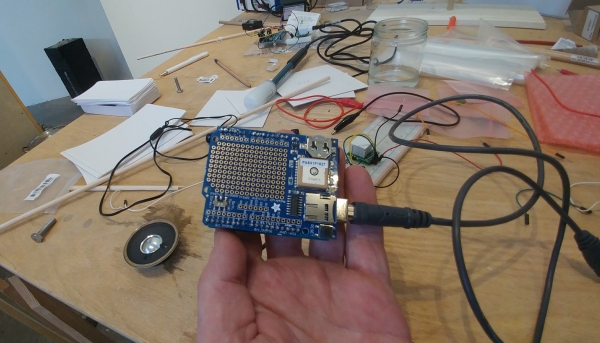
I am building water quality sensors which will capture geolocated data. This was my first test with this technology. This is part of my ongoing research at the Santa Fe Water Rights residency (March-April) and for the American Arts Incubator program in Thailand (May-June).
This GPS data-logging shield from Adafruit arrived yesterday and after a couple of hours of code-wrestling, I was able to capture the latitude and longitude to a CSV data file.
The is me walking from my studio at SFAI to the bedroom. The GPS signal at this range (100m) fluctuates greatly, but I like the odd compositional results. I did the plotting in OpenFrameworks, my tool-of-choice for displaying data that will be later transformed into sculptural results.

The second one is me driving in the car for a distance of about 2km. The tracks are much smoother. If you look closely, you can see where I stopped at the various traffic lights.
Now, GPS tracking alone isn’t super-compelling, and there are many mapping apps that will do this for you. But as soon as I can attach water sensor data to latitude/longitude, then it can transform into something much more interesting as the data will become multi-dimensional.
And the cover image? That would be me, shopping at Whole Foods.
For more information and updates, please join the American Arts Incubator Facebook page.
As I prepare for departure, I’m getting even more excited to host a workshop at the Garage Contemporary Museum of Art soon after I land in Moscow. The workshop will explore how art be used as a tool to address disability inclusion. I will leverage my skills in electronics, interactive design and wearable technology to guide learning around the role art, combined with interactive media, can play in creating new models and visions for a future where people with disabilities can experience art in new, accessible and inclusive ways.
The workshop will be a learning lab focused on introducing ways to place technology on the body. We'll also look at how basic sensor tech and sensory exploration can inform and allow us to reinterpret our senses, augmenting them in different ways. I hope these ideas and creative explorations can help us explore the various ways disability can inform the future of art and design. By designing with people with disabilities from the start, getting people excited by what can be made through the lab, and having inclusive design inform the learning process, the workshop can be a source of creative play and learning to use empathy in the design process.

I’ve just come back from a trip to Austin, TX for the South by Southwest conference that focuses on film, music and interactive technology. I was presented as a finalist for the Student Innovation Award with my thesis, work that really informs this current exploration into wearables and health for American Arts Incubator. Using this residency as a place to inform my own practices, it’s my hope to provide a space and community that cultivates inclusion and creative expression. I’ve been able to represent the body in new ways informed by teachings on consciousness and human experience. By conceiving of technical apps that help guide and navigate a user in difficult mental situations, to creating a speculative interface that aids in a spiritual journey, expressive prototypes that design alternative health systems can help inform a unique vision of what can be possible in the future.

Fun times are still rolling here in Guatemala! After a week of soldering, programming, and LEDs, the participants have split into four groups to work on their own projects. I must say how impressive these four groups are. They each have a realistic perspective on their project and an authentic dedication. The majority of these participants are taking several hours a day from work or family matters to work on their projects. All four groups have a clear understanding of the value of research, marketing, outreach, and partnership.
Guatemalans are entrepreneurs at heart. Many believe that the answer to high unemployment is small business enterprise. Every day, everywhere you go, you see small businesses selling goods or services. Even when you take a bus ride, entrepreneurs will board the bus to sell everything from a single candy to cell phone accessories. This is how millions of Guatemalans make a living or supplement their income.
The four Guatemalan community project groups are:
Education
This group is developing and researching the educational component of the makerspace the participants will create. They will develop curriculum for workshops based on research of urban under-served populations.
Website Opensource Common Knowledge
This group will create a website. It will include tutorials in a DIY interactive format, general info on the makerspace, and will support the education team by hosting the educational content they develop. It will make that content available to the community worldwide as an open source education tool.
Makerspace
This team will develop a mobile makerspace based on their research of urban under-served populations, combined with the research and feedback of the education team. They are working hand in hand with other groups. They will design everything from the mobile makerspace unit itself to the tools it will house.
Outreach and Sustainability
This team is working to develop events, promote workshops, and develop social media outreach and economic equity awareness content. Among other tasks are branding, partnerships, and fundraising.
All the teams have a diverse membership of community leaders, students, workers, working mothers, artists, and entrepreneurs, yet they all understand and value the tools of the business world. This group strongly believes that economic equity can be promoted with business tools.

One month until American Arts Incubator begins in Cambodia. In preparation, I am working with Bophana Center and Kruosar Solar to design and install a local solar electric power system at Bophana, where the exchange program will occur. It will provide electricity for the month of workshops and project development. After the exchange it will continue to provide power, sustaining the community projects, building environmental health. Each day the energy is replenished when rotated into the stream of sunlight. What worlds will we create with the power we collect?

When my kids pre-ordered the Nintendo Switch earlier this year we decided to add another level to the game - it would only be charged with power they collected. Before it arrived we put together the power system– a 21-watt portable solar panel with charge controller connected to a 5-volt USB battery pack. Now that the Switch has arrived they can use it as much as they want, as long as they are able to keep it powered by the sun. If they can power it, they can play it.
We are learning to get really good at catching the sunlight.
A photon that will reach the earth has just left the sun.
spilled light
(an energy-inspired poem)
photons fall upon us
born in the fusion reactor at the center of our solar system
4 billion kilograms of matter converted into photons every second
only 1 in 2 billion photons are radiated directly towards the earth
every second 2 kilograms of matter is converted to energy and sent just to usIn 8 minutes and 19 seconds they complete their journey of 150 million kilometers
some of this light is reflected back into space
less now that the ice has melted
some is harvested by plants giving them the power to grow
a few are caught by solar panels and transfer their energy into electricity we can use
most end their journey by simply spilling heat into the oceans and onto the global citynew photons are just now beginning their journey from the sun
their light will be here soon
catch them before we spill
It has been a few days since my arrival in Guatemala City. My memory of downtown is different. I remember it being a place of transit and noise. Now a few streets have become pedestrian streets. But the noise is still there!
So far the experience has been great. I've met in person the folks from ArteCentro, which is a cool space and a visionary organization. They promote new practices and help artists to create by providing working spaces and studios.

We started the project with an artist talk during which I got a big surprise: the Mayor of my town and the Cultural Affairs Office presented to me with official recognition for my work! I got the chance to meet a few participants from diverse backgrounds, from startups to visual artists. They expressed real interest in this kind of workshop and projects.

It's looking like we will have a really great 3 weeks to learn and share together. I hope to make this 3 weeks a space for an exchange of ideas and actions.
And finally, I had a few hours to see my Guatemala family, meet my new cousins, and just play like kids in my most favorite place on earth — El Cerro Alux.

Finally, it is time to travel to Guatemala!
Over the past few weeks, I have literally been working non-stop, from coding to imagining how the project will be. I love to be ready ahead of time (not an inborn trait, but something that my wife taught me), however I know there will be times during this project when the unexpected will happen and I’ll be thinking, "What the # am I going to do now?"
 Custom circuit board. Photo: Courtesy of Balam Soto.
That has already happened. Despite ordering the custom printed circuit boards I developed way in advance, they took several weeks to arrive. They finally arrived just a few weeks before my departure. What if they don’t work? But they did! This was a huge relief and I began to open my mind to new ideas for utilizing these boards when I return.
I’m thinking about developing them into wearable cyclist turn signals as low cost urban biker safety gadgets.
This started really putting me in the mindset I need for managing the project in Guatemala. I need to introduce the concept of innovation. Not just what it is, but how to make it happen. What resources are there in Guatemala and how can these resources be integrated with new tools to rediscover the potential of Guatemala? The Mayans were a great civilization once before. We have it within us to recreate that greatness.
However, to help the program participants do this, I’m going to have to help them reassess and reimagine everything they already know about Guatemala and the culture. Going back one more step, I’m going to have to reimagine everything I know about Guatemala and the culture. I can’t wait to get started...
Research
As a designer, I look towards my environment and observations of the people around me as sources of inspiration and intrigue. In observing, watching and looking for threads of disability throughout my travels and in daily reoccurance, I have become acutely aware of how spaces are inhabited by invisible and visible bodies.
It’s interesting to consider how much people with disabilities have to “honk”, “wait” and “display” themselves in public to be noticed and assisted. In terms of wayfinding and navigating the public environment (as show in the images above on the left, a building, and on the right, gas stations), navigating the environment is seen as a very independent process in America. In order to “evacuate” or “have gas pumped”, someone with disabilities might require assistance. So importance is placed on one’s need to proclaim disability, as seen through the “wheelchair” sign or display placards on cards.
When I traveled to Hong Kong and used their subway system, a curious little device caught my ear...
Here, a melody of tones play to help the user locate the device. The interface is fitted with braille and raised surfaces to map out the subway through tactile forms. It uses the senses of audio and touch to communicate information with the user. The subway is an especially busy place in Hong Kong, where people walk more and use public transportation. With special devices installed for the blind, people with disabilities can navigate the subway stations and walk around to get from place to place.
Looking at design can give great inspiration to an artist. How can design influence art and artistic expression? The functional and utilitarian ways of navigating space with a disability provides an interesting perspective on how one lives with disability, often dependent on available tools in public environments to maintain relative independence. What is interesting is how culture plays such a large role: shaping how visible or invisible a disability is, how much independence is given to the user, even how the users feel during the interaction. Oftentimes, the interaction is a very visible experience where one is labeled with the identity of the disability as understood by other people. Navigating public spaces then requires a certain degree of social vulnerability and visibility at the same time.
Play
So what about the influence of disability in spaces of play or expression? The example of the tactile interface with the friendly melody coaxes the user towards the wayfinding station, adding personality and charm to the experience. I’m reminded of spaces like festivals or theme parks where recreational immersive experiences become spaces of play and imagination. What would it mean to play and “share space” in ways that go beyond languages and abilities?
Navigating such environments, as shown here at the TomorrowWorld festival, an attendee and her deaf friend are there enjoying the music, which can be interpreted and appreciated in a number of ways that exceed the sense of sound. The feeling of the bass, emotional meanings, sights and elements presented in the whole experience create an immersion in sensory experiences and meanings. There is also the sense of inclusion evoked by them dancing and enjoying the moment together. Imagine what might be possible if new kinds of sensory tools were developed that could interpret our reality in shared spaces to allow for inclusive interactions.
Wearables
The influences technology has had for people with disabilities is far reaching. Take for example, the hearing aid, where its influence can be felt in the design of headphones and earbuds with ever increasing need for smart technology, like wireless communication. With the popularity of audiophiles and our audio-visual culture, we are surrounded by exciting examples where disability inspires expression, like in the sense of hearing and sight. Here we are still looking at the framing of disability through the loss of sense and amplifying it through electronics. The hearing aid’s functionality and purpose are to amplify the surrounding environment, while headphones enable users to switch to a completely different digital or analog environment. The headphones add a layer of expression and emotion on top of our existing environment. Design and artistic expression can tackle situations in new ways that can bridge both physical and mental disabilities.

Over the next few weeks, I will begin to explore how accessibility and sensitivity can be designed into our environments and experiences. I’m excited to explore such possible avenues that wearable technology can have both in America and in the streets of Moscow. Looking at disabilities inclusion through the lens of an arts exchange such as AAI, the emerging influence of wearable technology in the West can find new inspiration within the rich visual art and culture found in Russia. Beginning to explore socially engaged art through emerging sensors and wearables can begin to break down barriers and promote inclusion through new kinds of social, and possibly sensory, interactions.