Photogrammetry is the science, technology and art of obtaining reliable information from non-contact imaging and other sensor systems about the Earth and its environment, and other physical objects and processes through recording, measuring, analyzing and representation. In this case, photogrammetry is used to create 3D models from series of photographs taken at various angles.
IMG 9773 by johncraigfreeman on Sketchfab
Geo-located Augmented Reality allows people to experience alternative realities at site specific locations. The public can simply download and launch a free mobile app and aim their devices’ cameras at the surrounding physical place. The application uses location detection technology to superimpose virtual objects, people or scenes at precise GPS coordinates, enabling the user to immerse themselves in the work as if they existed in the real world.
After meetings with stakeholders in Hankou, I had the opportunity to test if geo-located augmented reality was even possible on Chinese mobile networks. Zhang Heer helped me acquire a local SIM card for my phone at China Unicom, a local provider.

Although fraught with suspicious anomalies, the mobile networks of the city were active enough to open temporary access to alternative realities emanating from New York City and Los Angeles.

I’m just starting up a new adventure with art, technology, and the natural environment in the Philippines. It’s a project managed by ZERO1 in partnership with the U.S. State Department’s Bureau of Educational and Cultural Affairs! The goal will be to launch several projects with community members that combine digital technology with local crafts in order to address the issue of Environmental Health.
My previous work (digitalnaturalism.org) has involved working with scientists and crafters to build technology to interact with animals and natural environments. Typically my personal blend of interests and experiences across science, technology, and the arts can make it hard to find programs that support all these realms; this generally means I am forced to downplay some parts of what I do, in order to focus on the specific technological, scientific, or artistic tasks at hand. ZERO1's unique program allows me to explore and protect natural environments via collaborative new media art - a true synthesis of my favorite passions.

Most of my previous work took place in rich tropical environments (such as in Panama and Madagascar) full of unique creatures in special relationships. Being able to continue my work in the tropics of a new fascinating place (I have never been to the Philippines before), increases my exitement for the AAI program yet another level.
Preliminary Research
I am just starting to research the Philippines and specifically Dumaguete, the main town in which I will be based. As I mentioned, I have no firsthand knowledge of the Philippines, and the basic idea of a country formed out of a collection of tropical islands is fascinating.
Dumaguete itself is located several islands south of the largest, and perhaps most well known, city in the Philippines: Manila. The island it is located on is called Negros (“Black Island”), and is divided into east and west provinces. Before the Philippines was colonized, most of the islands were apparently inhabited by different groups of indigenous tribes. On Negros, the indigenous locals are referred to as “Negritos,” and from my early research there looks like a fascinating cultural center nearby in Dumaguete called Sildakang Negros Village. Dumaguete is now known as a small university town hosting Silliman University.

The first thing most discussed when looking into Dumaguete is the broad array of marine resources. It’s seated at the edge of a channel of several islands known to attract sea turtles, dolphins, and whale sharks. Terrestrially, Dumaguete is near a couple national parks home to interesting animals such as Flying Foxes, Hawk-Eagles, Leopard-cats, and Tarsiers. Negros itself is home to most of the endangered species in the Philippines as it is one of the areas most threatened by development and environmental destruction.
Right now I am focusing on making as many contacts as possible with researchers who have worked in the Philippines along with Philippine-run organizations in Dumaguete. It’s thrilling to imagine all the different ways this project can turn out!

I have been invited by the U.S. Consulate in Wuhan, in partnership with the K11 Art Foundation to spend 28 days in Wuhan, China where I will engage and empower youth by building a portal to an alternative reality. Based on traditional Chinese timber carpentry techniques, the physical structure will act as an access point where the public will be able to immerse themselves in virtual reality (VR) and augmented reality (AR) experiences documenting the rapidly changing city.
I will assemble and train production teams made up of faculty and students from the Hubei Institute of Fine Arts, Central China Normal University, and the Wuhan Textile University to engage the local community to determine in which parts of the city we will create VR and AR work. Other potential partners include China Endangered Culture Protector, Hubei Museum of Art, Wuhan Art Museum and the studio of local artist Cai Kai.
The City of Wuhan
Wuhan is a city of over 10 million people locate in central China’s Hubei Province at the confluence of the Yangtze and Han Rivers. The city is consolidated from three traditional walled cities: Wuchang to the east of the Yangtze, and to the west, Hankou north of the Han and Hanyang to the south of the Han. With a more ancient history than Beijing, Xi’an, and Nanjing, the three cities date from before AD 223.

During the Second Opium War (1856–1860), the Qing Dynasty was defeated by western powers, which led to the founding of foreign concessions along the banks of the Yangtze in Hankou. In 1911, the rebellion that ended dynastic rule and led to the founding of the Republic of China was launched from Wuchang. The city was occupied by Japanese forces during the Second World War and largely destroyed by U.S. firebombing in December of 1944.
Considered one of the fastest changing cities in China, Wuhan just might be the fastest changing city in the world. Choked by Tortoise Hill in Hanyang and Snake Hill in Wuchang, the Yangtze has a history of unleashing devastating floods in Wuhan, which was an important factor in the building of the Three Gorges Dam, 335 mile upstream, and the recurrence of Dragon King mythology.
Site Visit and Planning Meetings: November 27, 2015
On my first day in Wuhan I was met by Jamie Dragon, Public Affairs Officer from the U.S. Consulate General in Wuhan, Bu Shi, Assistant Manager of Arts Projects at K11 Art Foundation (our AAI program partner in Wuhan), and Officer of Arts Projects at K11, Zhang Heer. We all walked over to Zhongshan Park to look for some test augments I had placed there before I left for China.

For me, as a Queer Vietnamese American Woman in the diaspora, the issue of LGBTQ (Lesbian, Gay, Bisexual, Transgender, Queer) rights has always been vital to my survival and existence. I have had to navigate my queerness in the context of my identity as an American, as mixed race, and as a transnational Viet Kieu (overseas Vietnamese). When I came out in the early 90s there was no one to look to in order to see myself, in the US or in Vietnam. In the U.S., visibility of LGBTQ community was sparse and there certainly weren’t out queer Asian Americans, much less Vietnamese people that I could relate to. I took it upon myself to be as visible and out as possible.
Over the years in my travels to Vietnam, I have always sought out LGBTQ Vietnamese. Over a decade after coming out, I had to navigate my queerness delicately when I traveled. After my trip to Vietnam in 2003, I wrote a bit about my search for folks like myself. Here is a link to the soundcloud from the Whitney Biennial SAIC Free radio that details my story.
Twenty years after coming out, I remember sitting in a cafe in Saigon in June of 2013, with my Viet Kieu Queer friend celebrating the overturning of DOMA (Defense of Marriage Act) in the U.S. We sat and cried by ourselves. No one to share our joy with as we witnessed the slow roll towards equality in our home country. Fast forward to July 2015 when the U.S. Supreme Court overturned bans against same-sex marriage nationwide in the U.S., hashtags of #lovewins and #vietnamnext exploded across Vietnamese social media.

In the recent years, I have watched the shifts in the political landscape in Vietnam from afar, and it has been incredibly emotional. In 2012, one of the initial precursors to the contemporary LGBTQ movement was a flash mob organized to happen simultaneously in Hanoi and Ho Chi Minh City (formerly Saigon). I was moved to tears watching the LGBTQ flash mobs in Hanoi and Saigon. It was so compelling to see young Vietnamese LGBTQ people out and proud - waving rainbow flags. Here were all the people I had been looking for since I came out over 20 years ago. This movement of LGBTQ Vietnamese is incredibly young, and seems to be driven by young people under the age of 20 - young enough to be my own children! It gives me enormous pride to watch these LGBTQ developments in Vietnam. There are many new LGBTQ organizations that have sprung up in the past few years since I returned from Vietnam. Some of the organizations include Viet Pride and ICS and iSEE PFLAG and most recently Queer Forever. In 2013, the first ever Pride events took place in Vietnam, a small gathering and parade on motorbikes in both Saigon and Hanoi, now an annual event with elaborate shows and performances.


I am looking forward to meeting LGBTQ Vietnamese in Hanoi and creating a space for visibility through digital media. While I know the recent enfranchisement of LGBTQ offers some legal protections, it is far from acceptance. As an artist, I want to offer a platform for the stories of Vietnamese LGBTQ in this time of change. I want to document their stories. I want to create a space for these young people to tell their own stories, and create visibility, which in early stages of LGBTQ movements is essential and vital to success of the transformation, LGBTQ people, and all people, in Vietnam and beyond.
By the end of my trip in Ulaanbaatar, the weather changed from steady rain to an intense, dry heat. Throughout this experience, I had an amazing group of 4H volunteers along with Binderya (my superstar project assistant) surveying ger district residents for the Nomadic Mapping Collective. Long days of sun and hot weather were no deterrent, and many of the ger district residents offered tea, candy, and respite. It was the complete opposite of a visit from Comcast, and it took me awhile to adjust to this overwhelming hospitality from the residents. I originally imagined a string of visits in one day, showing up to a hasha (the household yard), going through all the measurements, and leaving. This vision of "get-it-done" home visits did not come to fruition, yet the reality became a welcome detour -- I learned a lot from talking with the members of each household. By the end, we started shortening the name of the Nomadic Mapping Collective to just “Mapping Collective” -- the nomadic part was blatently obvious to all involved.
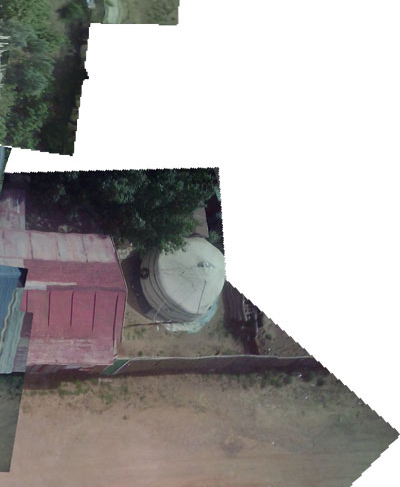
Our collective led a user-centered design process that I never had imagined we could accomplish (language barrier being one obstacle!). Over 100 interviews and paper surveys were gathered from three distinct districts in Ulaanbaatar -- Songino Khairkhan (one of the poorest ger districts by income level), Chingeltei, and Sukhbaatar (one of the older, most established ger districts).
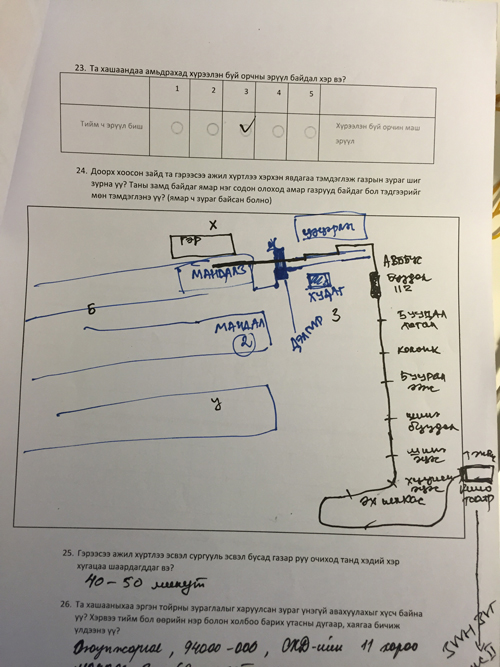
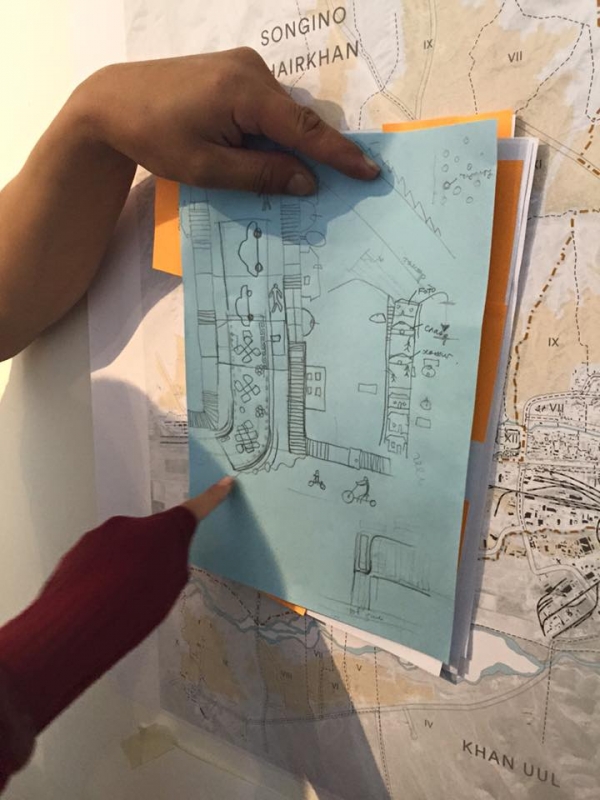
We ended up doing detailed site surveys of 15 hashas, or yards, and making these into artist edition booklets. These artist edition booklets were a collaborative effort by the Mapping Collective and the members of each household we surveyed, and were given to each hasha household for them to keep. It wasn’t an official legal document (although I did try to convince Binderya that a public notary should stamp our editions -- she insisted that it would have been near impossible), which is why we referred to it as an artist edition. Still, these printed documents were a way to empower residents with actionable data for designing their yards, and to allow ownership of their own data.
We were tackling two issues with our artist editions -- (1) the misconception that ger districts, as informal spaces, were full of shoddy, haphazard, non-data driven planning / construction by residents, and (2) the common practice of ger district data being collected by many government organizations, foreign aid orgs, and other NGOs but not shared with the residents being surveyed. From the beginning, this lack of data accessibility was a sore point amongst many ger residents. Being excluded from the data led many residents to be suspicious of the data collection processes, and limited the number of residents willing to participate. Instead of being privy to the survey results and thus empowered to change their environments based on the data, residents watched data flow to "outsiders" who designed and planned the ger districts. The Mapping Collective’s artist edition sought to change this by collecting and sharing actionable data that supported residents to make decisions (e.g., where best to put a small garden or a greenhouse). Also, we hope these artist editions will be considered under intellectual property law, and that the data will hold legal gravity as a work by the hasha residents that could not be taken or copied without their permission.
Referencing legal / contractual art such as the work of Superflex (http://superflex.net/tools), when a resident agreeds to have his/her hasha surveyed, the resident becomes part of the Mapping Collective. Because the Mapping Collective owns the intellectual property of each artist edition, the resident thereby becomes "owner" of this artistic representation of real data.
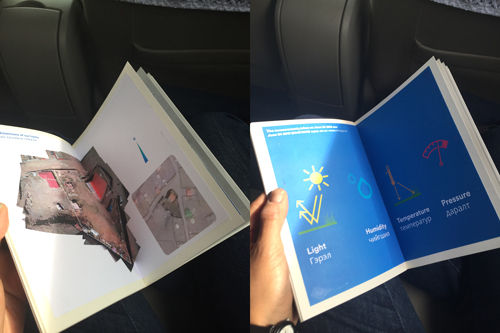
We built into this artist edition analysis of the hasha characteristics like hottest place, coldest place, most humid place, best places for planting, etc. By including this analysis, we transformed the idea of data-driven design in informal settlements into reality. Many of the residents expressed interest and excitement in interviews and paper surveys about improving their hashas -- which proved right our hypothesis that ideas of “run down ger districts where no one cares about their environments” were simply a false construct. Most of our survey respondents chose to live in ger districts because it offered them the open space to have at least some sort of nature or connection to the landscape in a way that apartment house living did not.
Finally each artist edition was given a special hashid in Cyrillic as a mark of authenticity -- there now exists a list of official, Mapping Collective-recognized hashids.
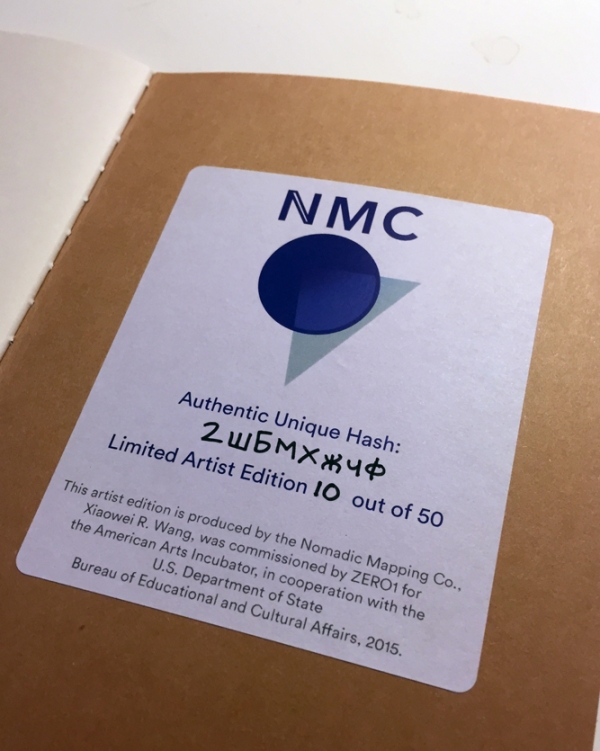
This unique hashid provides access to each hasha owner’s data online, in a private way, almost like a data locker. Residents will be able to access their data via nomadicmapping.org by entering their hashid (which was done in Cyrillic, to accomodate Cyrillic keyboards). Having some data online made sense, as there were a lot of measurements, calculations, and analysis that went into each hasha -- we couldn’t fit all of the data into one printed booklet!
When I began this project, I thought that the Mapping Collective could corral the data simply through open-source collection methods. Yet through extensive surveys and face-to-face conversations, it became clear that data ownership and control over channels of distribution were extremely important in Ulaanbaatar, almost culturally antithetical to certain Californian ideals of open sourcing everything.
As we discussed this project with participants, a lot of them actually brought up the incident of Google Maps in Japan, where privacy was a major concern (see: https://en.wikipedia.org/wiki/Google_Street_View_privacy_concerns). It was here that I learned a lesson: while in certain pockets of the West we love and exoticize open data and public data, it’s not true everywhere. In fact, in at least half the world, the idea of putting all your home’s data online is a violation in so many ways - why do it? One resident even brought up the weirdness of Google Maps and that maybe the idea of “public” data was just a ploy for Google to gather information about people without seeming too sinister. This expressed need from residents to keep their data private and truly have ownership of it reaffirmed our format for the artist editions, and emphasized the Mapping Collective’s belief in empowering the ger district residents through actionable data.
Meanwhile, while conducting ger district surveys, we also were organizing the final community event, to be held at a beautiful Ulaanbaatar park. All four projects had either begun or were nearing completion.
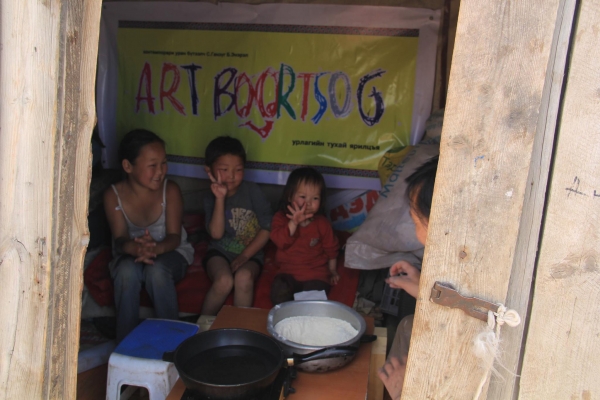
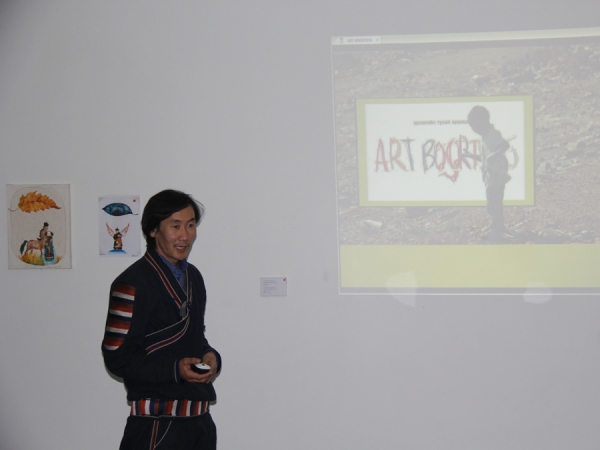
The Art Boortsog team (http://youtu.be/PsOS2QtWx7k ) had been going out every day, to some incredible places in Ulaanbaatar that no one would think to go -- everywhere from ger districts to sites of extreme poverty. For project creators Ganzug and Enerel, it was an up and down that brought some invaluable food for mind and body to marginalized communities, but also made them confront aspects of their practice in new ways. During the final event at UB Park, they showed images from their project and made Boortsog.
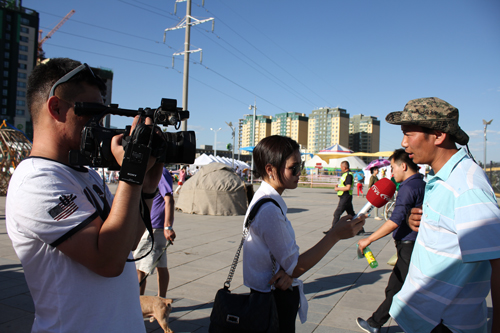
Our Street is Our Home created a set of gates for their installation at the final event -- bringing the atmosphere of the ger districts to the center of the city. They hung specially made curtains that usually line the inside of a ger (yurt) into gates, making a public place a "home" for dialogue. They plan on turning their recent installation event in the ger district last week into a more regular occurrence, almost like a public art event, beginning again after the July Naadam holidays.
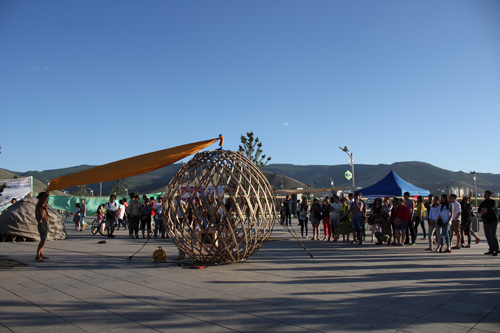
To the Origin arrived back from their long nomadic journey. They showcased their work, their variation on a ger (yurt), and did a performance that collected the works they showed in the countryside, transposing it back onto the Ulaanbaatar city fabric. “If you can understand this performance, you can probably understand most things about nomadic life," explained the project leader. They will continue working on the documentation and digital components.
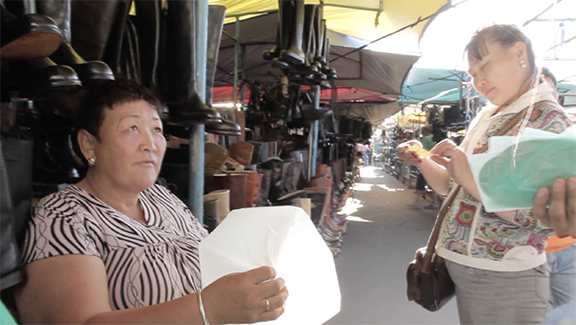
Everything For Sale showed the results of their initial work -- selling fresh air, animal bones, and CDs with the sound of “silence” at one of Ulaanbaatar’s most famous black markets -- Narantuul. They created print material to promote the “store” and will continue selling their work and talking about different types of pollution with the public. During their black market sale, someone bought a bag of air and sucked it down in one go, which says a lot about the state of air pollution and how the public understand it in Ulaanbaatar.
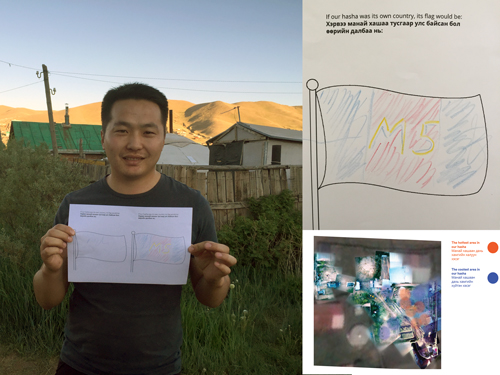
After the public event we spent several days compiling the artist editions for the hasha surveys, delivering them, and collecting feedback on them from the new Mapping Collective members.
The mapping and workshop materials now belong to the Mapping Collective of Ulaanbaatar -- a diverse group of middle-aged ger district residents and 4H volunteers. All equipment will be part of the American Corner makerspace, at the Ulaanbaatar Public Library. The American Corner is a public space inside the Ulaanbaatar Public Library, maintained by the local U.S. Embassy and common in a lot of countries, that provides resources and programming. We held talks at the Ulaanbaatar American Corner, and 4H has been using the American Corner for education and workshops for the past 2 years.
Binderya will lead and coordinate new and continued site surveys as part of the 4H programming in the fall, and I will be supporting her remotely with curriculum ideas. While I can't be there, I know the project is in good hands, and in many ways I'm surprised and deeply satisfied that it feels like just the beginning of a much bigger project.
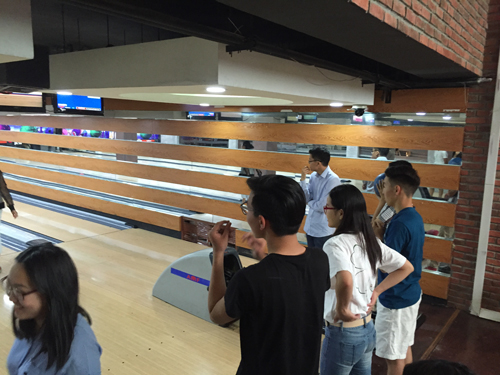
After all this work, I was heading home to the U.S. and everyone else was off to Naadam celebration and adventures. But before heading out there was one very important thing that needed to get done: take our amazing volunteers out bowling!
It’s been a whirlwind these past few days in Ulaanbaatar. The micro-grant projects are underway, and some of them have been enormously successful already.
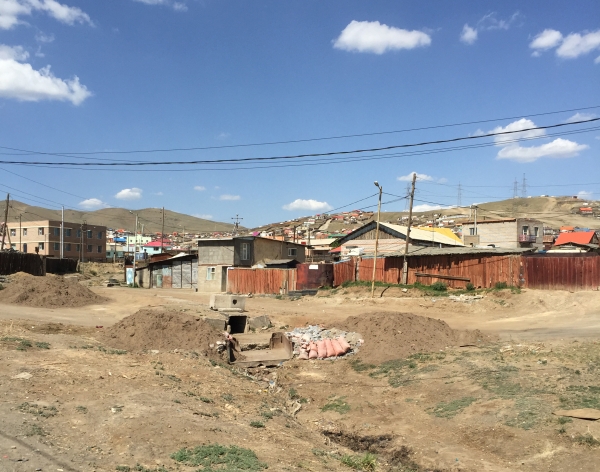
Ger districts are called so because they usually have a ger (traditional Mongolian tent) inside a yard. They are “where more than half of the capital’s residents live without access to basic public services like water, sewage systems, and central heating...population growth in the capital [of Ulaanbaatar] is expected to continue at the same pace, and with little affordable housing available, most of the newcomers ultimately settle in the ger areas.” (Asia Foundation, http://asiafoundation.org/in-asia/2013/10/23/mapping-ulaanbaatars-ger-districts/).
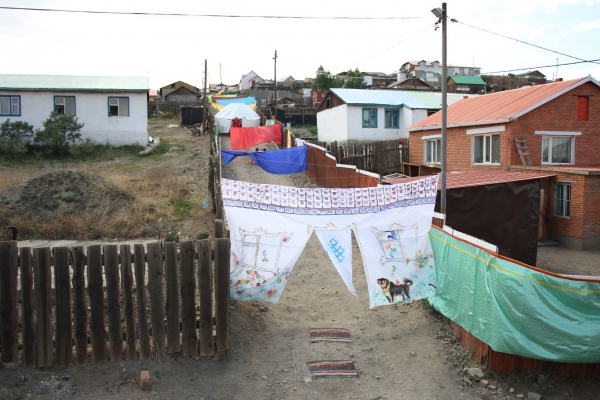
This past Saturday I visited Our Streets are Our Home in the ger district of Chingeltei #12. The typical street of a ger district -- dusty, rocky, strewn with debris and bare under the hot sun was transformed. By blocking off cars for the day from the road and transforming the fences and street through a floating ger, painted murals on fences and fabric, the neighborhood became less like a place where people throw rocks at you because you’re a stranger (what happened on my first visit), and instead the good parts of living in a ger district was shown -- community, closeness to neighbors and civic spirit.
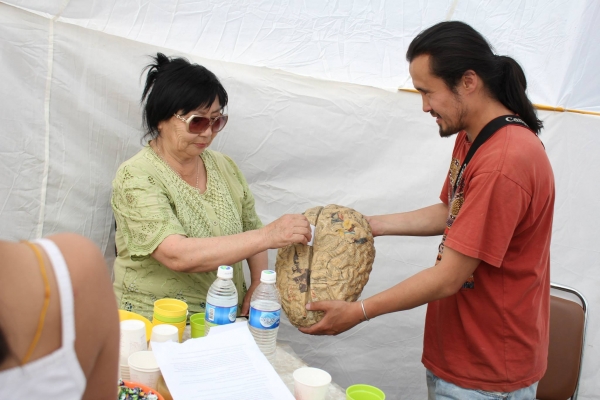
I had enormous fun visiting the installation. In the middle of the street was a ger structure suspended over fences. Inside, one of the artists, Narbaysgalan made a brain sculpture for residents of the community to cast their suggestion for neighborhood improvements. It was exciting to see this new kind of art as civic engagement happening in Ulaanbaatar, but especially the ger districts of all places! Earlier, one of the artists, Chinzorig actually invited the administrators of the district to attend the interactive installation, presenting it to them as a future strategy that the neighborhood could do on a larger scale, to really improve civic life from the ground up.
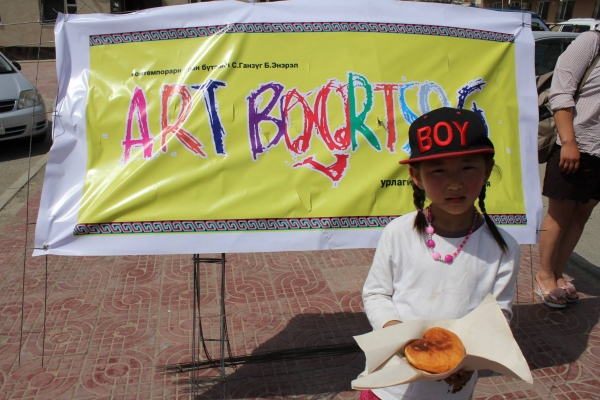
Other projects, like Art Boortsog have also been providing sustenance for the mind and body across town. Residents in ger districts as well as Tsagaan Davaa, an area near UB’s landfill were treated to conversation on art and boortsog biscuits in whichever shape they requested. Even the police were supporting the public art project, while just a few years ago, according to artist Ganzug, the police were the very source of anti-public art sentiment!
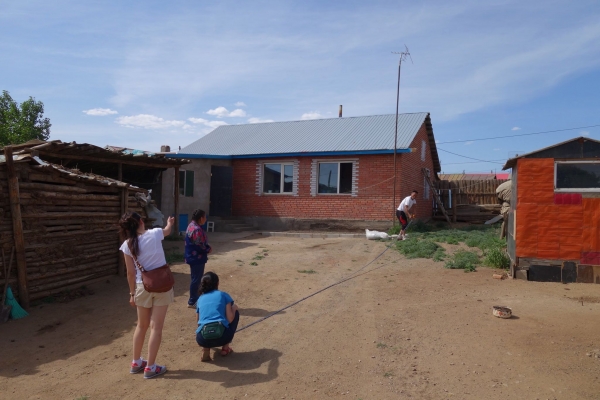
In the meantime, the Mapping Collective has been hard at work, surveying and going to two ger districts -- Songino Khairkhan (one of the poorest and most sprawling) and Chingeltei. We’ve been collecting data to empower people for actionable design of their own hashas (yards), and some high res aerial imagery.
The 4H volunteers of Ulaanbaatar have been an immense help throughout the entire survey process and will be carrying on the torch of the Mapping Collective, using the sensors and other equipment brought from the US. Part of the process has also included on site interviews with ger district households to collaboratively design their artist-edition-data-books. These data books are filled with data about their hashas and the aerial imagery, allowing residents to challenge the traditional notion that those in informal settlements just build haphazardly -- instead giving residents access to the tools for more data driven design. Additionally, it’s no surprise that geographic data, which is extremely valuable for us in the US, is collected and taken by a coterie of organizations and foreign aid in the ger districts but never made accessible again to the residents who were surveyed.
Needless to say, it’s been an incredible whirlwind. Amongst all this we’re getting ready for the final event on the 25th...
After a week of learning new skills, brainstorming, and working together on their presentations, pitch day arrived! There were a wide range of projects, ranging from new media (video and social media narrative to create a fictional scenario and product for one project) to performance art using food, to creating an interactive map showing public art around the city, to interactive art using lights and sensors, and nomadic works bound by the thread of geolocative technologies, maps and tradition. Originally 14 group projects after day 3 of the workshop, some groups and individuals combined to become 11 groups pitching to a panel.
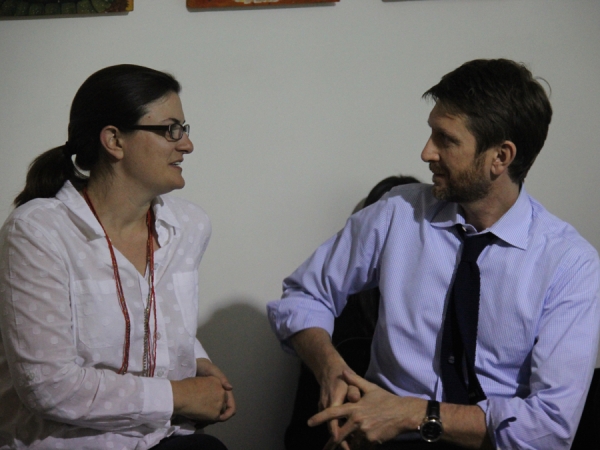
The panelists for the evening were: Shannon Moore, Nathan Johnson and Dondog Badamsambuu from the U.S. Embassy, Solongo Tseekhuu from the Union of Mongolian Artists, and Gantuya Badamgarav from our partner gallery, 976. It was a tough deliberation process, and Gantuya commented that the amount of time we spent deliberating winners was the same amount of time she spent this past year deliberating on Fulbright winners!
From 11 group projects, we managed to select four winners:
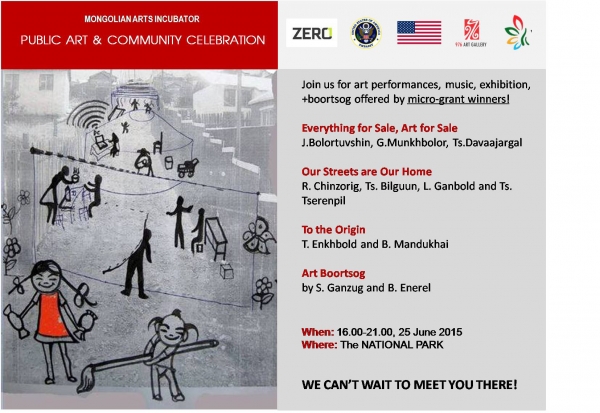
Everything for Sale, Art for Sale, by the group Brothers and Sisters, will “sell” three things on a mobile cart throughout Ulaanbaatar -- fresh air collected from the countryside into bags, the sound of silence on CDs, and livestock bones, which will address the different types of pollution in the city.
Our Streets are Our Home, with lead artist R. Chinzorig and group members Ts. Bilguun, L. Ganbold and Ts. Tserenpil will create a one day happening on their street, located in the Ger District where one of the artists resides. Curtains will be hung with color houses painted on them, and wire sculptures of gers will hang from utility poles, creating an environment for interactive art and services from their local neighborhood such as hairdressing, wifi station, tea drinking and childrens’ mural painting.

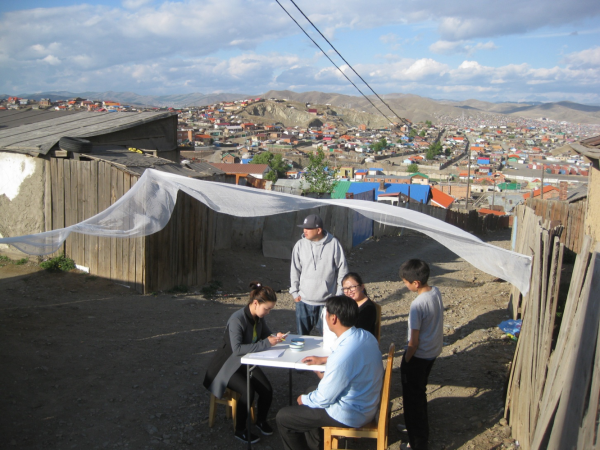
To The Origin, with T. Enkhbold and B. Mandukhai, where they will travel in the city to the countryside, living in a ger alongside a herder family. They will bring a nomadic exhibition to countryside families and mark points along the way using geolocation, confronting ideas of distance, changing tradition and changing lifestyles.
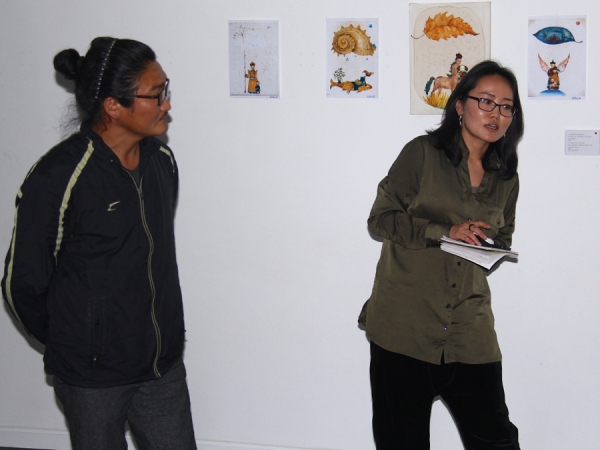
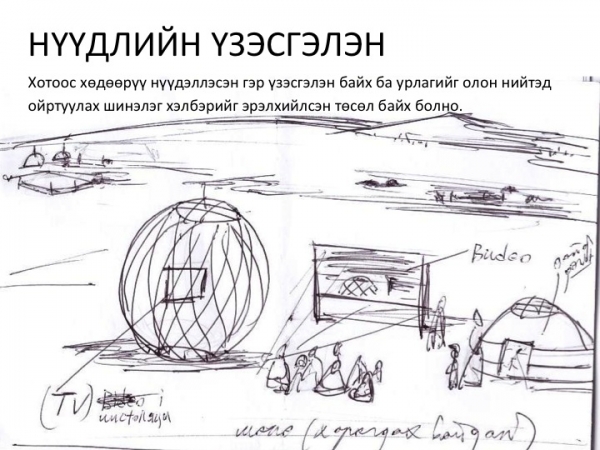
Art Boortsog, by S. Ganzug and B. Enerel. Art Boortsog will travel to three different locations in Ulaanbaatar -- to a landfill site where families live, to a ger district, and to the center of the city. Ganzug and Enerel will make traditional Mongolian biscuits in whatever shape people at the site request. While they are making these biscuits, they will engage with people on conversations in art, sustainability, hunger and economic conditions. Feeding the stomach and feeding the mind is their project goal.
A huge thanks to all the participants and panelists…it was amazing to have so many good projects in competition with each other. Excited to see what emerges from the micro-grant projects!
Hello, sain bainuu! Or, Сайн байна уу if we’re being proper about our script usage. Like a lot of Soviet influenced countries, Mongolia uses Cyrillic script to phonetically spell out the language. The change in language, weather and time zone makes Mongolia feel like polar opposites with San Francisco. Even though I haven’t been in Mongolia for a full week yet, the whole immersive process into Ulaanbaatar makes me feel like I’ve been here for as long as I can remember. I've been receiving so much since my arrival -- kindness, the great energy of the participants, knowledge and warmth from the host gallery and Embassy here.
I arrived into the tiny Chinggis Khaan International airport late at night, greeted by Binderya Munkhbat, the translator who would be helping me these next few weeks of work. Bindey’s big, radiant smile immediately reassured me that I was in good hands, and that I had an ally in navigating a place that some folks, like the Economist deem “the Bangkok of the Steppe”. (http://www.economist.com/node/21543113). The Economist article gives a pretty good description of UB, although mining contracts have been fluctuating recently. UB is a place where you might think how impossible it is to cross the street with relentless drivers on the road, admire crumbling Soviet style buildings, as you’re on your way to a restaurant with some of the most delicious North Indian food you’ve ever had, run by expats of Hazara ethnicity and eat this food sitting inside a Haveli made of teak wood.
Needless to say, cognitive dissonance is an understatement in UB.
I gave two artist talks the next day, on June 5th to help promote the workshop, one at the American Corner (a program that I was unaware of, but in some cities abroad the U.S. Embassy sets aside a space for learning about American culture) and another at the partner gallery, 976. Right before my first talk, it started torrential downpouring, with pools of water forming in the streets, and I was convinced no one would come to the talks. Bindey assured me not to worry, and that the rain was a good sign. She told me that there is a Mongolian belief that the person who brings the rain, brings good will. People did end up attending and I had my fingers crossed that the same would happen for the next day, workshop day 1.
About 17 people from all walks of life showed up to workshop day 1 on Saturday, June 6. It was a strange day to hold a workshop: I didn’t know that it was Ulaanbaatar International Marathon until I stepped outside of my apartment and the streets were entirely free of cars. Police and barriers were up on the street near 976 Gallery where the workshops were being held. The entire city was car free for the day. Despite the transportation difficulties (no motor vehicles on the roads), we had fantastic energy on the first day. We looked at mapping and cartography as a tool and as an art form itself. Participants then worked in groups to pick a place in the city, went for a walk, and mapped one built or environmental process that they saw. One group managed to map 502 trees in the central UB area! Others went to interstitial spaces near the river, and for one participant who lived in a ger district (http://thediplomat.com/2014/03/mongolia-puts-ger-shantytowns-on-the-map/ for an explanation of ger districts, they are essentially informal areas where traditional felt tents, or gers are set up by families and they become urban campers) it was her first time placing the context of her neighborhood in the larger map of UB. It was wonderful to see how flexible everyone was -- that any original expectations of what an “art workshop” would be like went beyond the confines of traditional artistic mediums.
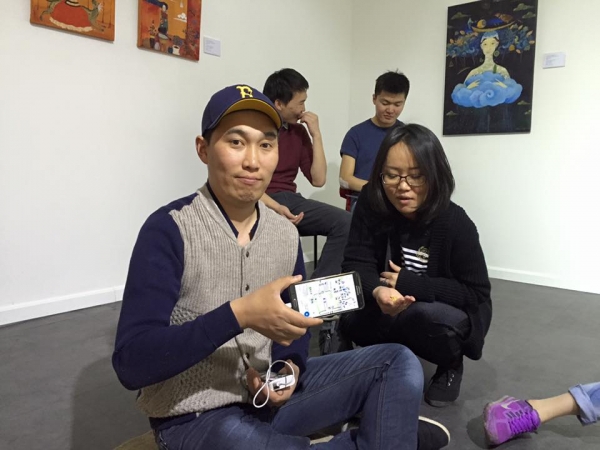
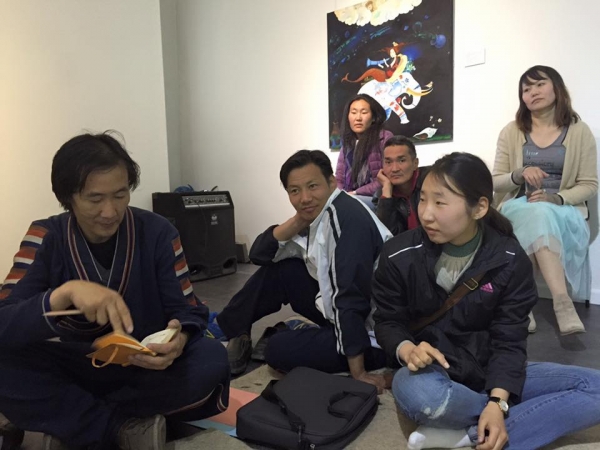
We gathered more and more new participants for Sunday, day 2 of the workshop. We talked about findings from day 1, and looked at prototyping, making small models, and using LittleBits as a prototyping tool to make interactive sculptures that respond to sound, motion and light. Using these tools, participants were encouraged to take their findings and environmental issue from the first day and connect it to site conditions, socio-economic conditions and put together a prototype. The group that mapped trees the previous day began to refine their idea into a project -- perhaps putting sensors in the soil and lights in the tree that would call attention to issues of soil pollution and street trees. One artist brought his daughter for the day, and they built a sound triggered sculpture together. Another group thought about the countryside, and a way to protect herders’ sheep on the grassland from wolves : if one actuator could trigger a mechanism to wake up guard dogs. It was exciting to see everyone work collaboratively and in such a hands on way -- something is apparently pretty rare for typical, stiff “training sessions” as it’s called here.

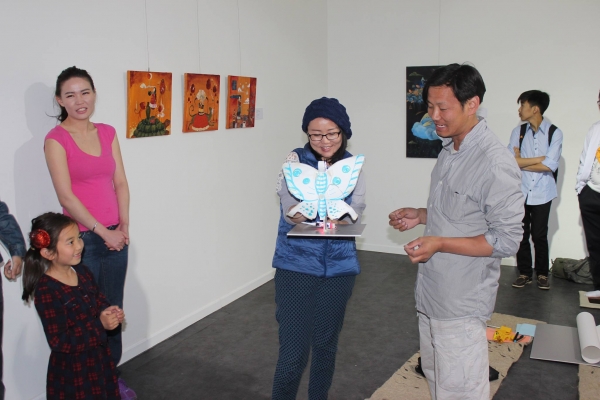
We gathered even more steam and more participants on Day 3 -- by then the gallery space was probably at capacity! Nearly 30 people showed up for the workshop, and people formed groups for projects, presented their project ideas and we held some very Silicon Valley style, rapid ideation exercises. We went through what their project idea was, trying to summarize succinctly, plan out a project with budget and go through an impact versus effort analysis to identify where the passion was for each project, what the most important elements were for each idea, and trying to cut away excess elements for increased project agility and to strengthen project feasibility given fiscal and time constraints. I was incredibly excited in seeing the discoveries that people made, and seeing the groups work through a process that everyone expressed was “very, very new” to them.
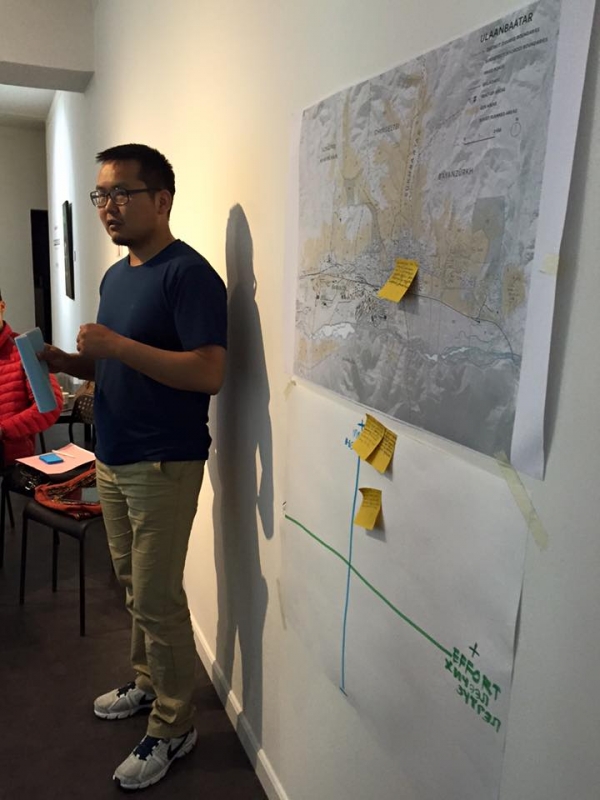
By the end of the day we had a set of groups with incredibly strong project ideas. Some of these ideas:
-Making a sculpture from dough, cooking it, bringing it to both a landfill site where families in poverty lived, having people eat the sculpture and break bread together.
-Constructing an “art ger” (ger is tent, so it’s a art tent) that would travel from city to countryside, with art workers living inside the ger and offering art beautification services to countryside and city families.
-Taking air from the countryside, putting it into bags, and selling it on a mobile cart throughout the city to raise awareness about the air pollution
-Using environmental sensors to bring attention to trees, through a responsive lighting system
-Creating more trash cans that feature art and eye catching photography in ger districts, as a way of combating litter (since trash pickup is impossible when the trash is dispersed all over)
-Projecting poems outside
-Augmented reality for UB to emphasize history of certain buildings
-Ger district art improvements -- improving an earth road in a ger district by formalizing and building a concrete portion 10 meters long on a key incline, painting the road with traditional, colorful patterns. Also creating curtains to hang over the wooden fences that have become typical and visually representative of ger districts (and thereby equated as “rundown”), with the image of the house that each household would like to live in.
Just some group ideas…! Each group will be working on their presentation in the meantime… !
[et_pb_section fb_built="1" admin_label="section" _builder_version="3.19.6" custom_margin="0px||" custom_padding="0px||"][et_pb_row admin_label="row" _builder_version="3.19.6" background_size="initial" background_position="top_left" background_repeat="repeat" custom_margin="||" custom_padding="||"][et_pb_column type="4_4" _builder_version="3.0.47" parallax="off" parallax_method="on"][et_pb_text admin_label="Text" _builder_version="3.0.74" background_size="initial" background_position="top_left" background_repeat="repeat"]
We have awarded the third round of the American Arts Incubator “small grants” to local Lao artists and organizations. The public presentation of the projects was hosted by i:cat Gallery and was attended by over thirty local artists, leaders, and curious members of the community. I unveiled the mural design created during the workshop that had been submitted to the Laos Government for approval. Just at that moment, Matthew Ference, the Public Affairs Officer at the U.S. Embassy announced he had received an email from the Laos government approving the mural project. The room erupted in cheers and smiles.
The first small grant was awarded to the Khao Niew Lao ("Sticky Rice") Theater Group. Insisiengmai Lattanakone (Toh), is the director of this Lao performance group that uses found materials to create beautiful puppets and props. Toh will create three puppets for a performance that promotes reusing and recycling plastic waste. Each puppet will be constructed of recycled plastic purchased from the local collectors who walk around the city and pick up the trash. The puppets will be a visual representation of the amount of plastic waste produced by the average household in Laos in one day, one week, and one month. Toh also will travel to a children’s center outside the city to hold a workshop on the importance of reusing and recycling plastic. The young workshop participants will create small sculptures out of plastic that they collect around the neighborhood; the work they produce will be installed at the public exhibition as part of his performance. By empowering youth to learn sustainability through art-making and collaboration, this project hopes to begin a new tradition of innovative environmental health practices that is interactive and fun. The concept for this project will serve as the foundation for a larger performance at the international puppet fair held next January in Vientiane.

The second grant was awarded to Bounpaul Phothyzan, a professor at the National Institute of Fine Arts. Bounpaul will produce a large-scale public installation titled “Plastic City” that will be made out of trash and discarded materials. The structure for the installation symbolizes the wave of new architecture being rapidly constructed around the city. This obsession with the “new” here in Laos is part of what causes people to think only about short-term benefits of development, or the convenience of plastic. He will collaborate with students from the National Institute of Fine Arts to construct his project. The work will be temporarily installed for the public exhibition where it will become one of the first contemporary public art installations in the country. The vision is to find a permanent home to install the piece after the exhibition.

The third grant will go to Green Vientiane, a local organization that works to keep the city of Vientiane beautiful by promoting healthy recycling habits and encouraging local communities to reduce waste. Only about 40% of waste in Laos ends up in landfills or gets recycled. The remaining garbage gets burned, thrown on the ground, or dumped into the Mekong River. Trash collectors push primitive carts around the city and collect plastic and other materials that can be sold to the recycling center. These people are virtually invisible as they move through the city and clean up the trash. Green Vientiane’s project is titled, “Make My Cart Beautiful,” which will pair local artists with cart pushers to design and paint their carts. The artists will customize their design to interests of each cart pusher. The newly painted carts will help make the work that these people do every day more visible. The long-term vision is to start an “adopt a cart” program where local businesses, schools and organizations can sponsor the beautification of a cart.

The final grant was awarded to the newly-established mural collective, Color of Future, made up of twenty professors and students from the National Institute of Laos Fine Arts. Two professors shared their experiences during the workshop and talked about their vision to take the knowledge that they will acquire this month and share with their students to launch future projects. The next two weeks will be their research phase as they continue to learn each step of creating a large-scale mural with me. After this project, they plan to create a mural to be painted on the front of the new campus being built at the National Institute of Fine Arts. They will engage the students in the process, and teach them the skills they have learned from the workshop. Eventually they would like the students to design and paint their own murals as part of a new permanent curriculum at the school.

[/et_pb_text][/et_pb_column][/et_pb_row][/et_pb_section]
[et_pb_section fb_built="1" admin_label="section" _builder_version="3.19.6" custom_margin="0px||" custom_padding="0px||"][et_pb_row admin_label="row" _builder_version="3.0.48" background_size="initial" background_position="top_left" background_repeat="repeat"][et_pb_column type="4_4" _builder_version="3.0.47" parallax="off" parallax_method="on"][et_pb_text admin_label="Text" _builder_version="3.0.74" background_size="initial" background_position="top_left" background_repeat="repeat"]
I arrived in Laos with three rules for myself; stay open, ask questions, and listen.
Once people started talking, the same issue kept coming up: the accumulation of trash around the city. Laos is a developing country that is in the throes of robust economic and urban development. The growth in and around the city is outpacing the existing infrastructure to manage the amount of waste being produced on a daily basis.
The city produces at least 637 tons of waste per day on average. Only 250 tons of waste is recycled or taken to landfill, according to the United Nations Environment Programme. This leaves almost 400 tons of waste per day that either ends up being burned or tossed in the streets, canals and rivers. Mass amounts of plastic only started being used in Laos about twenty years ago, so it is a relatively new product in terms of widespread use. Traditionally, food items were wrapped in banana leaves and other organic materials. These items could be thrown on the ground and they would decompose or used in fires without any environmental consequences. Today, the banana leaves have been replaced by plastic bags and bottles; they are discarded without regard to where they will end up, and burnt without considering the impact of the air. That toxic scent of melting plastic is common around the city.

There are trash collectors who push wooden or metal carts around the city, collect plastic and other recyclables, and bring them to a local recycling center in exchange for money. The price for plastic, however, is directly impacted by the price of oil. In the US, we celebrate when gas prices drop. In Laos when the price of oil drops, the demand for recycled plastic also drops because it is just as cheap to purchase new plastic. The trash collectors end up receiving less money for the plastic that they collect and have less incentive to gather it.
The work ahead of us all -- as artists, students, teachers and youths -- presents a grand responsibility and vital opportunity to use public arts as a way to help influence public practices regarding environmental health. As we continue the collaborative process of mural-making to educate neighborhoods about practices like recycling, each community can work together to build a better environment for the future.
[/et_pb_text][/et_pb_column][/et_pb_row][/et_pb_section]
I have been in Vientiane for seven days. These days were packed with workshops and meetings with Lao artists, and youth and environmental groups where we made art, shared our dreams, and discussed ways to improve the environment.

This city is virtually devoid of public art.
The few murals that do exist are either propaganda for the Lao PDR Government or small murals painted by foreigners who work with a private business. In Oakland where I live, we are in the midst of a street art renaissance where new murals are popping up almost on a weekly basis. It’s a beautiful thing. Here in Laos, there is virtually nothing. The idea of creating a painting to be displayed in public outside of a gallery or museum is hard for local artists to fathom. Established artists use assistants as cheap labor here all of the time, but the act of artists working collaboratively to produce an artwork that honors the voices and skills of each artist is also very new.
Twenty professors and students from the National Institute of Fine Arts showed up for the workshops each day this week, during which I walked them through each step of creating a collaborative mural. Under my guidance, this group created the concept, developed sketches, and produced a fully realized design in only three days! They will spend the next two weeks painting the mural together on a public wall in the middle of the city.

During the workshop, we discussed the environment and the issues that most concerned the Lao people. The artists started by creating their own individual drawings that illustrated the issue that resonated with them the most. We placed the drawings on the wall and began to talk about the similarities between the images and the ideas. The accumulation of trash and plastic around the city was recurring theme in many of the drawings. Some of the artists illustrated the problem of people dumping trash into the river while others offered solutions with images of people picking up trash and planting trees. A few artists dreamed about what the future might look like if everyone worked together to help change the habits of the people and make the environment more of a priority. This became our concept for the mural: identify the problem, illustrate the solutions, and show the dream for the future. We had our idea.

The artists broke into teams to create the scenes of the mural. In less than eight hours over two days the artists worked together to create a ten-foot full color sketch of what the mural would look like – keeping in mind that Lao artists do not normally collaborate together like this. The teaching and the art practice here is very formal and traditional. All artists are gifted in the technical aspects of drawing and design, but are not encouraged to expand beyond traditional formats.
The energy and excitement increased with each day as they worked toward finishing the design. It was like watching a dance where one artist would begin drawing a figure, another would step in and add the detail, and another would twirl in to add the splashes color.

On the final day, the artists at the workshop formed a mural collective with the vision to start a mural program at National Institute of Laos Fine Arts. We brainstormed names and had a logo design contest to vote on our favorite ideas. The mural collective, “Color of Future,” was born. By venturing into uncharted public arts strategies and breaking from traditional arts practices, this collaborative group of Lao youth and professors will soon unveil a creative resolution to raising awareness about environmental issues and plastics to carry outwards to their communities, elders, and future generations. They will spend the next two weeks painting the mural on a public wall in the middle of the city.

It’s hard to believe that a year ago I was just beginning to think about a project in Mongolia. There’s a lot of built up anticipation in these next two weeks before I leave, much of it to do with my long-standing interest in Mongolia…
Coming from regional planning, I became fascinated with Mongolia because of its outward contradictions: a highly-networked yet nomadic society, its informal urban planning, its status as a developing country yet without some of what you might see/imagine as a “developing” country. The complexities of urbanism in Mongolia were what fascinated me most: the physical spaces carved out are as much the result of larger environmental and economic systems as they are historic and ideological ones.
What this boils down to is the compelling and somewhat daunting project I plan to develop in Mongolia: The Nomadic Mapping Collective. The challenges that face Ulaan Baatar, Mongolia are not necessarily unique, and in many ways are endemic to many “remote” places. Remote places are rendered remote either by physical inaccessibility, or ever increasingly by the virtual inaccessibility of being "off" the map.
Looking at the Nepal earthquakes and the rush towards virtual mapping as a means to affect physical relief efforts is a reminder – the impactful actionability of data. So much now depends on a map as instructions. Not a set of neutral data, but the instructions and the platform that drives physical actions, the articulation of space. One of the guiding thoughts behind the Nomadic Mapping Collective is less a virtual scan, remotely, but performing "ground truthing" – having citizens of a place articulate their city. "In a classic work, The Image of the City, Kevin Lynch taught us that the alienated city is above all a space in which peole are unable to map (in their minds) either their own positions or the ubran totality in which they find themselves..." writes Frederic Jameson.
So, in a place like Ulaan Baatar, there is much to be learned about maps, about data, about power and logistics. About the forces of development and control that often play at odds with local culture or even preservation. About power and who owns the data, who maps, who has access to knowledge and high resolution digital imagery. About land ownership and documentation.
Or, in the words of the incomparable Etel Adnan: "A map is not about places but about direction. It is to take you to places. It is a dynamic circus. I just wanted to emphasize the nomadic quality of the map."
In these next few weeks, I’m excited for the formation of The Nomadic Mapping Collective, and for the Collective to explore map-making as a tool of social and technological entrepreneurship. Inspired by art as service and forms of contracts as art, the rules of the collective range from offering “paid” services that are paid with using labor, and using the preciousness of limited artist editions (signed, sealed) as documentation for land registration.
There’s a lot of work to be done, and a lot of material to cover. I’ve been carefully going through equipment and testing out some tools, ranging from basic environmental sensors to nifty little drones that capture video. I’m also printing maps for the workshop, making booklets and preparing the artists editions, and preparing for participants to be tour guides. Hopefully as you follow along in this blog, you’ll be able to see the incredible city of UB in virtual space for yourself.

The intensity of the heat engulfed me as I stepped out of the plane and onto the tarmac at Wattay International Airport in Vientiane. It was both arresting and comforting, reminding me of the hot summer days during my last trip to Laos almost four years ago. After spending the night under the bright lights and bustling atmosphere at the Bangkok airport, Vientiane was sleepy and quiet by comparison. My large boxes of paint and supplies were waiting for me inside the airport and I was relieved to be waived through customs with nothing more than a nod. After months of preparation and anticipation, I had finally arrived.

On my first night here I had the chance to attend an exhibition of young Lao artists who are breaking out of the traditional Lao art practices.
It is easy to forget how fortunate we are to have the freedom to express ourselves creatively in the US. That freedom does not exist in the same way here in Laos as there are very rigid parameters for what contemporary art should look like. It was only my first night, but already I could feel the energy around the younger artists eager to push contemporary art in Laos into new territory. It was exciting and encouraging to meet these artists.

That night, I was awoken by the drums from the neighboring temple. The drumbeats were soft and persistent, a subtle reminder of rich history and religious traditions that are such an important part of Laos culture.

Tomorrow night we officially kick off the Laos Arts Incubator project with an artist talk and lecture titled: Public Art and the Collective Conscience.
It will be a chance for interested artists and groups to learn more about the project, ask questions, and hopefully be inspired enough to return for the workshops during the rest of the week. So excited to finally be here! More to come...
[et_pb_section fb_built="1" admin_label="section" _builder_version="3.0.47" custom_padding="0|0px|29.4844px|0px|false|false"][et_pb_row custom_padding="0|0px|14.7344px|0px|false|false" admin_label="row" _builder_version="3.0.48" background_size="initial" background_position="top_left" background_repeat="repeat"][et_pb_column type="4_4" _builder_version="3.0.47" parallax="off" parallax_method="on"][et_pb_text admin_label="Text" _builder_version="3.19.6" background_size="initial" background_position="top_left" background_repeat="repeat"]
Today is my last day in the Philippines. A few hours ago I landed in Manila, after waiting for over an hour while the Presidential airplane was landing at the Bacolod airport. I was already installed in my airplane seat, all buckled-up, and through the tiny
After all the anticipation, President Benigno Noynoy Aquino III was descending from his airplane and everyone around -even inside my airplane- suddenly stood up while a small marching band played quietly the national anthem in the background. This moment was perhaps the best closure for my time in Bacolod, also the moment when I finally understood something essential about Filipino culture: This is a place bound together by very strong community values. A strong sense of togetherness, a shared identity, and most importantly, an admirable resilience to an adverse history (colonialism, natural disasters, inequality) rule this country. I couldn’t be luckier for the opportunity to work in such an energizing context like Bacolod City, where art and community engagement come hand-in-hand.
Shortly after I landed in Manila, I had a three-hour taxi ride through the city’s heavy traffic, even though I was traveling only 7 miles. I was heading to Green Papaya Projects, a well established independent art space that has been active for over a decade and run by amazing people (Pewee and Merv). They had invited me to give an informal presentation about my recent work in Bacolod and “The People’s Island” project. You can imagine, I was both excited to share the experience and very fresh documentation but also quite nervous since it was only five days after the public launching of the project and I was still processing the intense experience...
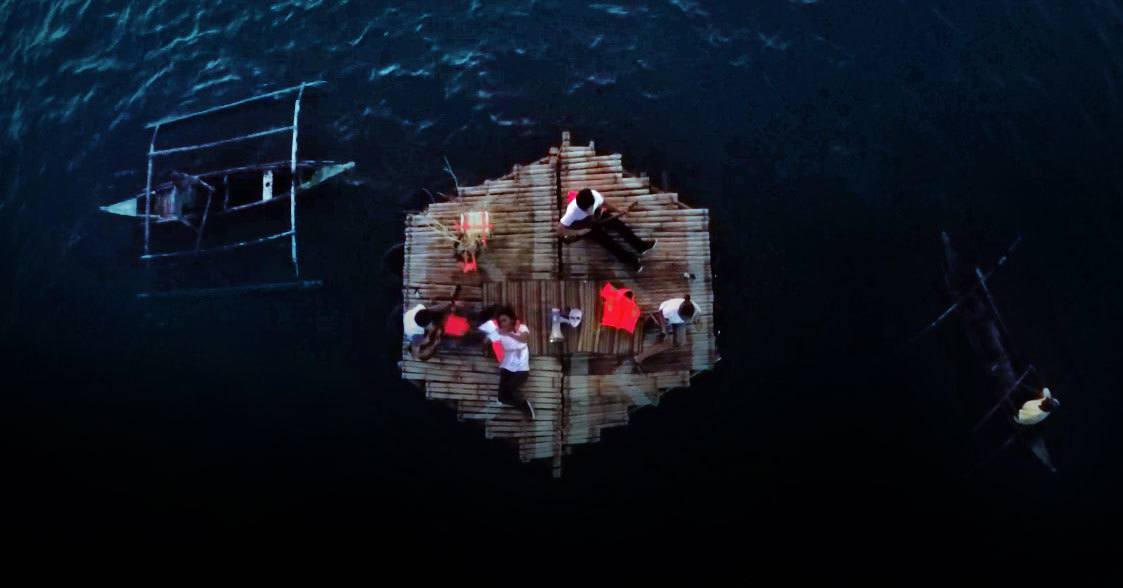
So, after a public lecture at the Negros Museum addressing the role of Public Art in fostering community participation and healthy environments; a five-day workshop exploring collaboration; sustainable urban planning and socially engaged art, I invited participants to creatively explore their city as an extension of the endangered natural world. This is how The People’s Island became a thinking tool, a collective dream and an immersive artistic experience that engaged around 150 people through a public event and exhibition.
Framed as a large participatory art project, The People’s Island really took place in the public sphere of Bacolod: in urban spaces, natural sites and even in our collective consciousness. The project evolved slowly during three weeks of intense work, conversations
Thus, on April 25th at
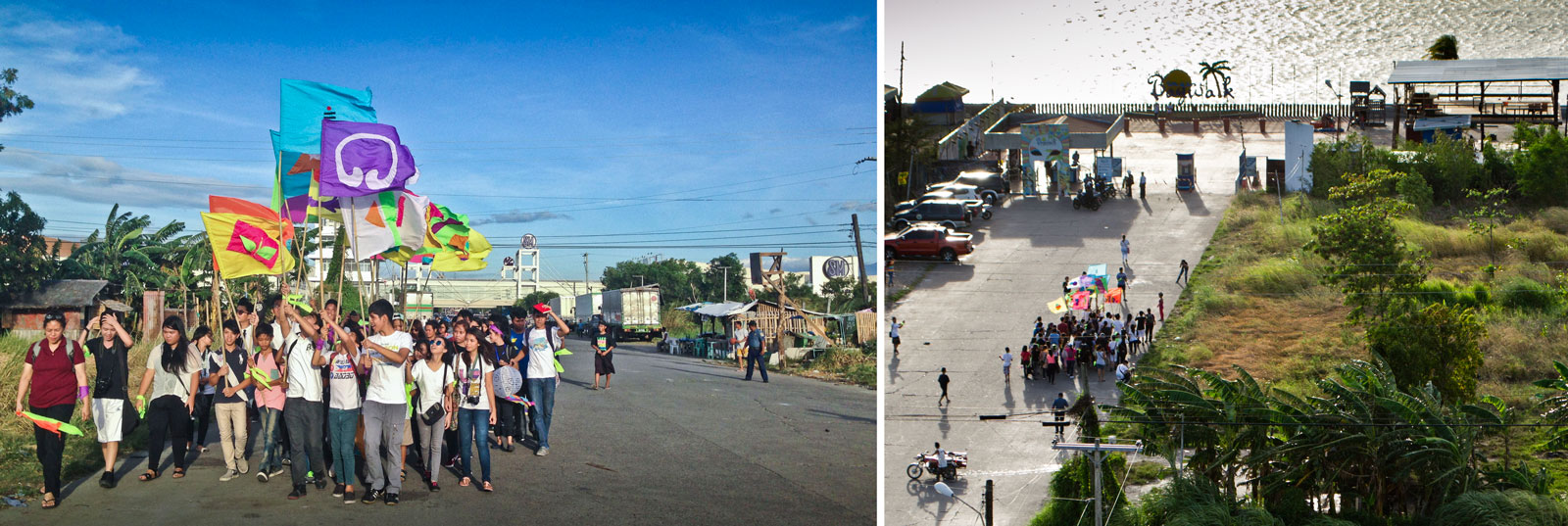
Once the public arrived
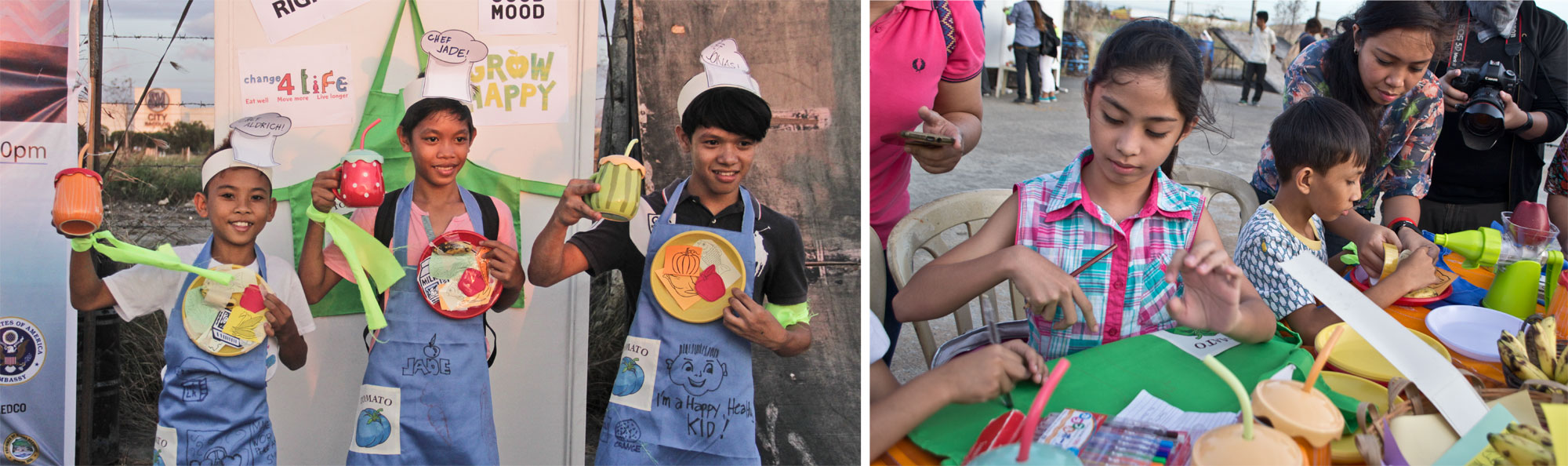
Around
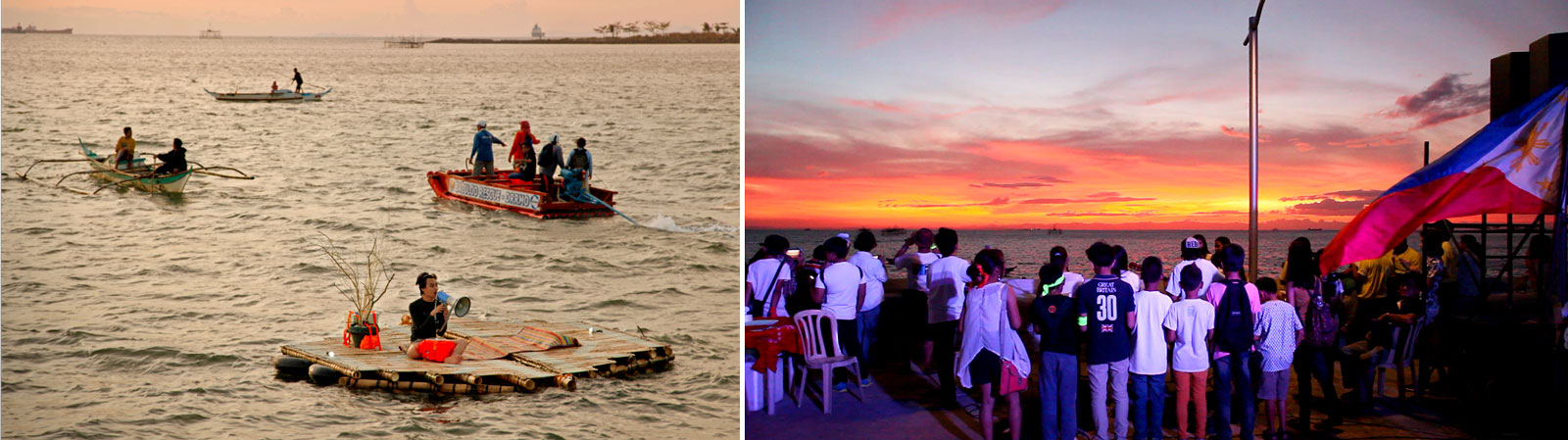
Around
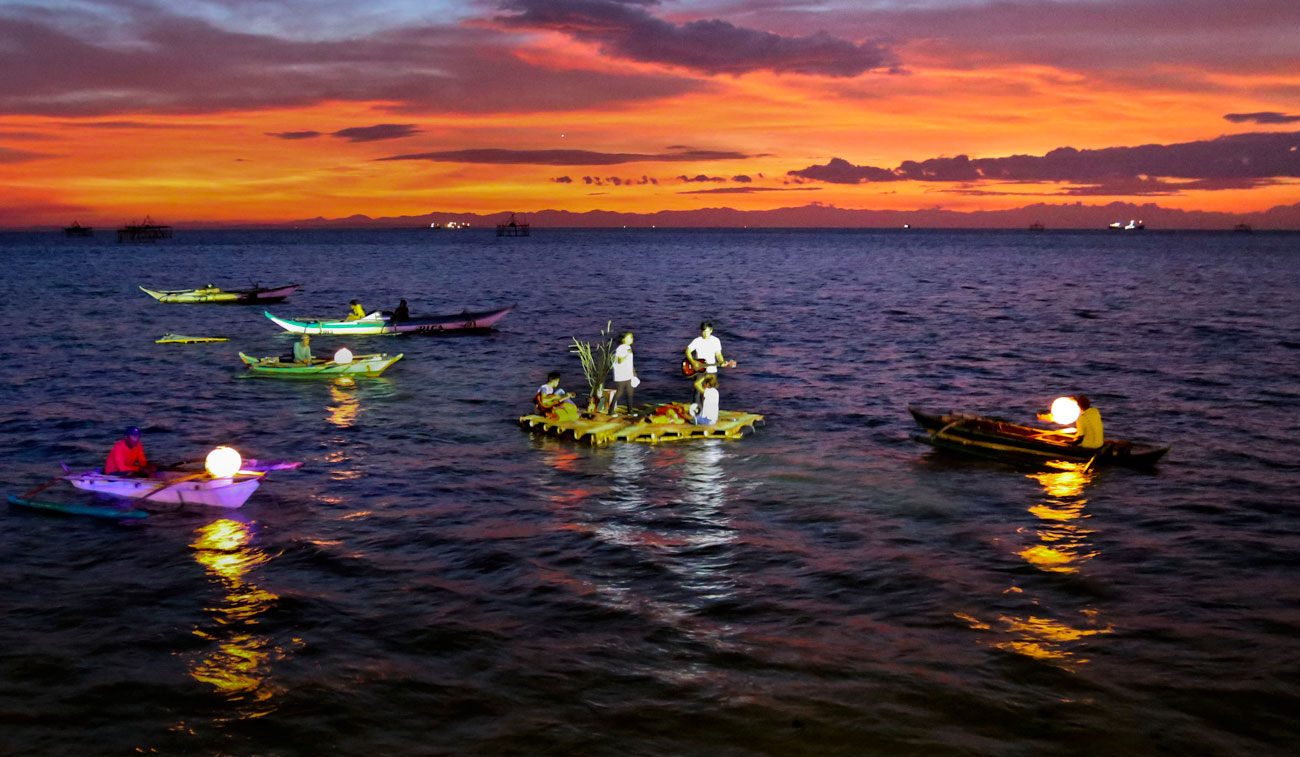
Around
*Its next destination will be Suyac Island in the Northern part of the Negros region, where the structure will re-emerge as the Floating Eco-Resource Center and Library.
[/et_pb_text][/et_pb_column][/et_pb_row][/et_pb_section]
[et_pb_section fb_built="1" admin_label="section" _builder_version="3.0.47" custom_padding="0|0px|29.4844px|0px|false|false"][et_pb_row admin_label="row" _builder_version="3.0.48" background_size="initial" background_position="top_left" background_repeat="repeat"][et_pb_column type="4_4" _builder_version="3.0.47" parallax="off" parallax_method="on"][et_pb_text admin_label="Text" _builder_version="3.19.6" background_size="initial" background_position="top_left" background_repeat="repeat"]
It’s a hot Saturday afternoon and I feel my voice resonate strongly inside my chest while my hearing still recovers from the pressurized cabin of the airplane. I can even hear an echo leaking through the century-old walls of the Negros Museum in Bacolod… Well, the fact is that I’m
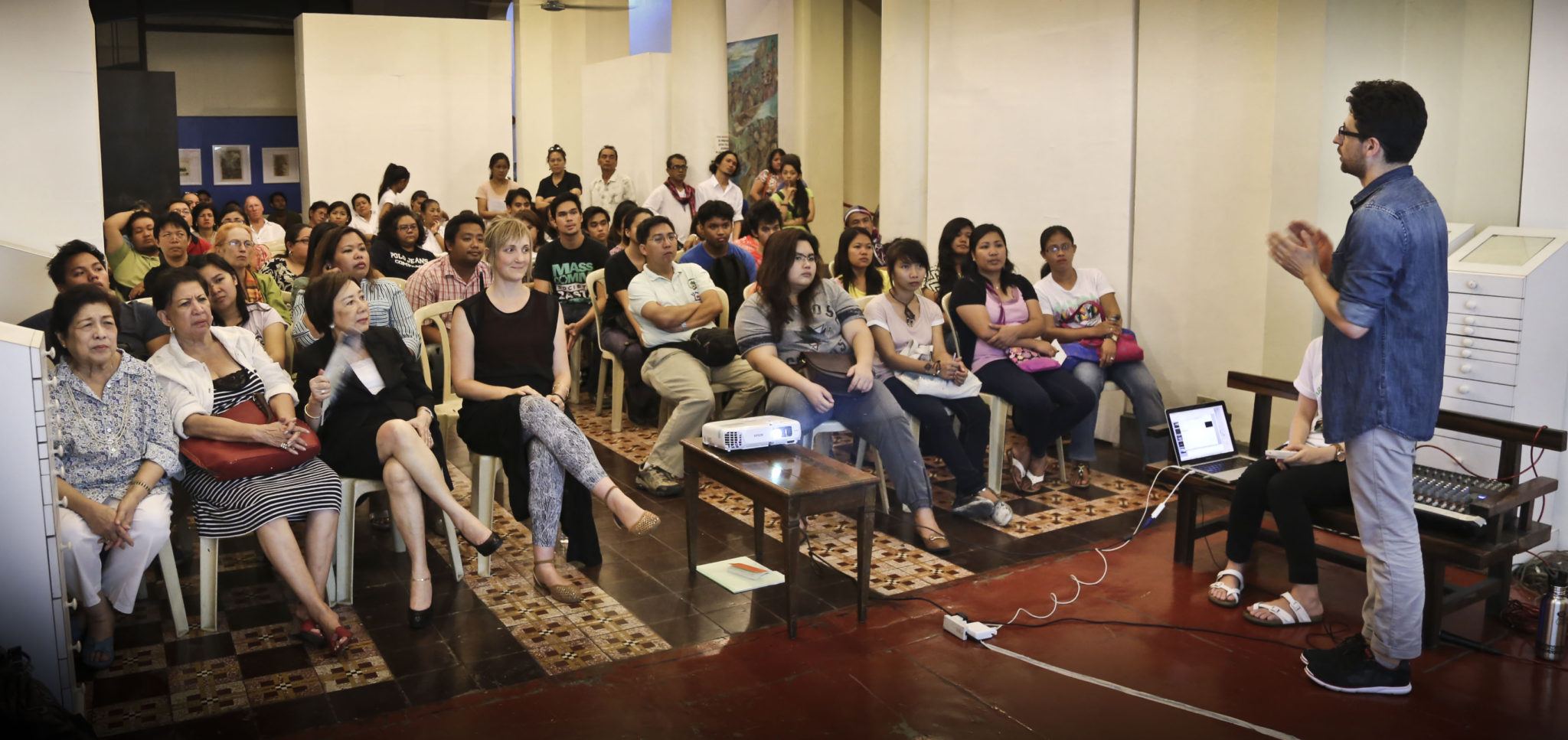
This was just our third day in the city and my brain was already full of ideas, questions, and yes, lots and LOTS of new names to remember. Just the night before, I gave a public lecture in the same room, which created a lot of curiosity among local artists, environmentalists
During the same talk, I introduced the public art project that I will develop in Bacolod titled, The People’s Island, which revolves around the idea that “reality is none other but the things we do together.” On the one hand, The People’s Island is a metaphorical site, or perhaps a thinking tool that allows workshop participants to create a fictional place that responds to their visions of what their ideal city or environment could look like. Throughout the workshops, participants gathered their concerns about environmental health and re-enacted them through quick, stop-motion animations. They then designed 3D scaled models of a fictive city, as a means to propose sustainable urban planning. This was achieved by transforming small paper sculptures into plans for hybrid objects that use clean energy and have a public function—from street planters that collect solar energy and emit light at night that replace expensive street lighting, to wind banks and a floating, self-sufficient restaurant and garden! All these ideas are slowly shaping a collective vision of a city-environment that local residents deserve, all found inside their own creative power. This is how The People’s Island emerges within us—the public.
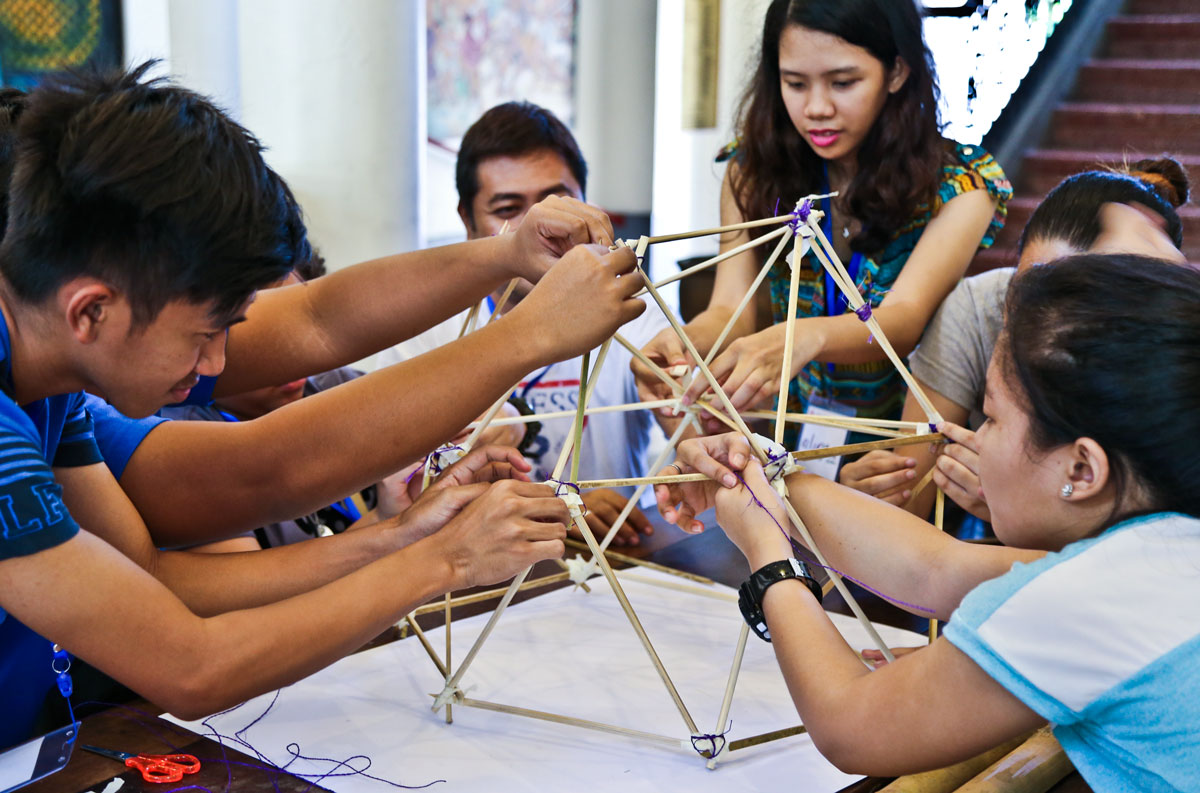
On the other hand, this project is a very tangible effort and has slowly moved from the realm of fiction to reality. Yes, that means that we’re making an island! Slowly but surely, The People’s Island is becoming a small floating platform composed of a series of rafts joined together (approx. dimensions 10ft x 10ft) made with indigenous materials like bamboo. The principle of The People's Island is to emerge as a temporary land-mass generated by people (literally) gathered together in a specific site, on firm land
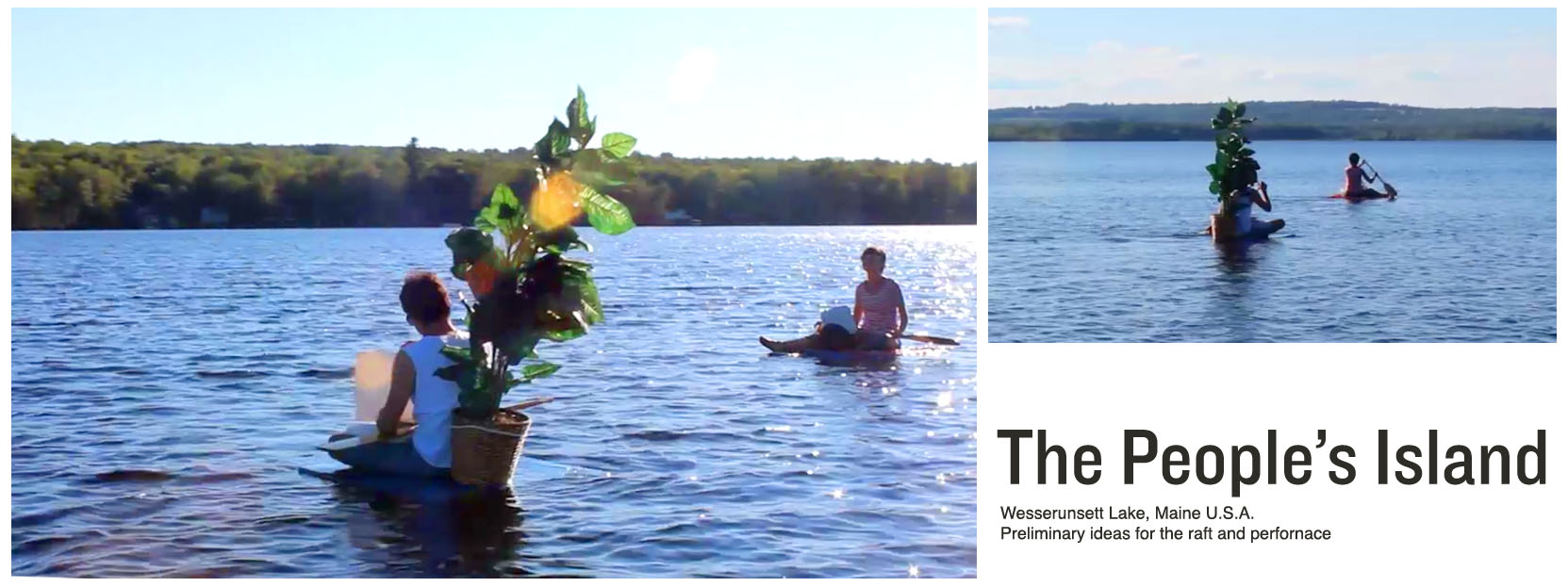
In the past week, workshop participants worked collaboratively in shaping this new, fluid "land." Through fun, hands-on art
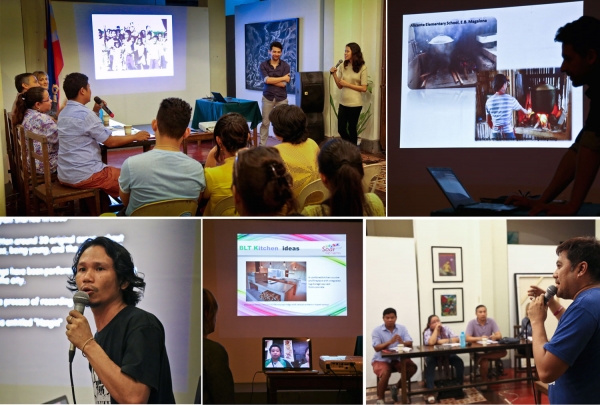
The first of these grants went to Katherine Maguad and Jeffrey Lazaro, who plan to utilize the knowledge and skills from local ceramic artists to create more hygienic stoves and efficient kitchen facilities. These sculptures/prototypes will be used in remote rural areas lacking from running water and electricity, and where children suffer malnutrition and health problems due to food contamination.
The second grant went to Aliana
The third grant went to Edmund Bacia and Peter Fantinalgo from the art collective, Binhi. Their idea is to produce a short video documentary around a song called “Hangin” (in English: Air), which was composed by Dina, a young artist from the underserved community of Banago. Dina passed away last year due to
And finally, the fourth grant was awarded to BALAYAN Organization, a group of environmentalists from La Salle University. Their plan is to use participatory art and experimental pedagogy to increasing community resilience to disasters in areas neighboring the ocean, which are the most vulnerable during the typhoon season.
As I write this, I prepare myself for a super busy but exciting week. We plan to celebrate Earth Day with a pre-launching of The People’s Island in the artificial lagoon in front of the local government building. Day after day, we encounter many challenges but also find creative solutions to keep the energy going, because
[/et_pb_text][/et_pb_column][/et_pb_row][/et_pb_section]
[et_pb_section fb_built="1" admin_label="section" _builder_version="3.19.6" custom_padding="0px||" custom_margin="0px||"][et_pb_row admin_label="row" _builder_version="3.0.48" background_size="initial" background_position="top_left" background_repeat="repeat"][et_pb_column type="4_4" _builder_version="3.0.47" parallax="off" parallax_method="on"][et_pb_text admin_label="Text" _builder_version="3.0.74" background_size="initial" background_position="top_left" background_repeat="repeat"]
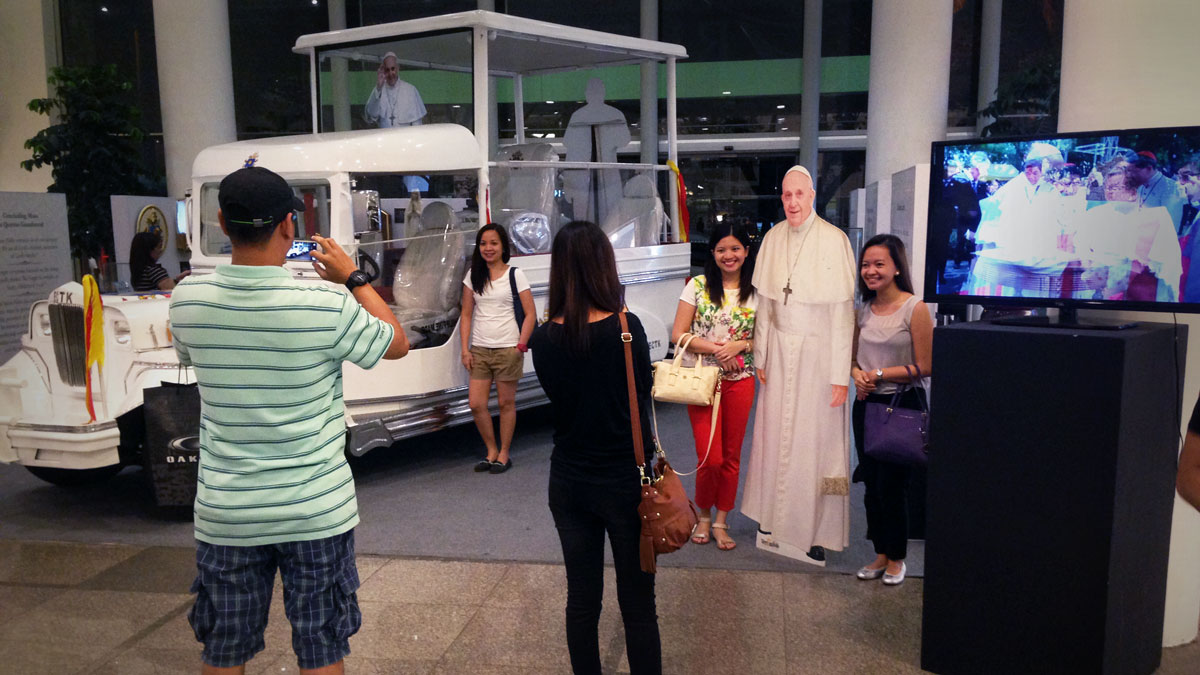
A week ago, I was just landing in Manila and getting ready to start the American Arts Incubator (AAI) program. Our first stop and "home-base" was Makati City, nowadays considered the Financial District of Manila and also an area that makes evident the booming market and financial growth of the country. There, I saw perhaps one of the biggest urban malls on the continent! Or, at least, one with enough room to exhibit a one of-a-kind, custom designed "Jeepney" for Pope Francis, or in colloquial terms here, “the Papamobil.” Anywhere else outside the perimeter of Makati City, one can see contrasting images of Filipino life, clearly demonstrating both the amazing opportunities and also the struggles present in this context. Our short stay in Manila also included a visit to Green-Papaya (a long standing artist-run space) and a quick look of Paul Pfeiffer’s new exhibition at MCAD.
Being my first time in the Philippines, I started to feel more confident navigating the local context on many levels: from public transportation to the lively social customs, and most importantly, the look and feel of the city. In this short time I have experienced an immediate connection with the country, perhaps because I spent many years living in South America, which, like the Philippines had a very strong influence from Spain (for at least 350 years) during Colonial times.
Three days later, Kate Spacek, ZERO1's program manager for AAI, and I were boarding an airplane to Bacolod in order to meet with Tanya Lopez and the staff from the Negros Museum, our host and local partner in the program. Our first two days with the museum were so carefully planned, which gave us the chance to meet local community leaders, journalists and representatives of the local government, literally one after the other. This system made me feel like sitting in a very professionally crafted “speed-dating” sort of situation. I’m not sure how common ‘speed-dating’ is in Filipino culture (ha ha) but given the precision and successful matching (of course, of professional interests), I think Tanya and her team found the perfect combination for initiating “first-sight” collaborations.
It has been only one week for us in the Philippines, but perhaps the most exciting part about this journey is to experience the energetic attitudes towards everyday life from the people of Bacolod. Their huge levels of inventiveness populate the city and create an environment where nothing seems impossible. From ingenious artifacts, like former military vehicles from WWII turned into (very) colorful public buses (or 'Jeepneys" in the local dialect); or bicycles and motorcycles attached to metal structures that are used to run food stands, transport merchandise or even replace taxis! Other unique occurrences that I have encountered by walking through the streets are as simple as an improvised hammock made only with two ropes, to entire homes made out of bamboo including the walls, flooring and even furniture.
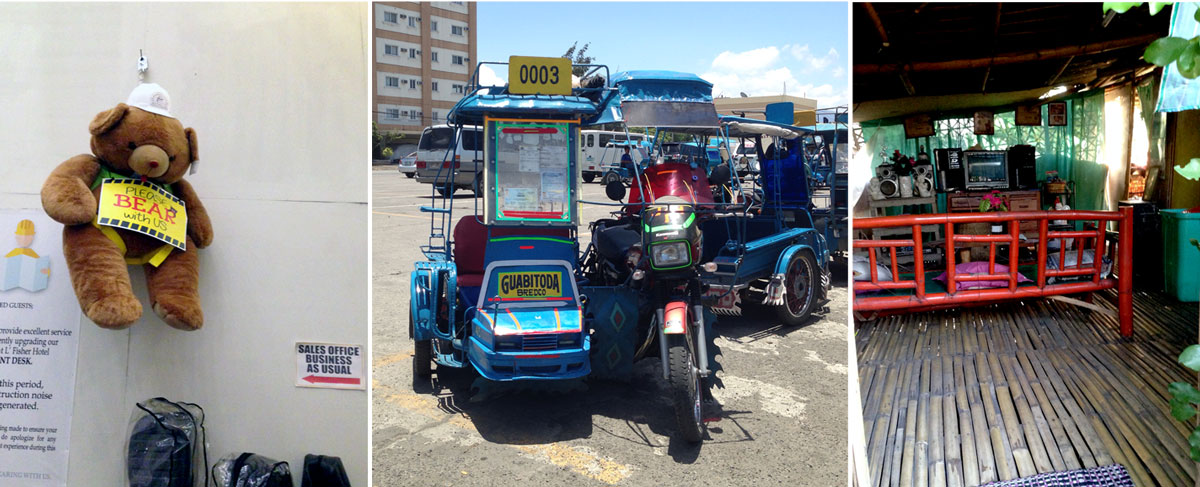
Overall, the excitement and diligent work being done by our amazing team of museum staff and volunteers, plus the openness of the people from Bacolod make this place already feel like my home-away-from-home. Meeting after meeting, I feel ever more confident about the connections, understanding and support that we can gain in the next few weeks. Now that we’re moving into the thick of the project and workshops, it’s fascinating to see how the conversation naturally shifts. Instead of making more statements about what Art is, we’re all trying to figure out what Art can do for our local contexts…
[/et_pb_text][/et_pb_column][/et_pb_row][/et_pb_section]