Pepper House is one of the locations my partner organization, The Kochi Muziris Biennial Foundation, uses for exhibitions, artist talks, and residencies. It's also the home of their art library. I have been spending many days running workshops and ironing out the details of my own project in this beautiful, historic space.
As a creative and progressive organization providing space for local and international viewpoints, I have been fortunate to have deep conversations about gender rights, learn about the methods transgender people navigate this community, and on one special occasion, unsuspectingly walk in on a band practice session of the reunion of a well-known local group who was playing in one of the many places the biennial has developed as artistic space. I have also been told that more Kochi community members attend the biennial each year, and that their tolerance for, and interest in, more challenging forms of art is growing.
Due to the nature of this foundation, “The People’s Biennale,” I have also been surrounded by a 20- to 30-year-old crowd who either work for or are involved in the biennial. As an artist-educator-dreamer, I have aspirations for creating spaces where conceptual and cutting-edge art is accessible to the community and art provides access for people to be empowered, rather than an opportunity or event focused on only one demographic. The Kochi Muziris Biennial has achieved this. I have met more than one young person here who has said they had no interest in art until the biennial changed their viewpoint, and that they are now pursuing careers in art that will take them further than they ever expected.
Association with the program also provides a kind of freedom that allows young people to operate outside some of the cultural expectations in the area. Just as I am able to walk on the streets after dark or wear clothing that shows more skin as a tourist (without someone attempting to admonish me for not acting acceptably), the young people associated with the Bienniale, especially women, are granted more leeway to navigate outside of acceptable cultural norms.
These access points will hold even more resonance in 2018 as the next biennial develops under the curatorial actions of Anita Dube. The word here is that women and transgender artists will hold a prominent place in this next exhibition, an important and progressive move for Kochi, which I can only hope will inspire curators back home.
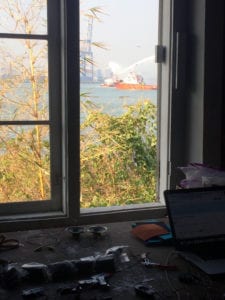
The view out of my studio window looks a little bit like home. Kochi is an extremely cosmopolitan city with a 97% literacy rate. In many ways, it reminds me of my home, Seattle, which also has an extremely high literacy rate for the U.S., and is a shipping port with large dockside gantry crane, a history of leftist politics, and an affinity for plaid (here it is called Madras checks).
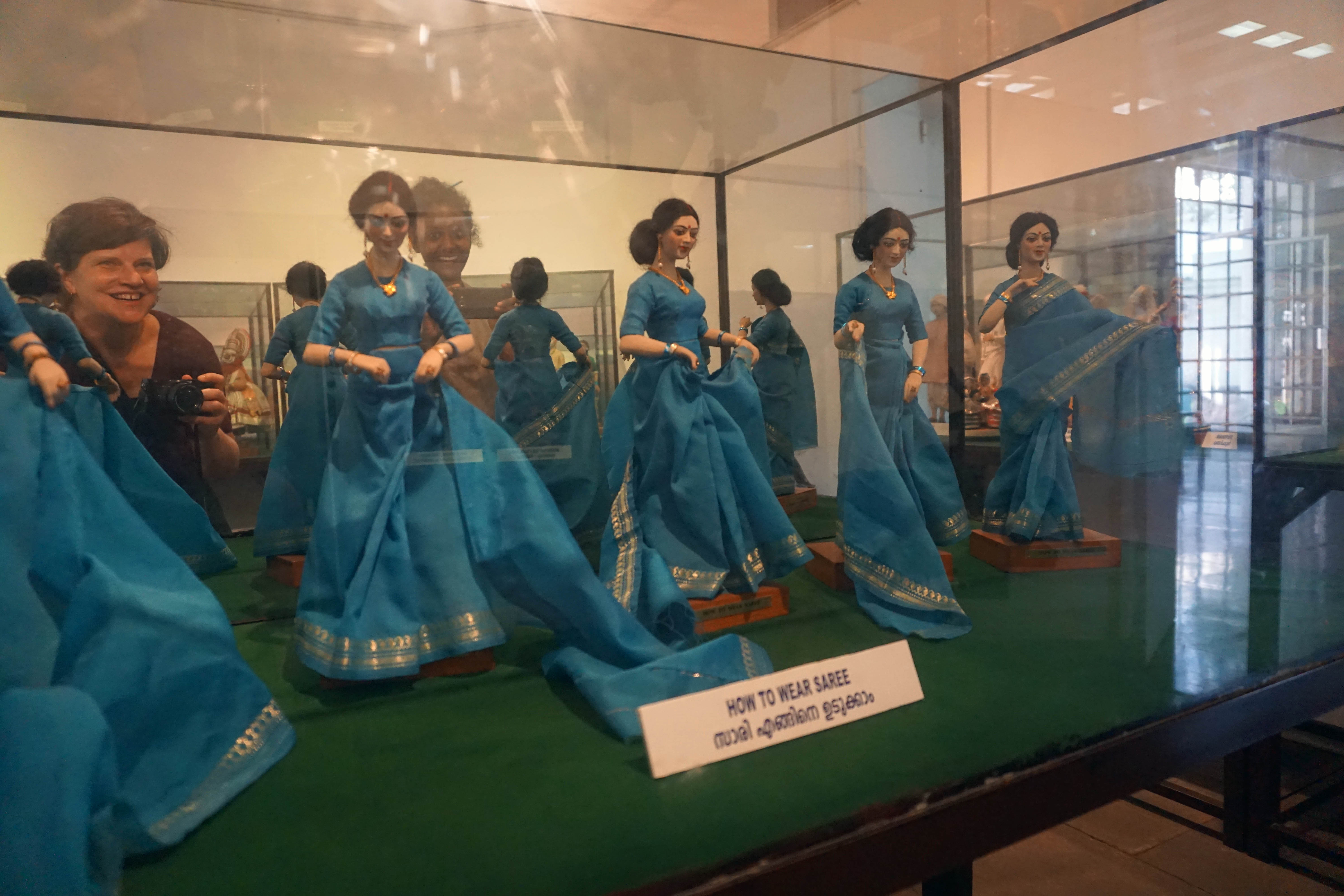
Selfies at the Kerala History Museum with my amazing assistant, Aparna, whose interest in contemporary art was spurred by the biennial.
As a daughter of immigrants in Turtle Island (aka North America), I strive to be in allyship to the original peoples and the land and waters that nourish me by activating multisensory storytelling and interdisciplinary art, including sculptural installations, performances, lectures, community engagement, writing, olfactory art and experiential technology collaborations with Native culture bearers, creative technologists and scholars. This trajectory shapes my approach to the American Arts Incubator (AAI) exchange where I will be supporting social inclusion of Indigenous and Afro-Ecuadorian populations in Otavalo, Ecuador through sharing how new media storytelling may shift dominant narratives.

I will be working with Centro Intercultural Comunitario Yawar Wawki Casa de Artes that is housed in Museo Viviente Otavalango, which previously was a textile factory that exploited Indigenous labor for two centuries until it was taken over by workers in 2011. Within this context, Casa de Artes counteracts marginalization and historization of Indigeneity through revitalizing Kichwa language, music and weaving. I am humbled to work with resilient people that embody self-determination. With my workshop participants, I hope to develop site-specific extended reality content to support spreading the story of self-empowerment. Our process will be a co-inquiry on how new media can amplify voices critical to futurity and challenge the notion that indigeneity and modernity are incompatible.

I want to take this opportunity to broaden general conceptions of technology to include ancestral technologies such as weaving, agriculture, plant medicine and wayfinding. I credit my AAI mentor Cristóbal Martínez (read his writing on Tecno-Sovereignty: An Indigenous Theory and Praxis of Media Articulated Through Art, Technology, and Learning) who pointed out that weaving was the first computer and that we must always question the ideologies embedded within the technologies we use, and how they may occlude other forms of literacy and perpetuate power structures. This resonates in an age where we rush to embrace new technological trends without contemplating how often they are derived from military initiatives that were once instrumentalized against certain marginalized communities. Navigating these power dynamics will be one of the first challenges I will face as the Incubator’s lead artist and I hope to find a balance between emerging and traditional media throughout our workshop.

Drone VS. Fort, Rhunhattan Project, April 2017. Image by Beatrice Glow and Highway101, etc. Exploring the embedded ideologies of technology, we used a drone to photograph Fort Belgica that was built by the Dutch East India Company on the original Spice Islands of Indonesia. By using 20th century military-derived technology (drone) to document 17th century military technology (fort), I reinterpret and subvert the ideology belying the drone and use it to support decolonizing perspectives.
Gearing up for the exchange, I have been rereading Decolonizing Methodologies: Research and Indigenous Peoples by Linda Tuhiwai Smith. I am also learning about Andean culture and cosmovision through learning the Kichwa language. For example, the word for “person” is runa, and the full definition is “a being of nature that acts with force and wisdom.” My teacher gave me a Kichwa name that realigned me on the path of runificación, which urges me to act in my full potential while being conscious of my relationship to the ecosystem and the cosmos.
During my stay, I hope to learn more about how Indigenous communities in Ecuador have been at the forefront of environmental stewardship, most recently evidenced by the Yasuni resistance against the pipeline construction in the Amazon Rainforest as well as the 2008 constitutional enshrinement of the values of sumak kawsay (buen vivir)[1], whose vision for environmental health is critical to a sustainable and socially-just future. I am curious to learn how this is implemented on a day-to-day level, the challenges, and how these takeaways may guide and strengthen parallel North American efforts. My time in Otavalo will undoubtedly expand my understanding about the ramifications of colonialism, environmental racism and Indigenous revitalization.
"The long poem of walking manipulates spatial organizations… it is neither foreign to them… nor in conformity with them."
—Michel de Certeau, The Practice of Everyday Life
I am so humbled by this opportunity to simultaneously teach and learn in Casablanca this March. And I am so excited and fascinated by the process of investigating how to explore questions of interest and concern to participants from a wide range of backgrounds.
It’s exhilarating to feel how aligned my host organization, L’Uzine, is with the goals and strategy for the exchange. After checking in this Saturday morning with Zineb at L’Uzine, it was clear that we are on the same page: working to develop an exchange that emphasizes interdisciplinary, cross-media, and cross-scalar collaboration and looking forward to the discoveries and experiences it might produce!
Together, workshop participants and I will be testing how research into personal narratives and critical cultural questions can be articulated through urban spaces; how collecting can lead to creating; how data visualization and mixed digital and manual prototyping can evoke and interrogate concepts; and how mixed qualitative-quantitative analysis can form the framework, foundation, and inspiration for novel sensory experiences.

The topic of the AAI exchange in Casablanca is youth empowerment2. The idea of the workshops is to provide conceptual frameworks and technical skillsets that facilitate innovation, entrepreneurship, and engagement. For those participants developing an artistic identity, I hope the workshops can also help with discovering and choosing expressive media; while for more experienced participants, the skills may help bring new research and data-processing techniques into their work.

For me, the development of these frameworks started with my family and the childhood experience of immigration. More recently, I have started to dissect (and self-map) the complex paths that experience led me down.
The self-map image starts to get at the following questions:
What can we discover when we start to explore the individual as a vessel of socio-historic confluences through quantitative analysis?How does one identify, question, embrace, and express an awareness of one’s own familial and philosophical lineage(s) in the process of exploring socially-critical topics?Can some of it happen through numbers? Can spreadsheets shed their corporate connotations and become powerful tools for artists? Can some of it happen through the senses? How can we identify and deploy physical experiences in exploring and articulating intellectual challengesWhere is the limit of one type of mapping and what subjective additions to we make to maps when representation breaks down?And how can we unroll an experience to discover and display narratives of cultural relationships?
L’Uzine is already involved in exploring its urban context. In particular, the Aïn Sebaâ exhibit investigated its neighborhood. I hope that this exchange will offer a way to supplement the great work under way and to develop some novel approaches to understanding self and space.
Wait — did I already say how excited I am to see what backgrounds, interests, and media workshop participants bring into the fold? What implications might rhetorical construction, collection, data visualization, and mapping have for the modes of expression and creation that participants engage in? I look forward to observing and participating as responses to these questions (and more!) coalesce and dissolve in the experimental framework of the “Rhetorical City” workshops at L’Uzine!

2. According to World Bank’s “Kingdom of Morocco Promoting Youth Opportunities and Participation” (June 2012), the landscape of employment in Morocco has undergone radical shifts in this century.
A large part of my arts practice is informed and shaped by the environments, spaces, and communities I’ve lived in and travelled through, including my native island of Oah’u in Hawai’i. I’ve always been inspired to create meaningful spaces for cultural dialogue, and work collaboratively with communities to create impactful projects, which I have strived to do as the Artistic Director of B4BEL4B Gallery in Oakland for the past four years.
In my personal arts practice I have used 3D modeling, augmented reality, websites, and textile design to tell stories that speculate on how we can reimagine the past, present and future. I’m interested in our relationships to our technologies and how they both come from and shape the environment, and focus on these stories in my work.

I’m excited for my arts practice to evolve next month as I travel to Kyiv, Ukraine, and lead workshops and community projects in partnership with IZOLYATSIA, a dynamic arts organization focused on cultural and social change. I have been inspired by the youth-driven “Made in Ukraine” movement where Kyivians have revitalized and cultivated a strong and unique identity. Through conversations I’ve had, Ukrainian culture and identity is a multi-layered and complex topic that shifts between generations and is interwoven with the political and geographical landscape and the ecology of the land.
Focusing on cultural identity and environment, I will be giving workshops where participants will consider how to use speculative thinking and designing towards prototyping cultural spaces and objects for the present and future. We’ll consider material ecology, design fiction and storytelling through exercises where we think about redefining boundaries, radically refiguring space, transforming damaged landscapes, collaborating with the environment, and how culture and ecology are inextricably intertwined. We’ll also use digital tools to express individual cultural and personal identities.

As this will be my first time teaching workshops in another country, I am looking forward to being both a student and teacher while I am there! I hope to provoke conversations and inspire people to create work that is meaningful to them that they will continue to build upon after my exchange.
Teaching is no less a work of art than the creation of artwork itself. For the past ten years my artwork has evolved into platforms and objects that aspire to give people a place to find their voice, express their individual and collective beauty, and learn more about the empowering effects of creativity. I have done this through projects such as collaborative textile-making processes, creating and running a neighborhood Super 8 film festival, and designing radio sculptures for non-traditional communication. Recently, I have been fusing my two primary interests, textile objects and traditions plus communication practices to express ideas of voice, identity, and place.
I am extremely grateful to be able to bring my art practice to Kochi, India and continue exploring communication and empowerment through a partnership with the Kochi Biennale Foundation, addressing the topic of gender equality. Inspired by Gandhi’s khadi (Indian hand-woven cloth) campaign, which “was a result of decades of experimentation with cloth as a means for communication,”[1] I am preparing for a project to embed speakers into textiles exploring micro-amplification to amplify stories from the Kerala region.
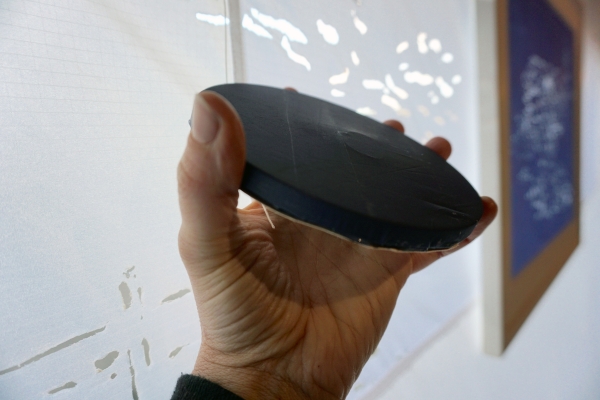
The workshop I am offering will explore amplification, sculpture and sound (including e-textiles), narrowcasting, and podcasting as a method for exploring gender equality, communication, and creativity. Inspiration for this project has come from India’s rising access to radio through mobile phones[2] and Vinod Pavarala and Kanchan K. Malik’s Other Voices: The Struggle for Community Radio in India, which credits radio with the “capacity to consolidate participatory communication into a thread that weaves through the development process and endows it with avenues to strengthen and give voice to all stakeholders.”[3]
I begin this exciting journey in mid-February and look forward to sharing my experiences there.
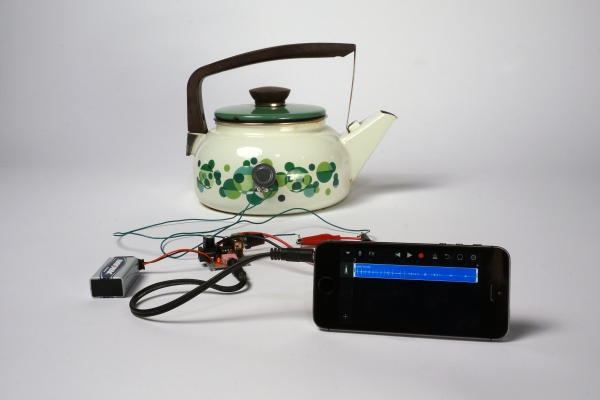
Workshop tutorials will include building speakers and amplifiers, making things “talk” through the use of transducers, audio editing and amplification, and hacking electronics to make what you want. Photo by Laura Wright.
[1] Gordon, Beverly. Textiles: the whole story: uses, meanings, significance. Thames & Hudson, 2014. pg. 104
[3] Pavarala, Vinod, and Kanchan K. Malik, Other Voices: the struggle for community radio in India. Sage Publications, 2007. pg. 182.
This has been a momentous year. 2017 has put our institutions to the test and demanded action in the streets. Making meaning in the midst of the turmoil, we have been reimagining what civic action looks like. Working in collaboration with government and individual citizens, ZERO1 has supported artists across the globe who are applying their creativity to the challenges their communities face.
This year ZERO1 artists made art that mattered: addressing homelessness in San Jose; improving disability inclusion in Moscow; championing economic equity in Guatemala City; probing water quality in Bangkok; cultivating peace in Medellín; promoting environmental health in Phnom Penh. More than ever before, we see the importance of connecting communities directly so that we may share approaches and align our efforts.

Our work is no longer just about enhancing our capacity with technology, exploring new truths with science, and representing beauty with art. We must now also repurpose our tools, apply our knowledge, and demonstrate how art can help us envision a sustainable future. To that end, here’s what we’ve been up to, by the numbers:
6 countries were sites of creative collaboration
32 projects applied art, science, and technology to social and environmental challenges
$20,000 in small grants awarded to community led-projects
$42,300 in fees paid directly to artists
$60,480 in artist travel expenses covered
68,456 miles flown to connect artists face-to-face
28.2 tons of carbon offsets purchased
5,964 people interacted with art that opened their awareness
We’re grateful to be supported by a growing community that cares deeply about using creative tools to build engaged and vibrant communities. As we step up to new challenges in the year to come, we ask that you stand with us, and renew your commitment to art that expands our vision for what is possible.
Best,

Barbara Goldstein
Board Chair and President, ZERO1
As a representative from the United States, it was inspiring to see that addressing environmental issues is such a high priority among so many people in Cambodia. Leaders young and old are working hard with beautiful creativity to heal our world.
The American Arts Incubator – Cambodia Facebook page continues to be a vibrant hub for workshop participants, environmental activists, and media artists in Cambodia. The four teams are continuing their projects, launching their own social media campaigns, and are well on their way to Phase 2 project production. I am excited to be a long-distance advisor as their projects continue to grow. The 360 Ricoh Theta S camera and virtual reality (VR) goggles purchased for the workshop are being shared in an ongoing equipment pool for the groups. The installed solar electric system for the Bophana Audiovisual Resource Center continues to provide power each day for screens to show artwork and fans to keep everyone cool. It is inspiring to know that when the sun is setting here in Philadelphia, it is rising over the solar panel in Phnom Penh.
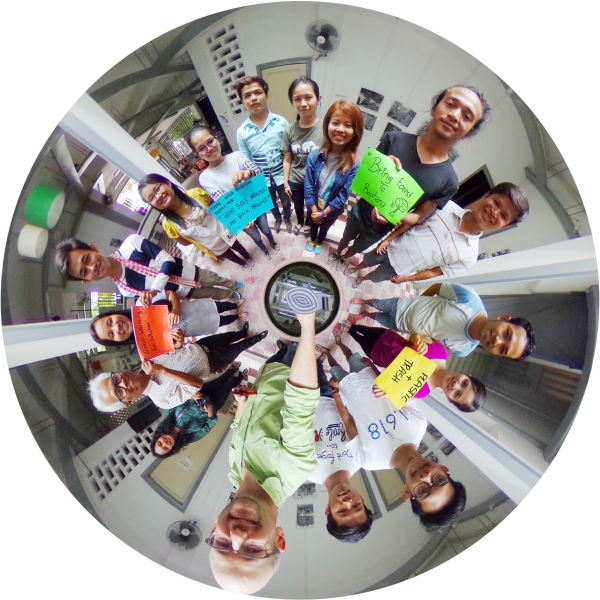
I feel honored to have led the Incubator at Bophana Center in Cambodia and thankful for all the support and enthusiasm of the Bophana Center staff. I was most impressed by the dedication and commitment of the participants. The teams worked really well together considering the strain of creative deadlines. Fortunately, there were no breakdowns or ego battles in the busy final days. A real sense of camaraderie developed among the teams as well as across the whole group. The final exhibition was a tremendous success and groups of visitors continued to come in for the month-long duration of the exhibit.

One of the installations created by the Plastic Team featured a statue of the mythological mermaid, Suvannamaccha, made out of plastic bottles and newspaper headlines. The statue had trigger images of sickly fish and some fruit. When looked at through the augmented reality (AR) app, the fish and fruit disappeared to reveal an image of the mermaid. The installation's purpose was to warn us of a future where ocean life disappears because of trash and other pollutants.
Usually, AR projects are about adding a new layer of information on top of the trigger image. This was a learning moment for me as the participants expanded my horizons to look at the technology differently. Their project conveyed how adding something can have a subtractive effect. Perhaps this approach can provide new and unique solutions to the seemingly futile pursuit of environmental sustainability.

While a couple of workshop participants had experience with virtual reality, none of them had ever experienced an augmented reality project. It was powerful to realize that in Cambodia, their first experiences with AR and VR were as art projects and not simply commercial applications for a corporate product. During the American Arts Incubator workshop, I watched them realize their potential as makers and innovators, not merely as passive consumers. They are now at the forefront of developing the aesthetics of these new mediums.
The one exciting potential of new media technologies is that peoples' use of it has not been trained by a lifetime of cultural influence. Through the workshop, participants were able have a more pure and personally pioneering experience in imagining the potential for AR and VR as tools for art-making and creating social change.
The community project descriptions below were written by participants in American Arts Incubator — Cambodia and focus on environmental health in the country. These projects were initiated during Michael Kuetemeyer's Incubator workshop and will continue to develop after the Incubator is complete. They were presented at the New Media Exhibition at Bophana Center from May-June 2017.
Trash is Not Bad
Artist team: Chum Mab, Chhit Vannat, Mok Sina, James Speck, Soin Vanda, Hul Hunsopheary
The Plastic Commune team is building statues of the god Hanuman and the mermaid princess Suvannamaccha out of recycled plastic bottles and newspaper. Images on these sculptures trigger augmented reality 3D models of these miraculous modern materials we are able to create but then treat without respect. Hanuman saved the world once upon a time. Can we all join him in this current epic quest to rescue the earth?
They are also producing the documentary, Our Health Our City, asking the residents of Phnom Penh about how trash impacts their lives.
We Destroy Our Own Planet
Artist team: Sanuch Svay, AN Sopheaktra

The Global Warming team is developing infographic posters that trigger 19 separate overlay video segments via augmented reality. The challenge of global warming is investigated in three phases: 1. the human activity that is causing global warming 2. the risks we all experience as a result and 3. the solutions we can employ to avoid the on-coming collision of wasteful prosperity with environmental destruction.
They have started a new project of personal community outreach and education using AR and VR new media.
Along the Water
Artist team: Tum Yuryphal, Seng Mengbunrong, Heng Lida, Bun Sreymom

The Along the Water team is producing an immersive 360° documentary about how our water became polluted and how it affects the living surrounding it. The video explores the life of a family living on a floating house and the close strings that tie water and life. A sculpture of a huge blue water drop covered by the waste it holds connects us to this precious resource and shows how “what goes around comes back around.”
Bring the Forest to the City
Artist team: Prum Bandiddh, Khim Darath, Mech Sereyrath

The Bring the Forest to the City team is traveling to three separate Cambodian forests to document them with 360° images and sounds. They are building these into web-based interactive VR experiences of the Areng Forest as well as the Chom Bok Forest in Kirirom National Park in Kom Pong Spuer. The goal is to connect the residents of Phnom Penh, particularly the younger, with the diverse biosphere that is at risk of consumption.
My month-long American Arts Incubator workshop in Cambodia focused on new media and global challenges. The question posed to participants was, “How can environmental health be supported by new media art projects?” Throughout the workshop we experimented with 360 virtual reality and augmented reality as storytelling tools. We talked about using art to engage communities and promote innovations that could lead us on a path to an environmentally sustainable future.
The culmination of the workshop was a new media exhibition at Bophana Center in Phnom Penh from May 17 to June 16, 2017. We had an enormously successful opening reception with guests and panelists from the U.S. Embassy at Phnom Penh and organizations like Development Innovations and Eco Life Cambodia.

The four community artist teams worked hard to put together this fantastic new media art exhibition, which was the first of its kind in Phnom Penh (according to folks who attended the opening reception!). Audiences were enthralled by the inventive uses of new media — from a VR documentary bringing you right into a family's living space on a floating house to augmented reality triggers on a mythical mermaid goddess that made objects in the frame disappear. It was exciting to watch people interact with all the VR/AR projects and engage in discussions about the environmental issues that the projects tackled. We couldn't have hoped for a better opening night.

In keeping with the theme of environmental sustainability, the project installations were powered by a 260-watt solar panel that we installed at Bophana Center at the start of the workshop. Low power devices such as 13-watt fans, 11-watt HDTV monitors, and LED projectors were in play during the exhibit – and they all used the power of the sun!

As lead artist for American Arts Incubator — Cambodia, I also premiered a new augmented reality installation “Circle Time” in collaboration with artist Anula Shetty. This installation uses hand gestures from classical Cambodian dance as triggers for a series of documentary videos exploring the new environmental/recycling-focused "Coconut School" being built in the Kirirom Forest. The participants were excited to see that there was a fifth artist team and were helpful as we all worked together in the mounting and installation.
All in all, the technology and internet cooperated throughout exhibition which created a real sense of accomplishment for all artist participants.
We have now have 4 active teams organized and developing their immersive media projects in Phnom Penh. They are exploring a great range of environmental concerns through immersive media projects. In the week of workshop exercises we played through the production and experience of augmented and virtual reality. Combining this technology with the aim of supporting environmental sustainability has led to some amazing project concepts.
“We Destroy Our Own Planet” (Global Warming)
This group has developed an infographic poster that will trigger 19 separate overlay video segments via augmented reality. The challenge is investigated in three phases: Human Activity that is causing global warming, the Risks we all experience as a result of the effects, and the Solutions we can employ to avoid the on-coming collision of wasteful prosperity with environmental destruction.
“Bring the Forests to Bophana” (Deforestation)
A second group is travelling to three separate Cambodia forests to document them as 360 images and sounds. These will be built into interactive VR experiences and a map-based app. The goal is to connect the residents of Phnom Penh, particularly the young, with the diverse biosphere that is at risk of destruction.
“Trash Is Not Bad” (Plastic Waste)
Statues of a traditional Cambodian dancer and the god, Hanuman, made out of recycled plastic bottles emerge from piles of trash. Images on these sculptures will trigger augmented reality 3D models of the miraculous modern materials we are able to create, but then treat without respect. Hanuman saved the world once upon a time. Can we all join him in this current epic quest to return the earth to health?
“Along the Water” (Water Pollution)
A fourth group is producing a 360 video about people living in floating houses on the river. They are also planning to have a sculpture with a projection on it as part of the exhibition. Living with the water pollution at Tom Nub Korb Srov in Phnom Penh will exemplify the adage that “what goes around, comes around.” How can we take care of that which sustains us?

We are underway with the American Arts Incubator — Cambodia workshop at Bophana Center!
In our workshop we have done a series of exercises working with the Aurasma augmented reality app. One group of students created an “aura” that uses the image of a skull-and-crossbones landmine warning sign as a trigger for an augmented reality overlay — a video they shot of discarded plastic bottles and other trash on the street. At first there were comments that the landmine warning was too extreme for this association with trash. But then as we discussed it, we began to wonder if future generations might look back on us with the same terror and concern. Is all this careless waste laying new treacherous mine fields for our children to cross? The documentary, A Plastic Ocean, screened at the American Corner at Paññāsāstra University of Cambodia last week revealing to us the tragic impacts of the flood of indestructible waste that pours from our consumer lifestyles.

In an effort to do our part, NRG Solutions - Kruosar Solar has completed a soft install of the components of the 260 watt solar panel, battery, and charge controller system we are donating to Bophana. We are going to hook it up and test out a variety of locations in the Bophana space, finishing the install next week. In addition, we purchased some really exciting low-power appliances from Niwa Solar to run on the power generated. There is a super bright light that only draws 3 Watts, a standing fan (13 W), 18” television monitor (8-11 W) and USB chargers. They all run directly from the 12 volts supplied by the 100 amp hour battery without the need of an inverter. We already have the components that can keep us cool, lit, and connected, bathed in electronic images and sounds! Plenty of extra power will be generated to share. Sustainability is achieved when the power generated balances the power needs. Once that point is reached, we have caught the wave and are surfing on photons streaming from the sun.
The average temparature of Earth's whole atmosphere cycles up and down each year because its southern hemisphere has more ocean coverage than the northern hemisphere. When these temperatures are graphed throughout the past 137 years you see that there is a range of warmer and cooler years. Color coding by time range produces a sharply separated rainbow - revealing a tragectory. The separated lines in recent years show that unfortunately this temperature velocity is accelerating.

Global map of the March 2017 LOTI (land-ocean temperature index) anomaly shows that North America and Siberia were again much warmer than the 1951-1980 base period.
How can we sustain our ability to live on this shared planet?
Preparations are underway for the American Arts Incubator Cambodia environmental sustainability workshop at Bophana Center, Phnom Penh!
Kruosar Solar / NRG Solutions and Bophana Center are meeting to discuss the installation design factors of the new solar powered time lens media installation. We will be setting up the system next week and aim to have collected enough electricity to be inaugurated it by powering the April 21st artist talk and the the week-long workshop starting on Earth Day, April 22nd.
The workshop is open to anyone in Phnom Penh interested in using media to improve environmental health. To enroll please apply here:
Time Lens Workshop - Immersive Media Pathways to Sustainability
Session 1 – Earth Day – Past
Saturday April 22, Bophana Center
Virtual Reality – Immersion into a location at a previous time
Ricoh Theta–S 360 camera, Kolor Panotour Pro virtual tour authoring software
Session 2 – Present
Sunday April 23, Bophana Center
Augmented Reality – Layering onto the current location
Aurasma augmented reality app
Session 3 - Moments
Wednesday April 26, Design Innovations
Work session for Video editing, and VR/AR editing and authoring
Session 4 – Future
Saturday April 29, Bophana Center
Collaboration and Creativity - What impacts do these media produce? What futures do we see through the time lenses? What “images” are revealed?
Session 5 – Sustainability
Sunday April 30, Bophana Center
What kinds of time lenses can be focused on sustaining the abilities of our shared environment?
4 groups pitch their project ideas. These are developed in the following 2 weeks, each with a $500 project grant.
Sustainability Achievement unlocked – One Million Liter Rain Catchment System
In preparation for the Arts Incubator I have been training up my own sustainability skills and have just completed a fresh water collection system.

A silicone painted roof clean rain catchment system that collects 1 million liters of fresh water each year.
The roof is a square that is 15.5 meters per side = 240 square meters of surface area
At this location, the rainfall averaged 4.55 meters per year between 1993 – 2010.
The average annual volume of water that falls on the roof can be calculated by:
240 square meter roof area x 4.55 meter depth of water
= 1092 cubic meters of water
= 1,092,000 liters of rain collection.
The rain water is stored in a 37,000 liter water tank. When needed, it is filtered, UV sterilized and pumped throughout the house.
One month until American Arts Incubator begins in Cambodia. In preparation, I am working with Bophana Center and Kruosar Solar to design and install a local solar electric power system at Bophana, where the exchange program will occur. It will provide electricity for the month of workshops and project development. After the exchange it will continue to provide power, sustaining the community projects, building environmental health. Each day the energy is replenished when rotated into the stream of sunlight. What worlds will we create with the power we collect?

When my kids pre-ordered the Nintendo Switch earlier this year we decided to add another level to the game - it would only be charged with power they collected. Before it arrived we put together the power system– a 21-watt portable solar panel with charge controller connected to a 5-volt USB battery pack. Now that the Switch has arrived they can use it as much as they want, as long as they are able to keep it powered by the sun. If they can power it, they can play it.
We are learning to get really good at catching the sunlight.
A photon that will reach the earth has just left the sun.
spilled light
(an energy-inspired poem)
photons fall upon us
born in the fusion reactor at the center of our solar system
4 billion kilograms of matter converted into photons every second
only 1 in 2 billion photons are radiated directly towards the earth
every second 2 kilograms of matter is converted to energy and sent just to usIn 8 minutes and 19 seconds they complete their journey of 150 million kilometers
some of this light is reflected back into space
less now that the ice has melted
some is harvested by plants giving them the power to grow
a few are caught by solar panels and transfer their energy into electricity we can use
most end their journey by simply spilling heat into the oceans and onto the global citynew photons are just now beginning their journey from the sun
their light will be here soon
catch them before we spill
I have a lot to digest after the intensive American Arts Incubator orientation retreat with ZERO1 in rainy San Francisco. Kate Spacek, Shamsher Virk and Michelle Peregrin provided valuable support and resources. Fellow AAI artists Balam Soto, Elaine Cheung, Scott Kildall and Nathan Ober offered much inspiration in their creative work and innovative plans for their exchanges focusing on water pollution, disability inclusion, economic equity and inclusive peace.
In April – May 2017 I will have the honor of collaborating with an exciting group of artists, activists and organizations in Phnom Penh, Cambodia. In partnership with our host organization, Bophana Audiovisual Resource Center, we will be developing a set of media projects focused on the challenges of Environmental Sustainability and Deforestation. Updates and feedback can be followed on our Exchange Facebook Page. By using collaborative video, augmented and virtual reality to layer memories and imagination onto the world around us, we will create time lenses that reveal pathways to a sustainable future.

After 30 traumatic years of war, Cambodia’s economy has been growing at one of the fastest rates in the world. In what ways can an improved standard of living be achieved while also increasing sustainability? Societies with modest energy and resource usage are actually already much closer to achieving this balance than high-use countries. Throughout the exchange we will practice renewable energy skills by powering the workshop and projects with solar power. Krousar Solar will be a key local resource for our solar power technology needs. Cambodian society has a great potential to develop the models that lead us to a sustainable world.
We will design the final exhibited projects to be self-sustainable entities that have their own built-in renewable power generators. What types of energy do the projects require? What power sources can be designed to sustain them? The balancing skills of sustainability are games that, if played well, can be won.
Resources and Potential Participants:
• Young Eco Ambassadors
• Sustainable Green Fuel Enterprise (SGFE)
• Fauna and Flora International
• Zaman University - Department of Digital Arts & Design
• Young Southeast Asian Leaders Initiative
• USAID - Supporting Forests & Biodiversity (SFB) project
• Open Development - Cambodia
Dark Skies in Dunedin
We have greatly improved on our prototype that was for the Climate Kit exhibition. We kept the same hexagonal structure with cubbies built in, but we modified the streetlight models to more accurately represent their real-world counterparts. We made it so light would shine through into the cubbies like actual stars, instead of just using large photos. We also created all-new panels that look much more professional and can each stand alone, but still all work together. The Dark Skies exhibit is up and running in the Dunedin City Council’s lobby.


 Light pollution solutions. Courtesy of Shedding Some Light community project team.
The team perceived the problem of the stakeholders in Banilad regarding traditional fish searching during the community immersion on the second day of the workshop. The activities include area project reconnaissance, interview with concerned stakeholders and locals, and formulation of solution through art technology using indigenous materials and garbage. This article further discusses the progress of the Sea Sense team from the perception of the problem to the inception of the project from April 16 to 29, 2016. Project planning, development, and simulation were done at the Waterspace Laboratory in Foundation University while actual testing of the partially completed project is conducted in the BOAT Lab at Banilad Marine Sanctuary.
The primary stakeholders are the fishermen and beneficiaries of the target community. Tasks were divided among the members of the Sea Sense team. Al Diego designed the circuit diagram and sensor programming. Moreover, Jeffrey Rivera did the configuration for automatic seawater sample suction and draining of sample. On the other hand, Geraldine Quiñones made the seawater data analysis and processing while Dae Habalo integrated science and technology to the project.
This project started with a week-long workshop and team building with Andrew Quitmeyer as the facilitator. After that, the team developed a prototype and presented the project idea on April 23, 2016, at the James B. Herring AVR. The presentation was attended by a representative from U.S. Embassy, Bantay-dagat president, wife of fishermen from Banilad, and Computer Studies and performing arts students. Feedback during the presentation was used to enhance the project. The group is motivated to complete the project based on the extraordinary reaction of the audience and acceptability of the project by the U.S. Embassy representative.
Andrew Quitmeyer then presented the team deliverables and project timeline. After which the group did the simulation, development and testing of the automatic multisensor seawater quality monitoring project considering the inputs of Andrew Quitmeyer.
The team performed the testing process in the Waterspace laboratory and actual sampling area in Banilad Marine Sanctuary. Initially, the technology is tested using fresh water sample then implemented in sea water. After the testing process, the team purchased materials and started coding the sensors for sea water sample detection using copper wire.
The team celebrates for the successful completion of the sample seawater extraction, detection, coding, and simulation in Banilad Marine Sanctuary. At the moment, Sea Sense team is preparing for the May 1 project exhibition at the Negros Oriental Convention Center.
This is the second week of the Waterspace Incubator workshop. On May 1, Foundation University was invited by the Technical Education and Skills Development Authority (TESDA) to showcase state of the art programs. The University approved the participation of WaterSpace and Sea Sense was among nearly 20 exhibitors showcasing the work in progress at the Convention Center.
Sea Sense is practically busy preparing for the public exhibition and launching of BOAT Lab at the Banilad Marine Sanctuary on May 7, 2016. Before the big day, the team acquired additional materials for the research and final exhibition such as portable divider, hose, and heat shrink wire connector. Al and Jeffrey assembled the PVC plumbing pipe and attached the frame to the experiment table for seawater extraction and draining procedures. Geraldine and Dae, on the other hand, completed the remaining deliverables (logo, how-tos, print documentation, poster) with the help of Jeffrey and a BSIT alumnus.
The team made several attempts to test the dosing pump, sensing of the seawater sample and setting up of the exhibit in the covered portion of the BOAT Lab at Banilad Marine Sanctuary.
We finally extracted the sensor reading and display the value using grove LCD. The figure below shows the display of pH reading.
On June 2, we had visitors from DOST, PCAARD team, who were interested to look at the project and visit the Banilad BOAT Lab site.
a) Malfunctioned LED removed from the container
b) New LED is tested before de-doming
c) De-doming of New LED
d) Attach and test de-domed LED to the container
Also, we started programming to extract reading from turbidity sensor.