Alexandria — Egypt. Photo by David Evers [CC BY 2.0], via Wikimedia Commons.
Each evening as I wind down here in the Bay Area, my partners in Nepal begin their work day. Though worlds apart, we have been in such close contact online that I feel a part of me is already there. In just three weeks, the rest of me will catch up, and I will be whole again in Kathmandu.
My residency will culminate in a workshop at Nepal Communitere, a cool makerspace in the heart of a vibrant art and tech zone in the Pulchowk district of Kathmandu. I’ll be leading a group of students and professionals to use digital fabrication to foster economic opportunities for women. The participants range from artists and engineers to entrepreneurs and teachers, with each bringing a passion for social change and valuable skills to support a community.
My practice has historically been to bring science and art together for projects that address environmental justice, and I wasn’t so sure at first that I could take on women’s empowerment as a focus. In researching women’s issues in Nepal, I became curious about what empowerment looks like for the women in my own community. What I’ve learned is that empowerment can’t be taught, but something we must all find in ourselves, and we can only do it within a supportive community.
Like Uroborus, the mythical snake who eats its own tail, empowerment and community are forever entwined: community supports us and must be supported by us. In creating a program for women’s empowerment, I find myself feeling more confident and connected in ways I didn’t know I had in myself.
I’m most excited about the opportunity to connect the participants to one another, and I can’t wait to see what they develop for the open house at the end of the month!
[/et_pb_text][/et_pb_column][/et_pb_row][/et_pb_section]
Heidi Boisvert, [radical] signs of life. Camera, Jim DeSeve; Editing, Yoni Turkienicz.
For the past 15 years, I anticipated future tech trends and used emerging media and technology to support social justice campaigns addressing violence and advancing values of equality and justice.
I’ve created animations to raise awareness about unfair immigration laws, video games to celebrate pluralism, and even location-based augmented reality apps to change perceptions around homeless (well before Pokeman Go).

Heidi Boisvert, Experience & Game Designer on @home (upper left) for the Kindling Group, Creative Director, Writer & Producer @Don't Deport Me Scotty (lower left) & Creative Director, Game Designer & Producer, America2049 (right) for Breakthrough.
Then I had a crisis of faith. I felt the tools I was creating to shift hearts and minds were actually eroding key areas of the brain responsible for critical feeling.
This awareness instigated my search for an antidote, which redirected my creative practice towards large-scale networked dance and theatre in an attempt to restore connection with our bodies, and one another by bringing people together in socio-collaborative spaces to play.
It also led to a collaboration with Marco Donnarumma to co-design and prototype a biocreative instrument, the XTH Sense—a wearable, wireless biophysical sensor that detects and captures mechanical soundwaves produced by musculature contraction to re-stimulate what I see as our (technology-) numbed biological selves.

Heidi Boisvert, Conceived, Directed & Produced, [radical] signs of life (2013). Photo Credit: Soyo Lee.
Fascinated with the potential role the body could play in social change processes, I started to ask questions about whether we could decolonize our somatic system through aesthetics, and if the interplay between ghost stories and ritual could catalyze collective effervescence. I wanted to bring movement back into movement building.
During this time, I also discovered that many activists-artists advancing social justice (myself included) were “walking wounded,” often seeking to redress issues in our communities that reflect our own unaddressed trauma. In the absence of truth and reconciliation in the U.S., I wanted to create a shared space for communal healing through a performance devised not from familiar tropes but from the physicality of the storytellers’ bodies, fostering the examination and evisceration of the legacy of lived, intergenerational, and epigenetic trauma stored in our collective and individual bodies.
The body is an archive of our stories, but trauma is not stored as a traditional narrative with an orderly beginning, middle, and end. Instead, trauma is stored as flashbacks that contain fragments of experience, isolated images, sounds, and physical sensations (fear, panic), continuously re-enacted within the body, wreaking havoc on our immune, muscle, and nervous systems.
The impact of systems of oppression—racism, misogyny, poverty—are pervasive. When experienced chronically, the cumulative effect is life-altering, intergenerational, and epigenetic. Because trauma is a contraction held within the somatic system, we are fundamentally "shaped" by terrifying experiences; they inform our worldview and impact our sense of identity, intimate relationships, physiology, emotions, behavior, perceptions, and feeling of belonging. Facing—and healing from—trauma is essential to building effective movements and catalyzing systemic transformation.
Trauma, I believe, is also at the root of the social challenge I will be working on in Istanbul, Turkey, which focuses on gender equity and women’s empowerment.
In preparation for my trip, I have done a fair amount of research on the issue from a socio-cultural and a political perspective. What I have discovered thus far, is that despite legal reforms to ensure equality between women and men in political and civil rights instituted in 1923 when the Turkish Republic was founded, and recent legislation adopted in the 2000s aimed at protecting women from domestic violence and eradicating gender-based discrimination, implementation and enforcement of laws has not been successful. Women in Turkey only make approximately 44% of the earnings that men make, and 38% of married Turkish women have suffered abuse from their husbands. Turkey’s overall gender gap places it 130th of 144 countries. It also ranks 109th in educational attainment, and 129th in economic participation and opportunity.

Source: International Labour Organization, Gender, Equality and Diversity Branch.
Generalized statistics, however, erase the somatic markers, the deep patterning of residual trauma left in the body by heteronormative, patriarchal structures, which often undermine women’s capacity to lead full, healthy lives.
Dance and performative gesture have the potential to rescript our nervous system and postural signatures through breath, postural realignment, and movement. I have conducted research on movement and the neuromuscular patterns of emotion. Based on my research, I believe people develop deeply unconscious physical postures (neuromuscular and energetic) as children when the limbic system is forming (ages 3-7), which can give rise to embodiments of feelings and chronic mental states.

XTH Sense in Action, Co-Created by Marco Donnarumma & Heidi Boisvert. Photo Credit: Margherita Pevere.
Our unique postural signatures often inhibit feelings that are difficult for us to bear, yet, like much of our physical life—sensations, feelings, gestures, movements, contractions, releases, expansion—operate outside of conscious awareness. If motion emerges out of emotion, then the opposite is also true: we can transform emotional states by activating new sensory-motor routines through free, unguided bodily expression. Through music and imagery generated from the inaudible sounds of dancers' inner bodies (somatic and autonomic nervous system), we can compose the fragments and re-animate the life force within each of us—artists, performers, audiences—that is often blocked or shattered through painful lived experiences.
This is what I intend to explore in Istanbul with a community of 20 women and youth from a broad range of backgrounds and skills. Together, we will transform deeply embedded scripts lodged in the physical body in order to dismantle cultural patriarchy.

Heidi Boisvert leading a Multi-Modal Movement Workshop in Amsterdam. Photo Credit: THNK.
To begin, I will use “play as process," a methodological approach I invented and have iterated upon in creative partnerships with various NGOs, cultural and educational organizations, across a host of issues. This four-part co-creation process will allow me to understand the socio-political context and how participants understand and interpret this social challenge. It will also ground me in participants’ concerns in art/design terms, so I can shape the multi-modal movement workshop and micro-performance process around what emerges.
The multi-modal workshop will consist of a 4-part co-creation process culminating in a short mixed-media performance. Participants connect personal experiences of trauma to a collective narrative by transforming embedded somatic scripts and historical patterns into live drawings and music, all generated from their body data. Movement prompts enhance somatic awareness, create new sensory-motor routines and establish a shared gesture vocabulary from which we’ll build choreography. Story circles create content for a database of images and storied objects triggered through capacitive sensing.

INOGAR/Art Newest Space at DasDas. Photo Courtesy of INOGAR.
My host partner, INOGAR, is a forward-thinking and highly interdisciplinary organization. They define themselves as “a new generation incubation center that combines innovation and enterprise culture with civil society, private sector, sustainable development, culture-arts and technology.” In doing so, their aim is to lead the way to sustainable development, creativity and technology-based transformation of the entrepreneurship ecosystem in Turkey.
I am thrilled to be based at their newest location at INOGAR/Arts and DasDas Theatre, located on the Anatolian side of Istanbul, which just opened a couple months ago.
During the month long exchange, I hope to teach participants how to build biophysical sensors, extract data, and use it to interface with various open-source software systems to generate live visuals and audio. In addition, we’ll play with show control systems for networked performance, and use a game engine for projection mapping. These skills can be applied to a host of fields, such as interactive installation, game design, live events and hardware development.

Soldering the XTH Sense. Photo Credit: Heidi Boisvert.
For my own self-knowledge, as I conduct a deep dive into curriculum design for the workshops, I have been reading up on Ataturk and the current government, as well as some quintessential Orhan Pamuk and Turkish ghost stories. In addition, I have been watching a lot of Turkish films (my favorite is so far is Aşk Tesadüfleri Sever), a documentary about different musical styles, and binging on a couple of telenovelas recommended by friends.
During my stay I hope to immerse myself and all my senses in the rich palimpsestual history and culture. I want to try new foods, listen to live music, go see dance, theatre, film and art, have random conversations and simply get lost on a disorienting, psychogeographic dérive to experience the unexpected. In short, I will be as fully present, embodied and alive, remembering that every encounter is a teachable moment, inviting me to challenge my assumptions about perceptual reality.
Durban has one of the most vibrant street art scenes in South Africa, and at the center of it is KZNSA Gallery located in Glenwood. The district has an eclectic mix of cultures and economic diversity, as well as dynamic youth culture. The gallery has become the artistic hub for the community with an ethos of “transformation, incubation, and activation.”

Street artist Iain EWOK Robinson at KZNSA Gallery. Photo by Niamh Walsh-Vorster.
On the Culture Trip website, Angela Shaw, the curator of the gallery, guides us through some of the emerging South African street artists in the city. What is clear from the article is that KZNSA’s ethos is all over the city. The artists reflect the community in their murals, and in turn the community supports public art. KZNSA Gallery dedicates their outdoor wall space to street artists, and new work is created on a regular basis. I am excited to experiment with their “activation” ethos and play around with augmented reality and street art, and work with local artists to make their murals come to life.

Priya on a Tiger mural in Mumbai. Photo by Tushar Prakash.
When I was creating the comic book series, “Priya’s Shakti” featuring India’s first female superhero who is a rape survivor, I was trying to figure out how to make the work popular and accessible. I discovered the power of public art through the work of Diego Rivera. He created massive murals in public spaces that showed regular people enduring and transforming history. His work was both a powerful artistic and political statement. Using his philosophy, I decided to take the iconic image of “Priya on a Tiger” and put it in public spaces in India. I think those murals have been seen by over 3 million people.
Throughout Durban, there are dozens of murals consciously (or subconsciously) influenced by Diego Rivera. The artists are painting regular people from their community on enormous walls or bridge columns, thus transforming the mundane into something beautiful and sublime.

Priya on a Tiger mural in Mumbai. Photo by Tushar Prakash.
Later, I discovered how to activate these murals and make them come to life through augmented reality. This emerging technology has the potential to change how we perceive and engage with the real world through a digital layer. Artists can create a monologue or physical version of their art and then re-imagine it through a digital transparency over the original without altering it. AR is a new toolkit for artists and for groups of artists to collaborate on new ideas. Even though the painting or mural remains consistent -- the digital layer can change instantly and react to the viewer’s perception of it. I am looking forward to exploring Durban’s street art scene with local artists and instill a spirit of adventure and play into the artwork.
[/et_pb_text][/et_pb_column][/et_pb_row][/et_pb_section]
As I prepare to embark on my journey to Egypt to begin the American Arts Incubator program in collaboration with ZERO1 and Alexandria Creativity Center, a year's worth of preparation is finally coming to fruition. I have been researching the Nile delta and its intricate system of canals and cisterns as well as the growing ecological and social challenges facing this ancient coastal city. From sea level rise to flash floods to water polluted by garbage waste and algal blooms, Alexandria finds itself balanced on the precipice of a global ecosystem in flux.

Photo by NASA [Public domain], via Wikimedia Commons.
I am drawn to this unique opportunity in search of new collaboration. The community of Alexandria is thousands of miles from my home, yet it faces the same need for innovative approaches to environmental sustainability. By bringing together individuals from a variety of disciplines, backgrounds and socioeconomic levels, we will share our perspectives, histories and vocabularies. The goal is to build trust, fostering cross pollination and friendship across cultural boundaries.
My past experiences leading community events across the boundaries of art, science, academia and local government as well as my work building interdisciplinary teams within the university have prepared me for this new challenge abroad.

Cranes and Construction along the shore in Alexandria, Egypt. Photo by Freesally [Public domain], via Wikimedia Commons.
Through deep listening, storytelling and sharing of both historic and emerging technologies, we will build bridges across language barriers, stereotypes and cultural differences. Environmental intervention systems will be designed to make the invisible visible. These ecosystem first aid kits will include data-collecting sensors, audio and video field recorders, digital microscopes, 3D scanners, battery powered pico-projectors and more. They will be modular by design and will include local materials and technologies that can evolve to meet the needs of the communities that they serve.
In the end, these tools are starting points for cultural and environmental empowerment, constructed with an open framework in mind — a system that can adapt to meet the challenges of a planet that needs new ideas and ways of being.
Group shot. Photo by Maged Makram.
The past few weeks have been spent in reflection on the American Arts Incubator workshops and project development in collaboration with ZERO1, the El Horreya Creativity Center and U.S. Consulate Alexandria. The final culmination of this unique project brought four interdisciplinary teams together for a final show in which we presented our work in the gallery spaces of the El Horreya Creativity Center.
These teams consisted of a broad spectrum of the Alexandria community, with individuals ranging from ages 19 to 60, and a broad spectrum of professional backgrounds, from students to professors to artists, engineers, and biologists.
These photos shot by lead artist Gene A. Felice II and official project documenter Maged Makram give a unique perspective on the duration of the various workshops and team collaborations that emerged throughout the four-week experience.

"Another Face" at the Exhibition. Photo by Maged Makram.

The lead artist's project. Photo by Gene A. Felice II.
The incubator included a series of creative technology workshops exploring technology such as video projection mapping, microscopy, audio/video recording, and editing. We also explored project development and prototyping processes while sharing each others' experiences and vocabularies.

Team project at the Exhibition. Photo by Maged Makram.
Our theme was water, with its myriad ways of connecting human beings to the environments that support us, while also being deeply affected by our actions. Through a variety of digital storytelling methods, we shared our stories of water and gained new knowledge and perspectives on the global scale of water-based environmental sustainability issues.

An audience engaged. Photo by Maged Makram.
We are eternally grateful to all the hard working project participants, to the staff at the El Horreya
Creativity Center, and to U.S. Consulate Alexandria and ZERO1 for making this cultural exchange program possible.
 This city-wide pilot project, produced by Lava Mae and ZERO1 and created by contemporary artist John Craig Freeman and Sound Made Public, seeks to build a bridge of shared humanity between neighbors – housed and unhoused.
As San Francisco finds itself embodying both the best of human capacity and the worst, our unrelenting crisis around housing insecurity and the houseless has come to define us as sharply as our innovation and entrepreneurship.
WE ARE ALL NEIGHBORS
Most of us know little about our unhoused neighbors – those we see and the many more who are invisible – their stories, or what’s required to navigate these challenging circumstances.
Most of us don’t realize that the majority of our houseless neighbors are unhoused due to circumstances beyond their control, such as eviction, and that homelessness is only a temporary experience for most.
coming home invites viewers to immerse themselves in a choice of eight life-size virtual scenes from across San Francisco neighborhoods, meet a full range of their houseless neighbors, and hear their stories – from life on the street to holding a job, as a student or an elder, and from the point of view of those who have successfully moved beyond what is, foremost, a temporary situation.

The 8 augmented reality scenes of coming home can be experienced through the Layar app at different locations throughout San Francisco. The piece is also available on Apple devices no matter the user’s location. The scenes are available as individual apps through the Apple App store by searching “coming home lava mae.”

About Lava Mae
Lava Mae is a San Francisco-based nonprofit innovating to transform lives in the world of homelessness and disrupt the way communities see and serve our unhoused neighbors around the globe. For more information, visit lavamaex.org.
About ZERO1
ZERO1: the art and technology network leverages technology, art, and science to create social change. Over the past five years, ZERO1 has utilized community-driven digital and new media art projects to instigate dialogue, build communities, bolster local economies, and further social innovation. Learn more at zero1.org.
American Arts Incubator: Request for Qualifications for Artists
Access PDF version of request for qualifications
American Arts Incubator (AAI) is a creative exchange program that utilizes community-driven digital and new media art projects to instigate dialogue, build communities, bolster local economies, and further social innovation. Each incubator addresses a relevant social or environmental challenge such as economic equity, youth empowerment, gender equality, and environmental health.
American Arts Incubator is an initiative of the U.S. Department of State's Bureau of Educational and Cultural Affairs developed in partnership with ZERO1.
The countries selected for AAI 2020 will be announced in early 2019 before finalists are invited to submit a full application. For more information about the program, visit www.americanartsincubator.org.
Deadline and Fees
Sunday, January 13, 2019, 11:59 PM Pacific Standard Time. There is no application fee.
Dates of Participation
Program duration is June 1, 2019 - August 31, 2020.
Core dates for in-person participation include:
- Fall 2019 — 1 week orientation in the San Francisco Bay Area in October or November.
- Spring 2020 — 4 consecutive weeks of overseas exchange to be scheduled between February and May.
Some deliverables are expected in the months leading up to and immediately following overseas travel (e.g., project proposals, documentation, evaluation, etc.).
Eligibility
- Emerging, mid-career, or established artists working with new media and/or digital art
- Experience with teaching, facilitation, group collaboration and/or social practice
- U.S. citizens residing in the U.S. that are at least 18 years of age
American Arts Incubator Program Basics
AAI sends U.S. artists abroad to lead collaborations with local communities that address a relevant social or environmental challenge using digital and/or new media art. Each exchange is supported by the local U.S. Embassy or Consulate and a host partner organization. There are four main activities that occur during the month-long incubator:
- Artist talk — Artist gives a public talk about the incubator and their artistic work to a local audience.
- Workshop series — Artist facilitates workshops to transfer skills in art, science, technology, and entrepreneurship to participants while facilitating dialogue and explorations around the given social challenge.
- Project development — Artist guides participant teams to build creative project prototypes which apply workshop skills to the social challenge.
- Open house — The incubator culminates in an open house that showcases the teams’ prototypes and solicits public feedback through a panel review.
After the international incubators are complete, ZERO1 will host one visiting international participant from each exchange country for 10-day professional development workshop in the San Francisco Bay Area to further build participant skills.
PLEASE NOTE: AAI is NOT an artist residency or commissioning program, nor does it support the development of the selected artists’ individual work. Participation in the program is an opportunity to serve as a cultural envoy and group facilitator by leading the exchange of knowledge and skills in art, science, technology while learning about the given social challenge in each exchange location.
Who We’re Looking For
ZERO1 is calling innovative digital and new media artists who have a record of:
- Social engagement — Artist has shown a commitment to their communities and have a practice that has addressed social and/or environmental challenges.
- Collaborative leadership — Experience facilitating dialogue and leading diverse groups towards collective goals through teaching, workshops, social practice, artistic collaboration, or other outreach activities.
- Cultural sensitivity and adaptability — Experience working in international contexts and comfortable “rolling with it” when conditions change on the ground.
- Strong project management and communication skills — Artists are independent self-starters, familiar with virtual collaboration tools, and responsive to the needs of multiple stakeholders.
- Artistic excellence — A strong record of artistic accomplishments that demonstrate innovative use of digital and new media.
Budget
The program covers airfare, accommodations, and basic travel costs.The artist will receive a USD $7,000 honorarium for participation, plus an assigned budget for workshop production costs overseas. This budget is determined during the project proposal phase, prior to overseas travel. It is based on approval by the U.S. Department of State's Bureau of Educational and Cultural Affairs (ECA), the respective U.S. Embassy, and ZERO1.
Selection Process
AAI artist selection will be a two-step process. Initial submissions received via the online form will be reviewed by ZERO1 and ECA. Finalists will be asked to submit a full application with more detailed responses to a second round of questions, as well as references in January 2019. Finalist submissions will be reviewed by a panel of arts and social impact experts, along with the Program Officer from ECA. This committee will recommend artists to U.S. embassies in the exchange countries. Each U.S. Embassy selects an artist and ECA gives final approval.
Upon acceptance of invitation to participate as an AAI artist, the artist must agree and comply with the contract terms presented by ZERO1 for the duration of the program.
Diversity
ZERO1 is committed to diversity and encourages applications from people of color, women, the LGBTQ community, and persons with disabilities, as well as applications from researchers and practitioners from across the spectrum of new media disciplines and methods.
The Bureau of Educational and Cultural Affairs of the United States Department of State strives to ensure that its efforts reflect the diversity of U.S. society and societies abroad. The Bureau seeks and encourages the involvement of people from traditionally underrepresented audiences in all its grants, programs and other activities and in its workforce and workplace. Opportunities are open to people regardless of their race, color, national origin, sex, age, religion, geographic location, socio-economic status, disability, sexual orientation or gender identity. The Bureau is committed to fairness, equity and inclusion.
PLEASE READ THE FAQs BEFORE YOU APPLY
APPLY HERE >>
ZERO1 leverages art, science, and technology to create social change. Founded in 2000, ZERO1 is a Silicon Valley nonprofit arts organization headquartered in San Jose, CA that aims to address complex social challenges, both locally and internationally, utilizing community-driven new media and digital art projects. We believe that artistic experimentation with emergent technologies broadens our critical understanding of the world and provokes novel creative strategies. Through a global network of partners, we bridge governmental, academic, corporate, and cultural worlds to build engaged and vibrant communities that drive social action. Visit www.zero1.org.
The U.S. Department of State’s Bureau of Educational and Cultural Affairs (ECA) builds relations between the people of the United States and the people of other countries through academic, cultural, sports, professional and private exchanges, as well as public-private partnerships and mentoring programs. These exchange programs improve foreign relations and strengthen the national security of the United States, support U.S. international leadership, and provide a broad range of domestic benefits by helping break down barriers that often divide us. Visit eca.state.gov.
American Arts Incubator (AAI) is an international new media and digital arts exchange program developed by ZERO1 in partnership with the U.S. Department of State’s Bureau of Educational and Cultural Affairs. AAI was created to support the collaboration of American artists and underserved communities abroad to create impactful, community-driven public art projects that address local social and environmental challenges.
After a rigorous selection process, we are thrilled to announce the six artists chosen to participate in the 2019 American Arts Incubator:
- Heidi Boisvert — Turkey
- Brittany Ransom — Mexico
- Leslie Joynes — Sri Lanka
- Ram Devineni — South Africa
- Jennifer Berry — Nepal
- Lauren McCarthy — South Korea
These American artists will act as cultural envoys, using artistic collaboration to foster new relationships built upon common social values and the collective exploration of difference. They will travel abroad to collaborate with local communities in each exchange country during a month-long incubator, transferring skills in art, technology, and entrepreneurship. Through a digital and new media art workshop, they facilitate dialogue and explorations of a locally relevant social challenge. AAI provides small grants to participants who break into teams to prototype creative projects applying workshop skills to the challenge, and each exchange culminates in an open house that showcases the prototypes and solicits public feedback. After the international incubators are complete, ZERO1 hosts one visiting international participant from each exchange country for 10-day professional development workshop in the San Francisco Bay Area during the summer to further build participant skills.
We are proud to welcome this year’s AAI artists into our ever-expanding network of multidisciplinary creators in art, science, and technology. In the upcoming year, we will be working together to provoke and explore new ideas that build more inclusive, engaged, and vibrant communities around the world.
The American Arts Incubator – Poland “Layers of Life” workshop questioned “What is Life in the Bio-Tech Era?” through the lens of empowerment – exploring this pivotal point we are at in evolution across many strata, including personal, social, emotional and environmental impact, questioning how we can empower ourselves and our world, creating concepts and projects that provoke new ideas to shape a more resilient future.
Our inquiry resulted in presentations at a pitch event and an exhibition titled "Wystawa Warstwy życia" or "Layers of Life: What is Life in the Bio-Tech Era?" at Centrum Nauki Kopernik/ Copernicus Science Centre in Warsaw, Poland. It was a very inspiring month of growth and development working together. The work was exceptional, and the amount of development and accomplishment in this short period of time was nothing less than astounding. I felt proud of the participants and proud to be involved.

Posters outside of Copernicus Science Centre announcing “Layers of Life” Exhibition. Photo by Amy Karle.
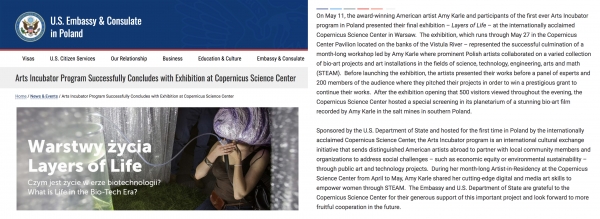
OPENING NIGHT: PRESENTATIONS & PANEL REVIEW
The opening night was May 11, 2018. The evening kicked off with presentations from each group, who presented their projects and competed for funding to continue the work before a 200+ member audience and esteemed panelists: Aleksandra Hirszfeld — philosopher, artist, curator, writer/journalist; Joanna Jeśman — Culture Expert, Professor, Researcher; Wiktor Gajewski — Director of Copernicus Science Centre, Dan Hastings — Cultural Attaché, US Embassy Warsaw; and Amy Karle — Bioartist, Artist in Residence at Copernicus Science Centre, American Arts Incubator Exchange Artist, and teacher/faciliator for American Arts Incubator — Poland “Layers of Life” workshop class.
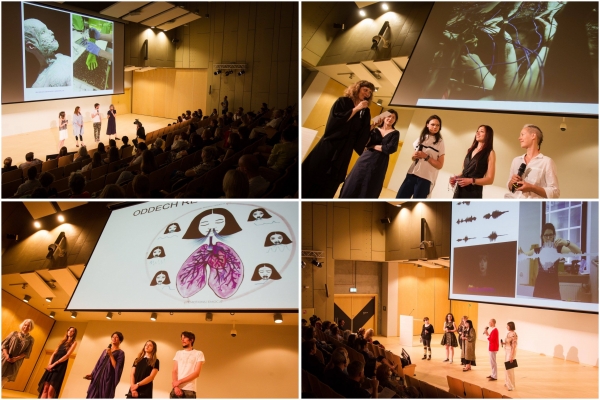
American Arts Incubator — Poland participants present their projects on May 11, 2018 at Copernicus Science Centre, Warsaw. Photos by Centrum Nauki Kopernik.
The pitches and projects were impressive and well-conceived in their creation and presentation. The judges asked poignant questions and gave great feedback! In the end, we determined all of the projects were so strong that the sustainability award funding would be divided equally amongst all groups so that they could all continue to pursue their great work. Thank you to our panelists for intriguing questions and thoughtful feedback, and thank you to the participants for your thoughtful and inspiring work!

Panelists Wiktor Gajewski, Dan Hastings, Aleksandra Hirszfeld and Joanna Jeśman (left to right). Photo by Centrum Nauki Kopernik.
OPENING NIGHT: EXHIBITION
The opening of the exhibition “Layers of Life: What is Life in the Bio-Tech Era” at the Copernicus Center Pavilion overlooking the Vistula River was a celebration of the learnings, advancements, and achievement, and shared the projects which were a collection of art installations and bio-art projects in the fields of science, technology, engineering, arts and math (STEAM). The show and the event was a huge success! Over 500 attendees visited the exhibition throughout the evening.

Snapshots from the opening night of “Layers of Life” exhibition. Photos by Grain Films and Amy Karle. For more information on the projects, see below. For more photos or larger size, visit American Arts Incubator - Poland group on Facebook and visit the Layers of Life Exhibition album.
At the end of the night, The "Heavens of Copernicus" Planetarium at Copernicus Science Center hosted a special screening of a film by Artist Amy Karle recorded primarily from her work in the salt mines in southern Poland and under the microscope in the biolab at Copernicus.

Heavens of Copernicus Planetarium at Copernicus Science Centre. Photo by Centrum Nauki Kopernik.

Artist Amy Karle's artwork in the Heavens of Copernicus Planetarium at Copernicus Science Centre Warsaw. Photos by CNK (l), Grain Films (center), Amy Karle (rt).
PROJECTS
AMY KARLE
The point we are at in evolution is biology and technology merging. This can be destructive or empowering depending on how we use it. I explore how nature creates and how to use this mergence with technology to our benefit: to heal, enhance and empower us. My larger project as an artist studies what it means to be human. I use the body, art and design, science and exponential technology (including 3D printing, regenerative medicine / synthetic bio, AI, etc.) as mirrors to the self and mirrors to who we can become.

Artworks by Artist Amy Karle, more information on www.amykarle.com Photos by the Artist.
As American Arts Incubator Exchange Artist and Artist in Residence at Copernicus, I considered "Layers of Life" and how we form: biologically/socially/emotionally/spiritually — on all levels, while questioning, “What is life in the bio-tech era?” I wanted to transcend these layers — from the micro to the macro, from the individual to the social, from the internal to the external, from the depths of the earth to the sky, space, and beyond.
I conducted research in the labs at Copernicus Science Centre and in two UNESCO heritage sites: the Wieliczka and Bochnia Royal Salt Mines; in one of the deepest parts of the earth accessible to humans (in Bochnia), and studied concepts of space at Copernicus. I also researched how nature forms and grows: in this case, the natural additive manufacturing (natural 3D printing) of salt water/brine and crystallization. I considered salt as a vital, life-sustaining element in our bodies and of our earth, and learned about theories surrounding the origins of life, which astrobiologists propose may have began with salt.


Amy Karle and Stanislaw Loboziak in the BioLab at Copernicus Science Centre. Photos by Grain Films.


Amy Karle researching salt and mining at Wieliczka (top) & Bochina (bottom) Royal Salt Mines in Poland; on a boat tour through one of the deepest parts of the mine in Bochnia. Photos/video stills by Grain Films.
While the participants were researching and creating their work, I was also creating my work, collaborating with other disciplines and institutions in the similar artist residency and incubator style as the workshop participants. Combining my research, influences and inspiration I created performance art, sculptures, prints and a planetarium show (film).
ARTISTIC RESEARCH in labs and mines conducted with the support of Copernicus Science Center Bio Lab, Stanisław Loboziak, Wieliczka and Bochnia Royal Salt Mines.
PRINTS Crystallization under various conditions under the microscope. Created in the Biolab at Copernicus Science Center with support from Stanisław Łoboziak:

Images by Amy Karle, 2018 with support from Stanisław Łoboziak.
PERFORMANCE ART in Wieliczka Salt Mine. Film by Grain Films, software by Aaron Thomen, with support and sponsorship by Wieliczka Salt Mine.
SCULPTURE on the origins of life in salt and water. Considering the role of salts in our bodies, earth and universe; how nature forms and grows; and women's empowerment, these works are 3D printed sculptures with natural additive manufacturing crystal growth. “Crystal Copernicus” is a large scale sculpture made with generous sponsorship by Titanic Design and support from Benjamin Julian.


Above: Sculptures by Amy Karle, 2018. Photos by Grain Films and Amy Karle.

“Crystal Copernicus” by Amy Karle and Benjamin Julian, 2018. Nade with generous sponsorship by Titanic Design, installed in The Pavillion at Copernicus Science Centre on the Vistula River. Warsaw, Poland. Photos by Amy Karle.
PLANETARIUM SHOW artistic video and sound art in Planetarium exhibition created with Grain Films (Maciej Przemysław Wróbel, Kacper Bartczak, Adam Woropiński, Piotr Wilhelmi), Copernicus Planetarium Team (Weronika Śliwa, Mateusz Borkowicz, Paulina Majda) and Copernicus Bio Lab / Stanisław Loboziak.


 Film and Photos by Amy Karle, Grain Films at Centrum Nauki Kopernik.
See more images of Amy Karle’s artwork made while American Arts Incubator Exchange artist in the Facebook album Amy Karle's Artwork and on her website, Instagram, Facebook, and Twitter.
A very special thank you to: Bureau of Educational and Cultural Affairs — U.S. Department of State's , ZERO1, U.S. Embassy in Warsaw, Centrum Nauki Kopernik, Kopalnia Soli "Wieliczka", Kopalnia Soli "Bochnia" Planetarium Niebo Kopernika, Titanic Design: Rapid 3D Printing, Grain Films, and all those without whose generous support this project would not be possible.
PULSE TRANSLATOR
Maria Dębińska, Vena Naskręcka, Beata Seweryn, Urszula Skiepko, Patrycja Stefanek
Programming: Piotr Paweł Adamczyk, Mateusz Janik
Aggregation of biological data extracted from our bodies is a fact. Our virtual identities are being turned into a resource. The body, which used to be the source of power/life/vitality, is being turned into a generator of data, which is then used in ways that we often find mysterious. Global corporations know us better than our partners, families, and friends — better than we know ourselves.
Is escapism the only alternative to being a passive data provider? Can this situation be seen not only as a threat but also an opportunity? Can our interference with the digital data collection systems create a new space for social change?
Empowerment does not happen in the process of alienation but consolidation. Together we become strong. We believe in collective intelligence and cooperation between humans and technology. The installation “Pulse Translator” proposes a tool that transforms biological data and uses them to generate a new message.


Pulse Translator, 2018. Photos by Amy Karle.
 Pulse Translator, 2018. Photo by Grain Films.
PULSE TRANSLATOR collaborators would like to give special thanks to: Copernicus Science Centre, AAI, Amy Karle, Piotr Gołąbek, Piotr Pobłocki, Dagmara Kiradze, Mateusz Pawełczuk, Jacek Rosiński, Monika Urbaniak, and Kinga Szymańska. Created in cooperation with FabLab powered by Orange.
BREATH OF LIFE
Dobrawa Borkała, Sara Kasprzyk, Dorota Kruszyńska, Stanisław Łoboziak, Agnieszka Sadurska
The Breath of Life is a prototype of a chamber with an oxygen reactor that intensively produces oxygen by water plants. The lung cleansing ritual is based on aquatic plants: cabbage and Canadian urea, which, thanks to their ability to carry out an intensive photosynthesis process, provide continuous oxygen production.
The project is a response to the growing problem of air pollution and everyday stress. We live fast on a day-to-day basis and do not think about processes such as photosynthesis carried out by plants to obtain oxygen which is essential for our lives. We are building roads, factories and many others structures, leading to the destruction of more and more plant species, resulting in the development of many civilizational diseases.
The chamber allows us to perceive with the naked eye this invisible-essential life function thanks to the oxygen bubbles produced by plants. The project shows in a physical way the process of photosynthesis and how important their preservation is to our survival.
Additionally, the chamber is a place where you can calm down and regenerate your lungs using conscious breathing. The high oxygen content has a positive effect on brain activity, which is the added value of the project. This experience is accompanied by breathing instructions to optimize body oxygenation and relaxation. Why is this so important? Because for most people stress is a factor that blocks them from developing their competencies. We can control this by breathing!
Breath is a powerful tool to regulate our mind and emotions. To enhance the experience, we’ve created a light and sound structure on the head to visualize the rhythm of breathing (by changing the color of the lights in coordination with the inhale and the exhale) with a mask through which air is taken in during breathing, saturated with oxygen from the reactor. Vases with water plants are live bioreactors that can filter air on the industrial scale and convert carbon dioxide into oxygen.

A visitor immerses themselves in Breath of Life, 2018. Photo by Grain Films.
 Breath of Life installation. Photo by Centrum Nauki Kopernik.
 Breath of Life, 2018. Overview of installation and details. Photos by Amy Karle and Breath of Life.
"Dobrawa Borkała "Ćwiczenia oddechowe","Breathing Exercises" by Agi Sadurska. Film accompanying "Breath of Life."
BREATH OF LIFE collaborators would like to give special thanks to: Copernicus Science Centre, AAI, Amy Karle, FabLab powered by Orange and Bartosz Andrzejczak.
CHLOROBODY / PLANTENSTEIN
Nika Danielska, Pola Demianiuk, Stanisław Łoboziak, Karolina Sulich
Recent scientific discoveries are turning our attention towards the ability of plants and animals to perform photosynthesis, a process which until recently been attributed only to the plant kingdom. In our project, we ask questions and speculate about the possibility of using this mechanism. We travel to the future where plant-based tissue garments with chloroplasts and printable chloroplast tattoos can give us an extra shot of energy. The costume is accompanied by an installation showing the process of immobilizing algae Scenedesmus obliquus and closing them in alginate spheres. We were inspired by symbiotic relationships between plants and animals.

 Chlorobody garment by Nika Danielska and Pola Demianiuk. Photo by Grain Films / Kacper Bartczak.
 Immobilizing Scenedesmus obliquus algae in alginate spheres by Stanisław Łoboziak. Photo by Grain Films.
"The Breath of Life", "Oddech życia" by Agi Sadurska. Film accompanying Chlorobody / Plantenstein and sister project Breath of Life.
 Plantenstein by Karolina Sulich. Photo by Amy Karle.
CHLOROBODY / PLANTENSTEIN collaborators would like to give special thanks to: Copernicus Science Center, AAI, Amy Karle, Piotr Gołąbek i Piotr Pobłocki from Fab Lab powered by Orange.
P.D.
Stanisław Łoboziak, Karolina Sulich
We are currently able to culture only 1% of our microbiome in laboratory conditions. It is 2 kg of our body weight and affects our health and well-being. We were inspired to build a Petri dish that is 60 times bigger than the standard size, where we gathered microorganisms living on our workshop group cell phones.
Here, we can observe their mutual interactions, which also take place when we shake each others hands, kiss another person, or move through the world. It is a visualization of the world that is not accessible to us because we can not perceive it with the naked eye. Moreover, we usually relate bacteria to being sick, whereas only a small fraction of them are pathogenic. Most of them collaborate with us, protect our organisms, and drive life on our planet. Our microbiome is our unique biological imprint.


 P.D., 2018. Photos by Grain Films and Amy Karle.
P.D. would like to give special thanks to: Copernicus Science Center, AAI, Amy Karle, Piotr Gołąbek i Piotr Pobłocki from Fab lab, Kuba Stańczyk from “Dobry Plan," and company Plexipol.
LAYERS OF EMOTIONS
Beata Jagoda Starek, Małgorzata Marczewska, Marta Mastalerska, Karolina Rospondek, Ula Jarecka, Marcin Steczkowski
How does our mind process emotions and how does our body use them? Could visualizing our emotional processes make it easier for people to express their feelings and understand the feelings of other people? How would our body and our society work if knowledge of emotions was more common? Would we be healthier if we knew how positive emotions are formed?
We want to show the unnoticeable, a layer that connects all the people in the world, and help them create beautiful and wise things. We want our recipients to see, hear, and experience by themselves the way emotions work, what they are used for, and how to use them. We want to encourage scientists to study emotions.
Our goal is to create the Pavilion of Emotions, a place that will fill our educational gap and help us gain knowledge around emotions, making it easier for us to make good and wise choices. The Pavilion will be a place of education, inspiration, and stimulation of our imaginations, where people will be invited to explore how important emotions are in our lives. At the exhibition, you will see a model of the Pavilion that symbolizes the mission of our project.
We used the model of Paul Ekman, which describes the six basic emotions that account for all the richness in our emotional lives. Our project’s main characters are Sorrow, Anger, Fear, Disgust, Enjoyment, and Surprise.
We have created an artistic visualization of sound waves accompanying words that describe our feelings and molecules of chemical compounds that co-create emotional states in our brain: dopamine — whose deficiency causes sadness, adrenaline — released by anger, noradrenaline — a fear-related compound, histamine — related to disgust, serotonin — a neurotransmitter associated with joy, and acetylcholine — which triggers surprise.
We have also designed a new Molecule of Empowerment. Who knows, maybe soon it will turn out that there is a molecule in our bodies that brings out the best in us?
The project also features a Dictionary of Indeterminate States – an educational game that encourages people to reflect on how the expression of feelings is culture-related.

Architectural model of Pavilion of Emotions by Marta Mastalerska in cooperation with Fab Lab powered by Orange. Photo by Centrum Nauki Kopernik.
Emocje, 2018. Film by Marcin Steczkowski and Layers of Emotions. Presented as part of the Layers of Emotions Installation.

 Installation representing molecules. Photos by Amy Karle and Grain Films.
Follow and learn more about LAYERS OF EMOTIONS at www.facebook.com/layersofemotions or www.facebook.com/niedookreslone
LAYERS OF EMOTIONS was created in cooperation with FabLab powered by Orange with special thanks to: Copernicus Science Center, AAI, Amy Karle.
INTROVERTOMIN AIR FILTER
A PROTOTYPICAL FRAGMENT OF INSTALLATION
Jan Dowgiałło and Nawojka Gurczyńska
Inwertomin is a visual representation of air monitoring stations. It encourages you to stop, breathe in fresh, pleasantly cold, and clean air, and to reflect on the problem of air pollution in the city.
Inwertomin is based on the concept of a reversion of the traditional chimney. Instead of spitting out hot fumes, it absorbs polluted air from above and releases it cleaned through the bottom side. The device's functional base is a cooling and moisturizing installation which moves the air inside downwards. One of the solutions we considered in order to achieve this effect is using a cooling substance in Inwertomin's external layer. Inwertomin's core consists of air filters inspired by coral reefs and moss. Their structure enables airflow within large surfaces. The pollution gathering on the filters causes Inwertomin to change its color from white to brownish-grey. The Inwertomin transforms itself gradually according to the airflow — it becomes dirty at the top and remains clean at the bottom. It acts as a warning totem visualizing the degree of air pollution.
 Inwertomin installation at "Layers of Life" Exhibition. Photo by Amy Karle.
 Inwertomin, 2018. Photo by Grain Films.
*Descriptions on the projects above were provided by each team.
These projects were produced as part of American Arts Incubator, an initiative of the U.S. Department of State's Bureau of Educational and Cultural Affairs and is administered by ZERO1. The incubator in Poland was produced in collaboration with U.S. Embassy Warsaw and the Copernicus Science Centre.
As an American Arts Incubator exchange artist, Artist Amy Karle’s task was to focus on public diplomacy and social innovation to empower women in STEAM in Warsaw, Poland. She led workshops and field trips, taught new media art skills, encouraged collaboration, and facilitated and supported teams to create community projects using art and technology to address social challenges in the model of a hybrid artist residency and Silicon Valley type incubator. The workshop concluded with the presentations, a panel review, small grants funding, and the public exhibition discussed above.
Follow the conversation, get updates and inspiration at American Arts Incubator — Poland Facebook group at: https://www.facebook.com/groups/361402877645612/

Visitors await entry to "Layers of Life" exhibition at Copernicus Science Centre's Pavilion 512 gallery on the Vistula River on May 11, 2018. Warsaw, Poland. Photo by Amy Karle.
I am so proud, again, of all the participants as individuals and as teams. There are a few other notable teams that were crucial in realizing these project work: ZERO1, L’Uzine, and the American Consulate in Casablanca.
I want to thank them for their help in supporting the program from start to finish and for inspiring the project that I am currently wrapping up as part of my exchange. This was a team effort.
---
In particular, the energy and excitement of L'Uzine have been my muses for this project.
The same line repeats in every iteration of the project proposal leading up to my departure to Morocco, “My personal project will be an architectural scaffolding for the participant projects…” Familiar neither with the organization nor with the participants, I imagined I would build a structure or design a space that could host each of the participant project prototypes.
But over the course of the workshops and as the participant projects developed, I realized that this scaffolding already existed; every day, the flurry of events and excitement, the rhythms of dance and meditative motions of textile design, the focus of the camera lens, the reverberations and translations of music, the flittering of fabrics, the echoes of philosophical conversations, and the fun that moved across, up and down, and around the building of L’Uzine.
Raucous laughter and decisive actions emanate from the 1.5th-floor administrative offices. Delicious smells waft up the stairs from the kitchen where Fantom and Fatima prepare a meal for the staff and visitors to eat together, pausing between energetic spurts of technical management, deconstruction, shopping, posting, meetings, and, of course, answering seemingly incessant questions from guest program coordinators, like me.
Zineb Haddaji’s responsive, positive, and witty perspective kept the program and the projects moving within and beyond office hours. Maria Daif’s infectious enthusiasm gave context to the projects. The care with which Nadir Houboub considered each shot, sequence, and composition and the poetry of each image by Ahlam Maroon represented our program so eloquently. Hamza Lyoubi's even and careful timing and articulation, and Abdessamad Bourhim’s intense and speedy technical execution bolstered our work. The workshops and exhibits also would not have been the same without Dounia Jawhar's calming presence, Sabrine Hakim's insightful questions, Abdessamad Noudirate's energy and resourcefulness, and Kristi Jones’s indispensable insight and support. And, last but not least, Fouad was always ready to open a door.

Some of the amazing L'Uzine staff helping with the exhibition. Zineb Haddaji, Abdessamad Nouidrate and Ahlam Maroon, Dounia Jawhar, Nadir Houboub, and Maria Daif. Photos and stills from videos by Nadir Houboub; photo of Nadir by Abdemassad Nouidrate.
The concept for my project came from the recognition that L’Uzine — as a building and organization — is a scaffolding that can and does support not only prototypes but ongoing work on the critical questions and concerns expressed and explored by the participant projects. L’Uzine’s heart and muscle are already doing the inspiring work of community building, recognition, and representation. Its body is filled with diverse projects and programs that display, disclose, and question.
L’Uzine’s building is not only a center of culture, it is also a cultural puzzle. It is a place where mega-cultures, mass-cultures, and sub-cultures connect, coincide, collide, and fuse together. Its spaces are allocated to music, dance, theater, performance, photography, painting, and design, and its circulation spaces host encounters among artists. The cultural puzzle re-imagines the way the building is subdivided — grouping spaces to create variegated cultural portraits through a diversity of disciplines and sensory stimuli.

L'Uzine as A Cultural Puzzle by Dasha Ortenberg.
This is a curatorial concept:
Three puzzle pieces represent the heart and muscle — L'Uzine's staff — the Heart, the Arm, and the Spine.
Five puzzle pieces represent cultural exhibitions, inspired by the Rhetorical City participant projects: each one uses a collection of sensory spaces to immerse visitors in a sub-culture — each organ perceiving, processing, and interpreting different aspects of the exhibit.

3D-printed L'Uzine puzzle pieces by Dasha Ortenberg.
Meanwhile, the Cultural Canvas & Composites concepts are a fusion of the American Arts Incubator model and some of the incredible work that is already underway at L’Uzine.
AAI bolsters the growth of artists through the development of art projects addressing questions of community, technology, and entrepreneurship. Shamsher Virk and Maya Holm provided an incredible foundation, and go above and beyond in coordination to support this process. And the Department of State and American Consulate were so generous in their support of the program and participation in its exhibition event — especially Stephanie Jensby, Salma Benbouia, and the Consul General, Jennifer Rasamimanana.
Artists explore and grow at L’Uzine — some participate in workshops and projects for fun, some become employees of the organization, and some become recognized city-wide, nationally, and internationally for their craft.
The Cultural Canvas & Composites concepts underscore the role that L’Uzine already plays as an incubator by providing concepts for small and large, singular and serial, physical and digital interventions.

L'Uzine Casa Earth Proposal by Dasha Ortenberg.
I want to return for a moment to the basis of this project — asking questions about empowerment through mapping and data collection and representation. Among the great concerns with power, data, and mapping are disempowerment, misrepresentation, and obfuscation, respectively. However, perhaps if we understand the systems by which these are constructed, we can become not only critics of but also activists within them, transforming the criticality that sometimes seems external to societal structures into something that is intrinsic and inherent to societal growth and development.
Perhaps social entrepreneurship is an exquisite product of opportunities for open self-expression and public conversations about convictions. And, finally, perhaps this constructive-criticism-turned-social-entrepreneurship is a form of love that can ultimately make a positive impact on our families, friends, neighbors, and communities.
---
I can't wait to see what forms the AAI participant projects take as they develop in the future and to see what configurations L'Uzine might take as it continues to do its incredible work
(L) Wall-sized aerial of Casablanca for L'Uzine, (R) Dounia Jawhar, Ahlam Maroon, and Zineb Haddaji make a portrait using a vinyl cutter. Photos by Dasha Ortenberg.

Composite photograph of L'Uzine by Dasha Ortenberg.
We are more than halfway into American Arts Incubator — Poland, and it has been an amazing journey witnessing our growth, development, and empowerment of participants and myself through the “Layers of Life” workshop.
Layers of Life // First Day from Amy Karle. Video by Grain Films.
Each exchange focuses on a social challenge unique to that country. The social challenge for my exchange focuses on women’s empowerment in STEAM. Before I went to Poland I started asking my family, friends, and colleagues what “empowerment” means to them. It is unique to everyone and a very interesting question to ask. I was impressed by the answers that I was given, it revealed so much about each person and opened my mind as well.
When I got to Poland, I started asking the same question — and quickly learned there is no word for “empowerment” in Polish. So, from the beginning of the workshop we consistently explored what “empowerment” means to each of us, and collectively, how we could explore and express it in theory, practice, our work and our everyday lives. We are still exploring this as we prepare our projects for the upcoming exhibition and pitch/panel review.

Exhibition and panel schedule — come join us for the event! Crystal photography by Amy Karle; image courtesy of Copernicus Science Centre.
Once we brought the concept of empowerment into our awareness, it quickly became evident that considering empowerment — how we can be empowered, how we can empower others, how we can make a situation empowering, etc. — is a very powerful lens to look through and can bring about positive change very quickly.
We found the spirit of empowerment is from within and also in support from and for others to enable and empower each other. It's diverse, and unique to all of us.
From within, we have been finding new skills in ourselves as well as inner strengths to try new things with boldness and courage.
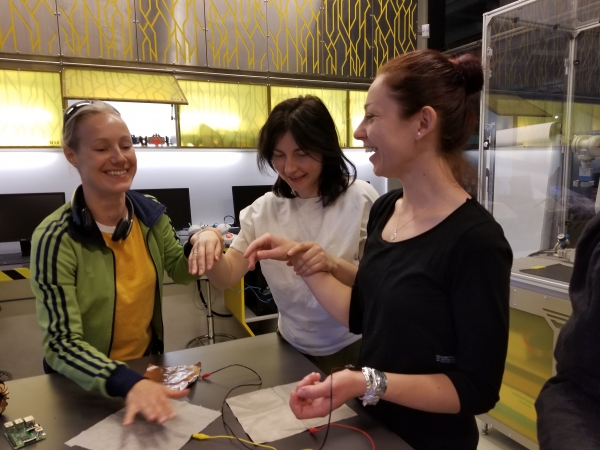
AAI — Poland participants in project development. Photo by Amy Karle.
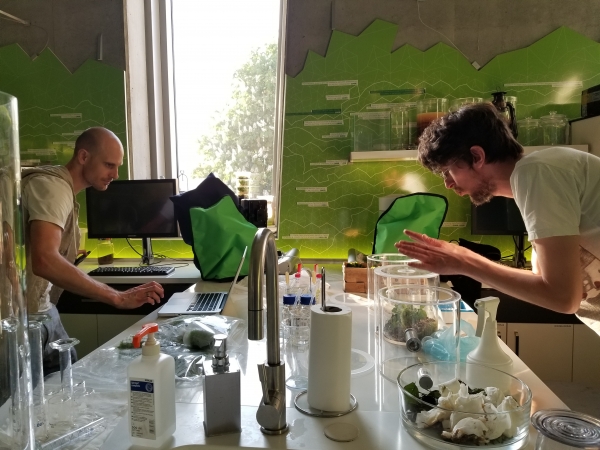
Marcin and Stanislaw in project development. Photo by Amy Karle.

Malgorzata with her prototype. Photo by Amy Karle.
For many participants, it's the first time working with digital manufacturing and fabrication technologies, working in diverse groups (with artists, scientists, theorists), collaborating across disciplines to make projects, as well as presenting, pitching, and exhibiting.
For me too, this was my first time leading a workshop. From the very first day of leading this workshop, it became apparent that empowerment to me is creating the space for others to make their best work, and ultimately to be their best selves. Reflecting on my role in this workshop has taught me the value of this position from the very beginning and I have done my best to come from this place while facilitating participants and their projects to grow... and do my best to set a great example working alongside them.
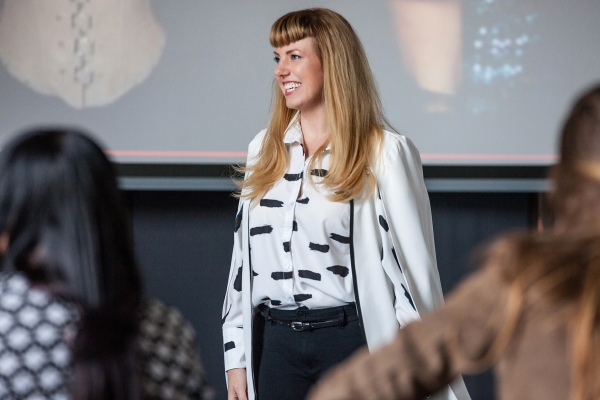
Artist Amy Karle leading "Layers of Life" workshop. Photo by Grain Films.
There was a lot to learn and a lot to accomplish in a short time… it's only been two weeks and there has been an astonishing amount of achievement. Although the participants demonstrated a great deal of talent coming into the program, they had to learn to work together and to use new tools — to teach each other, find empowerment in themselves, and empower others.
Not only were new skills and tools learned, new projects were made, presentations were created, and participants worked together incubator-style — preparing budgets and timelines to receive grants and funding. Participants collaborated across long distances and prepared group projects for an exhibition and panel review over a national holiday where much was closed. When I look at all that has been done, I look back in awe and amazement.
As the work from the exhibition and panel review comes out, I hope you can see the astounding conceptual development, execution, scope, and refinement of what was produced in such a short period of time — and see the projects both as they are and all that they achieved within this short timeframe — as well as the potential of what these projects and this work can become.
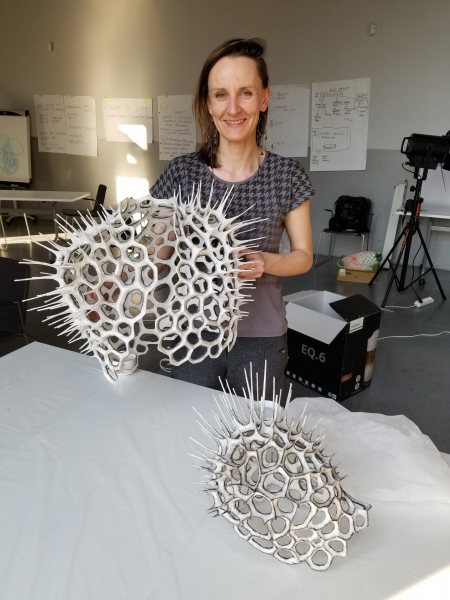
All smiles during prototyping. Photo by Amy Karle.
This brings us to the other part of empowerment — support from others. We truly couldn’t have done what or as much as we have without the people who supported, collaborated with, and empowered us. Cooperation, collaboration, support, inspiration… I don’t know if I could name exactly what it was that brought us to grow and achieve so much in such a short period of time, but something that the people and institutions who supported us did, and something we have been doing for each other enabled us and empowered us to make a quantum leap in our work and feel good about ourselves in the process.

Thank you for all of the support, FabLab powered by Orange (Warsaw)! Photo by Grain Films.

Thank you U.S. Embassy Warsaw for your support! Photo by Amy Karle.
Although we still can’t seem to agree on the right word for “empowerment” or what exactly it means... I believe I can say on behalf of the workshop that we are thankful and deeply appreciative to all those that opened the space for us to dream big and fulfill our potential — we hope that in doing this exchange and making these projects, we can continue to create visions, prototypes, projects, strategies, and practices that help shape a more resilient and empowered future for ourselves and others!

Artist Amy Karle at Copernicus Science Centre. Photo by Grain Films.
Learn more about our workshop and programming at:
- Layers of Life: American Arts Incubator and Amy Karle
- American Arts Incubator — Poland Facebook group
- American Artist and Copernicus Science Center Launch First Arts Incubator Program in Poland
It’s been an incredible month at IZOLYATSIA, and I can’t believe how far we’ve come! March 29th was the opening reception for Emergent Tributaries at IZONE, showcasing collaborative works from the community groups as well as myself. The name of the exhibition is in reference to the Dnipro River, which has historically played a central role in shaping the landscape and cities alongside it in Ukraine: as an ancient trade route for goods and supplies, a place for cultural exchange and gatherings, and a provider of energy through hydroelectricity.
I chose the Dnipro River as an entry point into this exhibition — as a meeting place of cultural exchange for a visiting artist and curator from America working at IZOLYATSIA, which is right on the riverbank. I also chose it metaphorically for its ecological network, which connects Ukraine through its many tributaries, as this exhibition has done the same for artists gathering from different parts of the country.
Now linked with digital technologies in a similarly networked fashion, Emergent Tributaries reimagines the present and future of Ukraine through the eyes of these artists and their collaborative new media works. Along the Dnipro riverbanks as well as in other physical and digital spaces, they have refigured cultural identity, personal identity, and our relationship to ecological systems, technologies, our bodies, and the spaces our bodies inhabit through speculative design and design fiction.

Exhibition vistors viewing The Waters Come Into my Soul. Photo by Iuļiia Rubļevska.
There were four main collaborative projects in the exhibition:
The Waters Come Into My Soul examines water pollution in Ukraine, particularly along the Dnipro River. The industrial run-off and overabundance of phosphorus, nitrogen, and phosphates causes active reproduction of cyanobacteria that spurs the "Dnipro blossoming" phenomenon, which negatively affects the flora and fauna of the river as well as the physical and psychological state of the people living nearby. The group investigated this phenomenon through digital textile prints, algorithmic video, projection, 3D prints, microscopy video, and sound.
The Waters group: Julia Beliaeva, Elena Klochko, Bogdan Moroz, Anna Prokopets (Umka Estebanovna), Iryna Proskurina, Alla Sorochan, Olga Tereshchenko, Oksana Chepelyk

Video projection and 3D prints in The Waters Come Into My Soul. Photo by Iuļiia Rubļevska.

Full installation of The Waters Come Into My Soul. Photo by Iuļiia Rubļevska.
Island Ї is a speculative floating artificial island on the Dnipro River. It is an open university and a scientific laboratory — a platform for artistic and scientific projects. Island Ї is a rhizome of diverse ideas, styles, and decisions that represent the diversity of Ukrainian identity. It combines harmoniously what seems like an insoluble contradiction: an academy of sciences, an erotic education center, self-regulating sails, and architecture with biomimetic forms achieved through futuristic technology of adaptive and regenerative growth.
Island Ї moves freely along all the rivers of Ukraine, to all the cities and remote towns and villages, influencing people and changing society through forms of nonlinear and horizontal interaction.
Mincult group: Yurii Efranov, Elena Klochko, Yaroslav Kostenko, Anastasiia Loyko, Mykhailo Rozanov Kateryna Shyman, Krolikowski Art

Island Ї at opening exhibition. Photo by Iuļiia Rubļevska.

Island Ї full installation. Photo by Iuļiia Rubļevska.
Session Room involves ASMR and Ukrainian identity, focusing on the lack of boundaries between public and private space. This project features a zoned, partially enclosed space in which the viewer can feel solitude and simultaneously experiment with various tactile and auditory elements including 3D video portraits of the artists and their voices.
MEDITATOR group: Alina Borysova, Anna Kakhiani, Anna Korniets, Irina Kostyshyna, Alyona Mamay, Oleksandr Manukyans, Hanna Shumskam, Oleksiy Yaloveha

Tiare Ribeaux with Session Room members in their installation. Photo by Iuļiia Rubļevska.

Exhibition visitor viewing Session Room. Photo by Iuļiia Rubļevska.
Spidertopia explores a theoretical renaissance of Ukrainian identity free from territorial invasions. Using the language of traditional “pavuk" or "spiders,” module-like elements of Ukrainian home decor which pre-dates Christianity, the project applies it to a utopian world. But within that high-tech world, we notice something strange… Spidertopia highlights a peculiar Ukrainian attitude on the verge of comedy, tragedy, and irony that has seemed to persist. It is an exercise in self-observation: times are changing, but do we change with them?
SPIDERTOPIA group: Ivanka Borodina, Olha Vashchevska, Serhii Nizhynskyi, Maria Proshkowska, Bogdan Seredyak, Olga Synyakevych
.jpg)
Exhibition visitors viewing Spidertopia. Photo by Iuļiia Rubļevska.

Spidertopia. Photo courtesy of IZOLYATSIA.
For my personal project, I focused on the “Dnipro Blossoming” phenomenon. I wanted to explore material transformation through the lens of the Dnipro, and created intimate portraits of the river in acrylic, transferring its boundaries to become a central focus to address this topic, layering and juxtaposing man-made tributaries with ancient and natural flows.
Using a water battery with polluted water from the Dnipro and speculative algal bioreactors, I consider converting cyanobacteria and polluted water in the Dnipro into energy; in this case, for illumination. A reframing of the river helps us to reconsider our impact on it and future methods of harmonious collaboration with it, other ecologies, and non-human species.

Tiare Ribeaux discussing her project at the opening exhibition. Photo by Iuļiia Rubļevska.

Full Installation of Tiare Ribeaux's project. Photo courtesy of IZOLYATSIA.
Another project I did in collaboration with participants and my partner Donald Hanson was ARUA.xyz, an augmented map containing digital sculptural works by multiple Ukrainian artists featured in this exhibition. It is an online browser-based project, and also an intervention of space, a rewriting of present geographies, a disruption of physical and digital borders, and an intentional positioning of new cultural digital monuments throughout Ukraine.
For this exhibition, these virtual sculptures can be seen in the gallery, but they can also been seen at different mapped locations via smart devices. My hope is that ARUA.xyz will live beyond this exhibition to include additional works by other artists from Ukraine.

AAI participants viewing ARUA.xyz. Photo by Iuļiia Rubļevska.
Over 200 people attended the opening exhibition and the showcase lasted two weeks. Following the opening, we had a panel review where all the groups presented their work and their future plans to evolve their projects over time. Arts and culture professionals from Kyiv gave critical feedback on all of the works and helped teams formulate actionable plans for their development and expansion into other communities.

Crowd at the opening exhibition for Emergent Tributaries. Photo by Iuļiia Rubļevska.
It's been an intense and transformative month — I had no idea what we would make together when I arrived in Kyiv, but I couldn't have imagined a more tremendous outcome. I am so proud of all of the beautifully crafted and meaningful works made by everyone in this program, and feel blessed to have met so many wonderful people during this time, and to have made so many new friends.
I am immensely greatful for the experience I had in Ukraine with IZOLYATSIA and with all of the talented artists I got to work alongside. I learned so much, and feel my perspectives on artmaking, teaching, and collaboration have really shifted during this time. I truly hope for more international opportunities to teach and work with communities as it really fosters true cultural exchange and dialogue.
I plan to continue my work with the Dnipro River, which has now grown into a collaboration with three of the AAI participants, and my plan is to return to Ukraine in July to develop this project further. I am sure all of these projects and connections incubated through AAI will continue to grow in the months to come, and three of the projects already have potential future showcases and exhibitions on the horizon later this year.

Tiare Ribeaux's ongoing collaborative project with Krolikowski Art about the Dnipro River. Photo by Alexander Krolikowski.
American Arts Incubator is an initiative of the U.S. Department of State's Bureau of Educational and Cultural Affairs and is administered by ZERO1. The incubator in Ukraine is produced in collaboration with the U.S. Embassy in Kyiv and IZOLYATSIA. Platform for Cultural Initiatives.
Arriving in Ecuador during the time of corn harvest, I was deeply impressed by the magnificent cornfields. I envision that was what parts of Manaháhtaan (precolonial Manhattan) used to look like. I also was delighted to learn that the companion-planting agricultural practice of the Three Sisters Garden (interplanting squash, corn and beans together to support each other) was also prevalent in Ecuador; another proof of shared knowledge across ancient Americas.

Endless corn fields in Peguche, Imbabura, Ecuador. Photo by Beatrice Glow.
I also ate a lot of corn during the months of March and April. Between boiled, grilled, tostada, mote, and quimbolito, the best was my first humita prepared by Maria Edubijes Mendez de Jesús, aka the beloved Doña Mary. Mary, always beaming with the warmest smile, is an Afro-Ecuadorian grandmother who often works as the chef at Casa de Artes Yarina, my American Arts Incubator host partner organization. While I directed American Arts Incubator — Ecuador, I noticed that the feminine labor of Doña Mary, the woman who took care of our wellbeing, was often invisibilized. Her warmth, similar to that of Mother Earth, is often taken for granted.

The pambamesa prepared by Doña Mary during the panel review of American Arts Incubator — Ecuador's Open House on April 6, 2018. Photo (left) by Ana Cachimuel and photo (right) by Beatrice Glow.
In an interview, Mary expressed: “If I were to be an element of nature, I would be a medicinal plant." As I got to know her, Mary shared that she had endured a traumatic childhood and had singlehandedly raised three children. I also learned that she is a medicinal plant healer, political activist, community organizer, culture bearer of bomba music and dance, and is now becoming an authority of regional gastronomy.
For me, Mary represented not only the strength of pachamama (Mother Earth), but also the core lessons of resilience and survivorship that initially drew me to working within the context of Casa de Artes Yarina and Museo Viviente Otavalango’s past as the Antigua Fábrica San Pedro, a site of indigenous exploitation between the 1850s through 1970s.

Prototyping with medicinal plant cornsilk. Photos by Beatrice Glow.
In local marketplaces, I noticed that cornsilk, a potent herb to heal urinary tract and kidney infections, was tossed as trash. Thus, my counterpart Ana Cachimuel and Mary helped me procure cornsilk from market vendors and I braided them to frame a drawing I made of Mary adorned in medicinal plants she uses to heal people. The drawing was then activated with a video interview paired as an augmented reality feature.

Young friends from Colectivo Umama came to present the Mama Cuchara project during the panel review. Here they are posing with "Doña Mary" 2018, Beatrice Glow´s personal project. Photo by Ana Cachimuel.
In addition to weaving cornsilk to tell this story of resilience, as part of the 28-day incubator challenge, I introduced how to create augmented reality (AR) based experiences to amplify intergenerational and intercultural dialogues to address social inclusion. As we used digital art to reveal historical patterns of exploitation and intercultural strife, I was weary of replicating unbalanced power dynamics within our incubator. My participants were diverse in age and socio-economic status as well as cultural, professional, and racial backgrounds. We had heated conversations on racial and gender equity. We searched for alternative terms to social inclusion and questioned concepts such as, "who has the power to include/exclude?"

Don Rene Zambrano, president of the Cooperative of Museo Viviente Otavalango, and his brother Don Clemente Zambrano photographed with a mural that was developed from an oral history session with Yuyay in Casa Cruz of Museo Viviente Otavalango. Photo by L. Merinio Maldonado.
This process led to the formation of three community projects that each received small seed-grants to build project prototypes: Yuyay applies augmented reality to site-specific community murals, Mama Cuchara is an AR Spanish and Kichwa language book on medicinal plants, and Warmi Tukushka stages immersive theater with rural communities for a social tourism project in order to generate income for Indigenous communities.

Sharing the AR medicinal plant book with Kichwa languange sound elements to our Open House visitors. Photo by L. Merinio Maldonado.
There were limits on how much I, as an artist, facilitator, admin, PR and community manager, teacher, exhibition designer, and translator could contribute to a community. Despite running the program with minimal infrastructural support — internet was often nonexistent, rain seeped into our tech workshop spaces, and I nearly fainted due to sleep deprivation compounded by altitude sickness — what we had was strong community spirit and ingenious resourcefulness thanks to Ana Cachimuel, her family, as well as the participants. I also acknowledge the behind-the-scenes support of Maya Holm and Shamsher Virk of ZERO1. Each team put forth hardwork and met my tough love with grace.
American Arts Incubator — Ecuador, 2018. Videography by L. Merinio Maldonado; video editing by Editor Satélite.
As folks looked to me for leadership, I often thought of my cohort of AAI "artstronauts" who are all exploring how to adapt the art and tech incubator to a demanding foreign context. There is no formula as each incubator is different, and that is the beauty of the AAI program. I admit that I had moments of disillusionment as I became acquainted with local community politics. Randi randi (the kichwa expression for reciprocity, literally meaning give and take) was constantly preached to me as a core cultural value, yet it was not always practiced and at certain moments I was hollowed witnessing crude self-interest and nontransparent resource distribution. Yet, witnessing Mary's resilience, I knew that I had to exert myself and call out problematic circumstances. #CulturalDiplomacy.

Installation view of AAI — Ecuador's Open House. Photo by L. Merinio Maldonado.

Installation view of Umama's Mama Cuchara project where they temporarily created a medicinal plant garden for AAI — Ecuador's Open House. Photo by L. Merinio Maldonado.
The day of the panel review was truly a highlight! The community projects were beautifully installed into a cohesive exhibition in Casa Cruz of Museo Viviente Otavalango. Each group passionately delivered their pitches to the judges and the public consisted of many community members, elders, students, and even the executive director of the Fábrica Imbabura, Edgar Flores.
Rich exchanges and insightful critiques took place during the public presentations, and each community project received additional support in the forms of mentorship, invitations to local incubators, and possible funding opportunities. Several participants traveled to Arte Actual Flasco, a social science and humanities cultural center in Quito, to share our process with a wider audience and connect rural and urban dialogues. I was full of admiration for each team sharing their aspirations.

The community projects received constructive feedback from experts in education, culture and entrepreneurship including Magister Alicia Dolores Mina Minda from the Ministry of Education, Andrea Viteri from the US Embassy, Silvia Echeverría from Manhattan Neighborhood Network, Ricardo Haro Tinajero from the University of Otavalo, Alexis Haro from Ciudad Yachay, and Julio César Morán de la Torre from the Ministerio del Ambiente. Photo by L. Merinio Maldonado.

Incubator participants presenting their work to panelists. Photo by Beatrice Glow.

The panel review day for AAI — Ecuador's Open House held at Casa Cruz, Museo Viviente Otavalango. Photo by L. Merinio Maldonado.
I’ve been back in the U.S. for less than a week and am trying to prolong that enigmatic transition period between settling back into my New York City routine, digesting the lessons from my intensive incubator challenge, and brainstorming next steps for my incubator participants to really thrive for the long term.
I leave inspired that many people in rural Ecuador, despite living in poverty, are still on their ancestral land and can live off the produce yielded from their home gardens. Their food sovereignty gives me hope that a regenerative and cooperative economy is viable. I believe that my incubator participants still have the possibility to carve out a new economy centered on sustainable land-based practices with healthy communities who will continue to cultivate the resistant ancestral technology called corn, generation after generation.

Visiting the Ministry of Environmental Health to learn more about sustainable agro-products and local community-based entrepreneurial initiatives. Photo by L. Merinio Maldonado
The participants have worked so incredibly hard to create insightful and beautiful projects.

Clay animals on map from event by the Littorale group. Still from video by Amine Krafi, Loubna El Ghallab, and Taha Azale.
With impressive tenacity and efficiency in a short amount of time, participants have developed profound bodies of research into the critical issues that concern them — surveying their neighbors, leading workshops with children, interviewing students on a university campus, and talking to other artists about collaborative projects. In the process, we are also developing new friendships and relationships across art, technology, and culture.

The Zero4 group at work (L, Youssef Zaoui, R, Yasser Benhar). Photos by Nadir Houboub.
They planned and produced, explored and innovated, played and discovered. The projects are not yet complete. I hope that they will never be complete — they are so many potential paths to pursue! Some aspects of the projects will be furthered over the coming months, some tangents may be followed through the end of this year, others....we have yet to see!

Project experiments by Hybrid Gastronomies group. Hicham Choukri and Abdelilah Azergui. Photos by Dasha Ortenberg.
Some of these project futures were imagined during the course of the panel review, which was inspiring and exciting! We were honored by the presence of Jennifer Rasamimanana, the Consul General of the United States in Casablanca; Maria Daif, Director of L'Uzine; Kenza Amrouk, independent curator; Mohammed Fariji, L'Atelier de l'Observatoir; and Kristi Jones, consultant and curator. Each member of the panel represented different aspects of the program goals and I am so proud that their observations included positive and constructive comments on the structures of the presentations, the level of craft, and insight into societal questions of the projects.

The panel (L) and the presenters (R). Photos by Nadir Houboub.
After completing and presenting their initial research and another ideation session, participants formed project groups — some related to the previous research, some new.
The groups are collecting, creating, designing, iterating, revamping, and installing their projects with excitement and enthusiasm. I am continuously impressed with how brave they are in choosing strategies for engaging people in public spaces, representing their ideas, speaking candidly about their concerns, and embarking on learning new technologies in the process!
Our space at L'Uzine has become an epicenter of exploration as each group returns and shares new cultural and technological discoveries.

Project notes and sketches by Loubna El Ghallab, Abdelilah Azergui, and Youssef Zaoui. Photo by (L) Dasha Ortenberg and (C,R) Nadir Houboub.
After a survey introduction to new media techniques, individual participants have chosen different technologies to focus on as they develop group projects. With the help of FabLab Casablanca, they are using media such as laser cutting and Arduino sensor kits to build dynamic exhibits and online maps to include complex and thorough sets of information.
Le Littoral | Amine, Loubna, Taha

Revealing the institutional knowledge within a coastal bidonville through mapping the memory, knowledge, and skills of the community. Photos by (L) Dasha Ortenberg and (C,R) Nadir Houboub.
Hybrid Gastronomies | Abdelkarim, Sabrine, Abdelilah, Hicham

Addressing challenges of diversity and immigration by comparing ingredients in Moroccan and sub-Saharan cuisine and proposing a fusion dish. Photos by Dasha Ortenberg.
To Art or Not to Art | Jalila

Investigating challenges faced by performers in public spaces at the Place Nations Unis. Photos by (L) Dasha Ortenberg and (C,R) Jalila El Achaari.
ReZero4izer le Zero4 | Youssef and Yasser

Letting a neighborhood's creativity shine despite its negative reputation using mapping and a valise of samples. Photos by (L) Dasha Ortenberg and (R) Nadir Houboub.
Even as these projects are in progress, there is so much excitement and support here at L'Uzine to find and provide tools and help participants realize their work! The energy is palpable and the potential is boundless. I can't wait to see what comes of these concepts, which are so beautiful both in their aesthetics and in their social innovation!

Hard at work. Photo by Dasha Ortenberg.
I am so thrilled to work with this incredible cohort: a group of philosophers and artists with a wide range of artistic and technical talents with passions that include history and memory, environmental causes and science, as well as social justice and art. There is no way I could have ever predicted how amazing the participants in this program would be. I am blown away daily by their commitment, inquisitiveness, and nuanced approaches to the profound questions that move them. Through them, I am seeing Casablanca.
---
The departure point of our studies is the idea that sensory and spatial mapping are interpretations and projections.
A space represented by a void is not necessarily empty.
A space replete with information is not necessarily accurate.
Information can be left out.
Information can be filled in.
Working definitions:
DATA: quantifiable information
MAP: data interpreted through space
EMPOWERMENT: knowing how generate to data to create maps that represent one’s own opinions, convictions, or knowledge.
Vast quantities of data are generated each second as we function in our digital environments. Patterns are found in this data and mapped according to preset priorities. In Rhetorical City, we look into what happens when we define the data we generate and choose the priorities by which data is analyzed.

Left: Abdelillah Azergui pixelates an image based on preference; Center: Abderrazzak Elamim reconstructs his portrait; Right: Jalila El Achaariweeds her portrait from the paper. L/C photos by Nadir Houboub; R photo by Dasha Ortenberg.
In conversation with our tools, we choose how to deconstruct and reconstruct information, including information and images of ourselves. Using bristol paper and vinyl cutting machines, participants created layered, three-dimensional portraits of themselves. In converting their pixel-based portraits into vectors, the participants chose the level of resolution of their portraits. In a more abstract version of the exercise, Abdelilah selected very large-scale pixels of an image based on parts he liked or didn't like rather than based on color or tone. The product is a mask for the image that reveals or conceals personal preference.
To put these tools and processes into context, we looked at a survey of digital fabrication technologies and visited FabLab Casablanca to see some of them in action!

FabLab Casablanca hosts Rhetorical City. Photo by Dasha Ortenberg.
We discussed the reciprocal cycles of interpretation between ourselves and our tools — be they hand or digital drawing, an X-Acto knife, a vinyl cutter, a laser cutter, or a CNC router.
As pattern-finders and interpreters, how do individuals perceive, translate, and analyze?

The final stage of synesthetic exquisite corpse — texture by participants. Photo by Nadir Houboub.
To engage our bodies in the construction and relation of meaning, we started the program with a game of synesthetic exquisite corpse: by sharing sensory experiences collected throughout L'Uzine with one another, the participants created interpretive sequences, which then led to conversations about how we structure meaning and information through the creation and comparison of categories.

Youssef Zaoui and Abdellah Hassak discuss relationships and connections among their interpretations of sensory objects. Photo by Sabrine El Moutaouakkil.
How do we create categories? How do we structure knowledge? How do we recognize the subjective in the process of categorization and how do we allow this recognition to liberate us from the pre-judgements and perceptions we have inherited? How do we display and validate our interpretations in relation to other interpretive systems that exist?
How do these corporeal experiences, memories, and categories impact our reading of our urban spaces?

Yasser Benhar works on identifying sensory locations in Casablanca. Photo by Ahlam Mahroon.
Through quick mapping exercises, participants then connected their physical (sensory) categories and memories to their cities.
Otherwise invisible moments of experience, communication, and translation thus became conceptual trajectories through the city.
How can the connection and interpretation of corporeal and urban spaces help us understand, articulate, and propose action for critical social questions?

Participants discuss research topics of interest. Photo by Dasha Ortenberg.
Research groups formed in the first week based on a quick ideation exercise. Using GoPros, audio recorders, and cell phones, the groups started to articulate societal questions of physical and economic access in public space.
Questions of accessibility, diversity, gender, environment, and economy were among those discussed and explored. In the process, different forms of transit to explore the life of spaces such as an unfinished highway, the bus, a skatepark, and major intersections.

From left to right: stills from GoPro research footage by A. Azergui, S. El Moutaouakkil, A. Krafi, L. El Ghallab, T. Azal, Y. Zaoui, Y. Benhar, J. El Achaari.
After this initial research, groups formed based on ideation exercises exploring interests, identifying questions, and expanding skill sets. The social challenges that participants have taken on are large and complex, the products and processes proposed are eloquent and elegant; working with them to develop these is not only fascinating, but also fun!

Team Hybrid Gastronomies pitches their idea. Photo by Dasha Ortenberg.
American Arts Incubator is an initiative of the U.S. Department of State's Bureau of Educational and Cultural Affairs and is administered by ZERO1. The incubator in Morocco is produced in collaboration with U.S. Consulate General in Casablanca and L'Uzine.