I can’t believe how quickly time has flown so far this month! IZOLYATSIA and the IZONE Creative Community have been incredible spaces to conduct workshops in and to connect with the arts community here in Kyiv. Before the workshops began, we received an overwhelming amount of applicants to the program. After choosing 34 artists, it has still been a very large group to work with, but full of wonderful and talented humans! The artists in the workshop make up a very diverse group of Ukrainian artists, coming from different places within the country and with varying levels of experience and background in the arts.


It’s been an incredible delight to work with all of the artists, and to have them so engaged in learning new digital skills and envisioning new projects of their own. I’ve been so impressed by their original ideas and concepts — taking the skills I presented in my speculative design workshops and applying them to cultural and ecological issues in Kyiv and Ukraine. I was told that speculative design is not a common practice or taught very often here, and people are having a lot of fun thinking outside of practical design boundaries to reimagine future cultural spaces and technologies along the Dnipro River and elsewhere in Ukraine.
It’s been enlightening to hear about what is important to participants from their cultural context — there are some universal issues, as well as some topics that would not be considered as much by Americans due to our different backgrounds, geographies, and histories.
.jpg)
Each artist in my workshop has had a different vision and speculative design for how they would like to see the future of Ukraine and shared their vision during a critique on the penultimate day of our workshop series. Some artists were really drawn to each others' visions and decided to work together in groups, applying their skills to different parts of a bigger collaborative project. Others were drawn to common themes and have created a new project from these themes. There were some artists that had a lot of difficulty working in large collaborative groups, as this is not a common practice in Ukraine. Most participants are artists who are used to working alone.
Fortunately, after overcoming some obstacles, all the groups were in place and starting to create some incredible works. We had a group excursion to visit Fabricator, one of the biggest fabrication labs in Kyiv, and artists are using this facility to do laser cutting, CNC milling, and 3D printing in addition to IZOLab, the smaller fab lab connected to IZONE.

I’ve been so full of warmth and inspiration working with all of the participants during this time, and am so excited to see all of the works these artists will produce over the next week.
The fierce equatorial rays, crackling fire, rising smoke, floating ashes, cultural protocols with community elders, taytas and mamakuna — these are the constant elements that have accompanied American Arts Incubator — Ecuador since we began in mid-March. We kicked off with an artist talk, “ACTivaciones: Art, Community and Technology,” at Quito's Arte Actual Flacso, which was followed by an early morning drive to the exchange city, Otavalo, to work with Casa de Artes Yarina housed in Museo Viviente Otavalango.
The following day I experienced my first press conference that would not start until the scent of palo santo pervaded the art center. The occasion was honored by a beautiful arrangement of wild flowers collected from the surrounding fields on a totora mat to celebrate friendship and diversity. Community life is very vibrant here. I was quickly integrated into communal lunches and invited into people’s homes. My host partner’s contemporary Kichwa music group, Yarina, is a band made up of eleven brothers and sisters that perform together with a three decade trajectory. Community is a permanent fiber in local culture.

My incubator participants vary in age, education level, class and heritage backgrounds, as several come from different native communities in the Imbabura province while many others identify as mestizo. Trying to find a way to address social inclusion through art and technology within a new cultural context and such a diverse group has required me to further explore cultural protocols, race relations and cultural specificities.

Our first day of workshops focused on exploring power dynamics and shared values within our group, getting to know the historical context of Museo Viviente Otavalango’s previous life as a factory that exploited Indigenous laborers and developing intro-level AR experiences. We also had a hands-on learning experience at Pakarinka Culture Center to learn about ancestral customs with Kichwa culture bearers. This day included healing with the sacred “cuy” (guinea pig) and medicinal plants, meeting traditional healers and midwives, and creating a pachamanka meal together as we discussed connecting to cultural roots and indigenous revitalization.
To contrast the learning experience in a rural setting, we also toured Ciudad Yachay’s (Ciudad de Conocimiento) state-of-the-art facilities including a supercomputer, fablab, technology and entrepreneurship initiatives.

All of these experiences helped us develop community projects that address social inclusion using cultural and educational methodologies. As I write, they are in full production mode as we gear up to install prototypes this week and pitch the projects to potential supporters. One of the projects, Yuyay, is an effort to create site-specific AR-activated murals in Museo Viviente Otavalango.
The project engages deeply with what it means to be an “Art, Community and Technology” incubator in a small Andean city in Ecuador. When we think of the word technology, we often think of 20th century innovations. Yet, as I mentioned in my previous blog post, this incubator accounts for ancestral technology. Otavalango’s previous life until the eighties was the Fábrica San Pedro that employed native workers under harsh conditions to produce woven textiles. This was the first factory in Ecuador and produced woven goods made from "telar callua," a pre-Incan form of backstrap weaving.

By the mid-19th century, the factory imported mechanical weaving looms from Boston to maximize production. Fast forward to 2018, and we are engaging digital media in an arts incubator to retrace the social history of the site through the impacts of the industrial revolution and the persistent threads of ancestral technology.


While I teach augmented reality workshops, I am also taking weaving classes in the old factory and getting an inkling of how contemporary machinery evolved from this ancient practice. Weaving is coding in binary motions, performing mathematical calculations, enacting geometry and executing precision. It is also about transmitting oral history, ancestral knowledge and following the movements of those who came before us in the social fabric.


I have thought a lot about what I would have done differently now that I have completed the exchange in Kochi, juggling tight deadlines within a demanding program. My first thought was that I should have chosen an easy personal project — something that I was completely familiar with and could turn out for an expecting crowd. The problem with this is that I have been an artist too long to not challenge myself. The point is the process, right? To grow and try to make sense of it all, and be successful in a way that feels like a true accomplishment. It is what I was asking workshop participants to do — to leave the comfort of aesthetically pleasing art behind to address an uncomfortable topic like gender equality and wrestle with it, focusing on exploring this challenge over the desire to make something impressive, finished, or entertaining without concept. If I was asking this of them, then I needed to set the example myself.
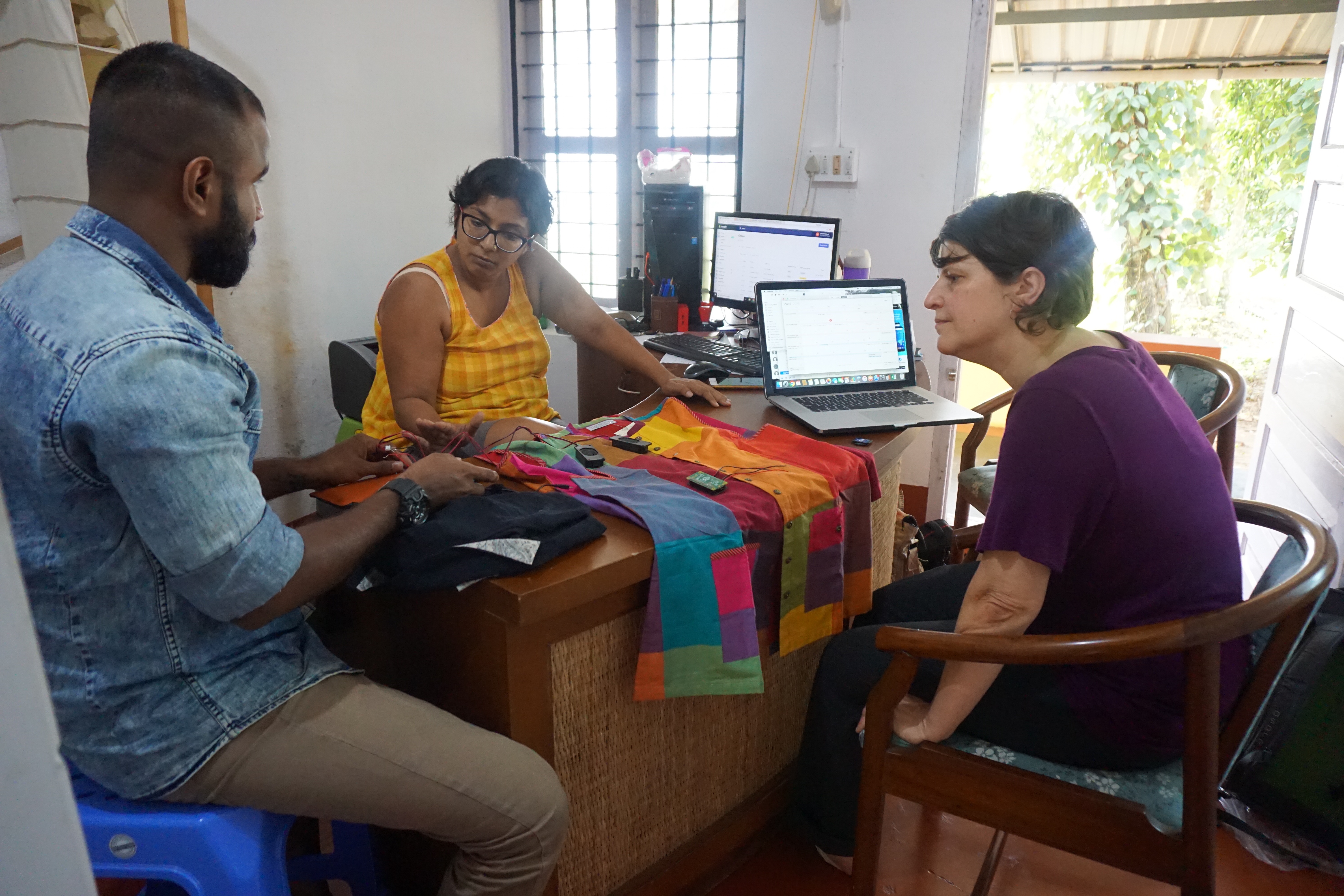
The success of my project was in supporting a locally-owned, female-run textile business during this exchange, and accomplishing a project, initially intended to use pirate radio broadcast methods, in a way that was respectful of Indian law. I also thoroughly enjoyed talking to five generous womxn who were willing to have their stories of struggle and success recorded for this project. It is content that I hope to build upon as I figure out how this idea will evolve.
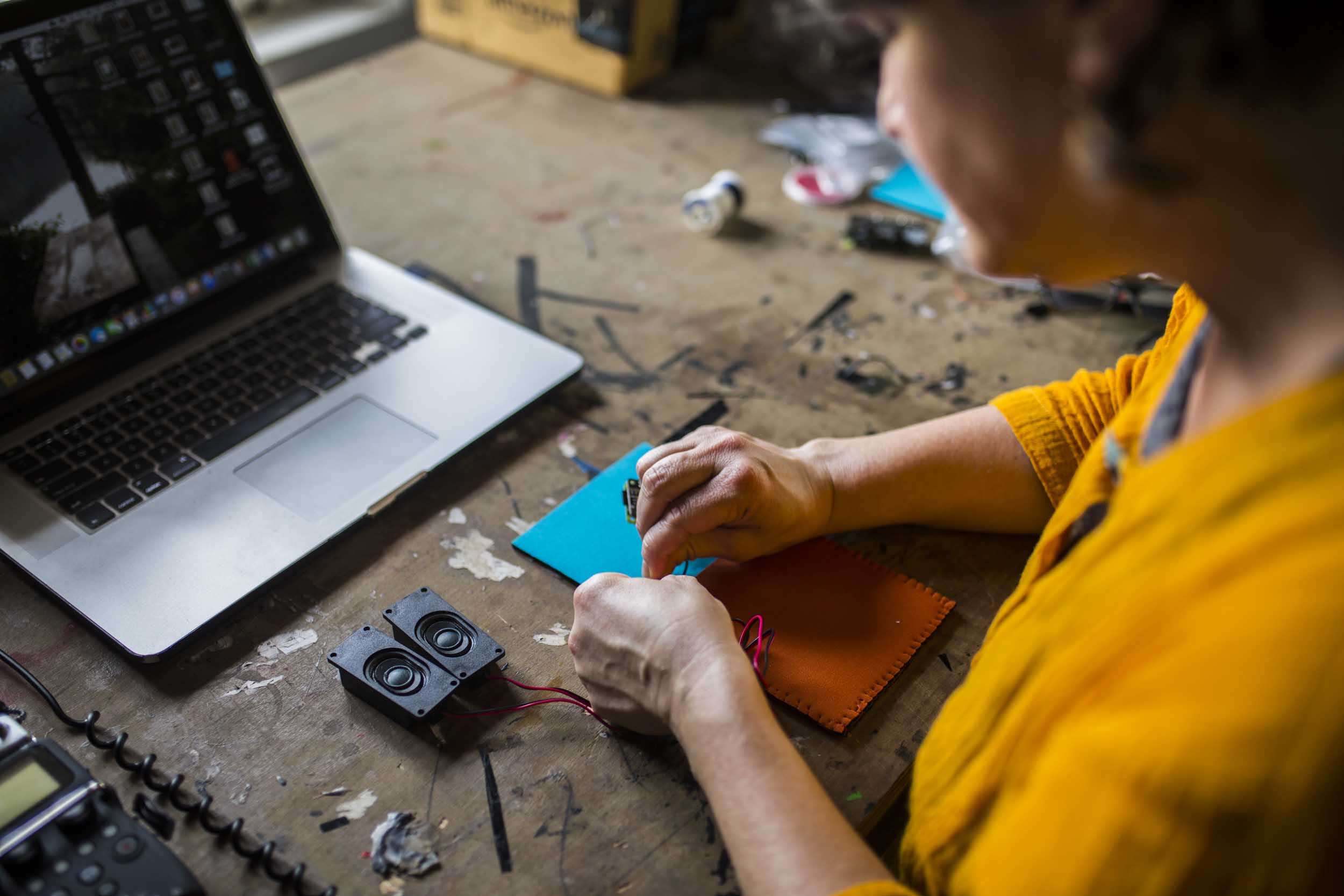
When I think about choosing an easier project, or trying to be less ambitious with the Amplified Voice Workshops, or even being assigned a topic that was less challenging than addressing gender equality, I keep hearing a popular Malayalam saying that is told as a warning to girls: “Whether a thorn falls on a leaf, or a leaf on a thorn, it is the leaf that will suffer.” This saying reminds me of the necessity for all womxn to experience life, freedom, and respect in spite of the obstacles in our global patriarchal society, and I can’t help but to hope that instead of suffering, we can begin to see the leaf as transformed into something new, which will soon ignite a fire.
Pepper House is one of the locations my partner organization, The Kochi Muziris Biennial Foundation, uses for exhibitions, artist talks, and residencies. It's also the home of their art library. I have been spending many days running workshops and ironing out the details of my own project in this beautiful, historic space.
As a creative and progressive organization providing space for local and international viewpoints, I have been fortunate to have deep conversations about gender rights, learn about the methods transgender people navigate this community, and on one special occasion, unsuspectingly walk in on a band practice session of the reunion of a well-known local group who was playing in one of the many places the biennial has developed as artistic space. I have also been told that more Kochi community members attend the biennial each year, and that their tolerance for, and interest in, more challenging forms of art is growing.
Due to the nature of this foundation, “The People’s Biennale,” I have also been surrounded by a 20- to 30-year-old crowd who either work for or are involved in the biennial. As an artist-educator-dreamer, I have aspirations for creating spaces where conceptual and cutting-edge art is accessible to the community and art provides access for people to be empowered, rather than an opportunity or event focused on only one demographic. The Kochi Muziris Biennial has achieved this. I have met more than one young person here who has said they had no interest in art until the biennial changed their viewpoint, and that they are now pursuing careers in art that will take them further than they ever expected.
Association with the program also provides a kind of freedom that allows young people to operate outside some of the cultural expectations in the area. Just as I am able to walk on the streets after dark or wear clothing that shows more skin as a tourist (without someone attempting to admonish me for not acting acceptably), the young people associated with the Bienniale, especially women, are granted more leeway to navigate outside of acceptable cultural norms.
These access points will hold even more resonance in 2018 as the next biennial develops under the curatorial actions of Anita Dube. The word here is that women and transgender artists will hold a prominent place in this next exhibition, an important and progressive move for Kochi, which I can only hope will inspire curators back home.
The view out of my studio window looks a little bit like home. Kochi is an extremely cosmopolitan city with a 97% literacy rate. In many ways, it reminds me of my home, Seattle, which also has an extremely high literacy rate for the U.S., and is a shipping port with large dockside gantry crane, a history of leftist politics, and an affinity for plaid (here it is called Madras checks).
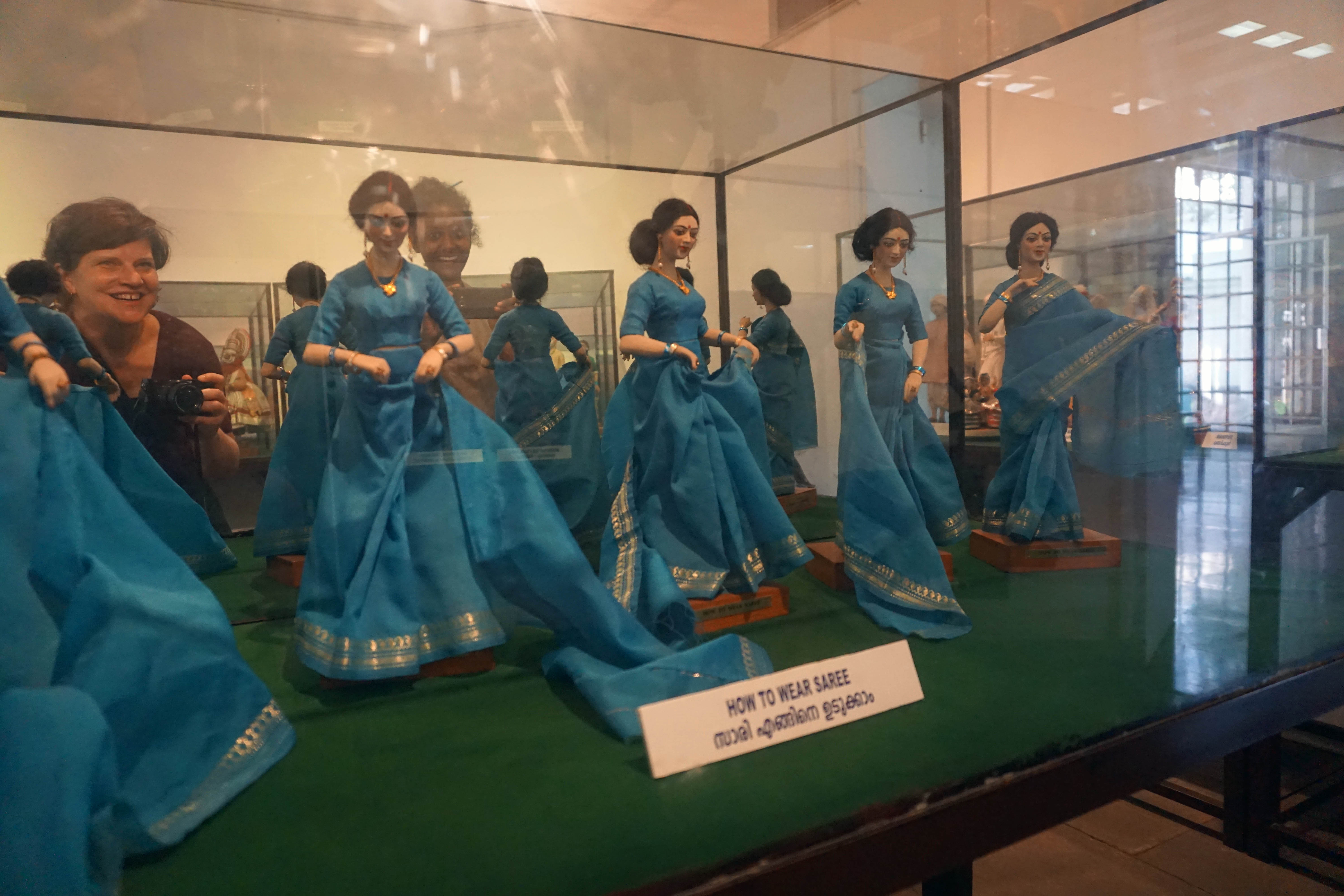
Selfies at the Kerala History Museum with my amazing assistant, Aparna, whose interest in contemporary art was spurred by the biennial.
The process of making art is like the process of exploring yourself. For me, it is one and the same. Making art is a process of exploring myself and the world around me, making sense of it in a way that is beyond the thinking mind… from a place of all of these stirred influences that made me into who I am… the stirred area of the collective unconscious too… when I’m creating my art, it's not just for me, and it's not just from me, it's from a place that I can only articulate through creating art, and a way for me to share this internal experience that is indescribable in any other way than through the language of art – to share it with others.
In the art-making process the past, present and future are all one, and all come through strong in my work. The work is really about presence though... in order to assimilate all of those forces into one it is about being present and letting them come though… it is not about the thinking mind and especially not about a to-do list.
The process of making art is like the process of exploring yourself: witness how past, present, future manifest into the material world. It’s about listening to ourselves, to our intuition, to nature, to the world around us, and to each other. It’s about just being... listening and observing… and balancing that with the creating and the doing.

Exchange: Connecting With Ourselves and Each Other
As an American Arts Incubator exchange artist to Poland, I bring my practice of body-based investigation and technological experimentation to explore what it means to be human. I use technology in my process as a mirror to the self and as a mirror to who we can become. My artwork can be seen as artifacts of a speculative future because I’m thinking about how to heal and enhance the body/mind/spirit and using technology and workflows to help us get there. It’s of vital importance that I explore this in a way that can be empowering and for our best and highest good, especially when using exponential technologies that have the potential to perpetuate evolution faster than natural means, and irreversibly.
As an artist I am a provocateur,
it is my own questions being reflected into my work.
As an exchange artist to Poland, I will share my personal stories and experiences, personally, and professionally. I’ll share what goes into my work and how I make my work, including methodologies of how I explore personal and universal stories of what it means to be human as the basis for creating meaningful and cutting-edge work in STEAM (Science, Technology, Engineering, Art, Math). I’ll share how I collaborate, how I get people excited about my work and working together, how I work across and with other disciplines, and how to develop proposals, document, speak about and share work. I will offer a workshop and guide group projects to build skills and connections through investigations of past, present, and future. Personal stories will be the basis for participants to create projects that acknowledge and/or enable them to break through barriers ingrained in cultural norms. I look forward to working alongside my Polish counterparts participating in the workshop.
Most of all I’ll be listening. Listening to the people, listening to the participants and listening to the area. It’s not just about what we can communicate verbally. There are life events, experiences and stories that we carry within ourselves, and show up in our identity, choices in life, health and well-being. Many of our experiences and emotions live in our body, and are not of the realm of language or thought. There are ways to access, study, communicate and understand these experiences we hold in our body and live through. Awareness, dialogue, experimentation and art making are some of those means.
I intend to make space for participants and I to create experiments that set us up to learn something about ourselves, or see ourselves in a new way and use STEAM in the process. I plan to focus on self-empowerment through opening the space and imparting tools for awareness, dialogue, experimenting, inventing, prototyping, creating and presenting STEAM related projects that function as a catalyst for self-awareness, individual expression and thus self-empowerment.
I hope to impart ways to get in touch with one's self (mind, body, emotions) and share it with others, excitement to experiment and prototype ideas, and I hope to provide insight and open minds into a way of thinking about exponential technologies and what it means to be human.
***********************************************************************
Art, Science, Technology and What it Means to Be Human

, 3D printed scaffolds for stem cell culture into bone is an example of integrating past, present and future as well as the human condition, emotional states, the body, mystic agency and scientific, medical and technological rigor all in one piece. “Regenerative Reliquary” embraces the mystery of life, religion/spirituality and life/death in a singular piece while making advancements in science, medicine and technology. It is not so much to speak to a single facet but to be a unified holistic model, communicating fundamental questions of what it means to be human and combining disciplines to open minds to future visions of who we are, and who we could become.
********************************************************************
Why Poland?
I was distinctly drawn to Poland because of the Polish people, their strength of character and unyielding spirit, as well as a softness and love that many carry inside. I feel there was something that I carry with me in my upbringing and my view of the world that I can relate to in Polish society, connect with and offer.
I grew up Catholic by heritage in an Italian American family in Endicott, NY, a small town largely comprised of European immigrants, including a large Polish population who came to the area because of the progressive policies of Endicott-Johnson Shoe Corporation. Women and immigrants were welcome to work there, and the company-sponsored library even had a section of books in Polish. My Grandmother and her friends were factory workers. Growing up, I visited many of my Grandmother’s Polish friends and heard stories of the “old country," witnessing their emotions and emotional style as they spoke. My extended family is Polish and I have a strong interest in learning about how contemporary Polish people relate to themselves and others, where they’re from, their view of the future and notion of present.
***********************************************************************
Self-empowerment.
Since accepting this role of American Incubator artist to Poland with a focus on empowering women in STEAM, this assignment has had me questioning my own empowerment, when I feel empowered or disempowered... and what to do (or not do) about it. Sometimes it is about external constraints but often it is more about our internal constraints.
Much of self-empowerment is how we feel. It’s a balancing act between internal empowerment and related action (or inaction). A big part of it is centering in how we do feel, accepting that – without trying to run away – and then also considering the best case scenario of how we want to feel, the best case scenario of who we want to become – even if only in a specific situation. Sometimes that requires outward action, but often the first action starts within ourselves.
How do we access what is on the inside and present it in ways that will be received? Present it in ways that are true to ourselves and empower us – regardless of the outcome?
This non-attachment to the outcome was a foreign concept to me, and required practice – but has empowered me – this notion to do our best in a way we feel good about regardless of the outcome… and then balancing that with focusing on a desired outcome and evaluating what the outcome is. It hasn’t always been an easy practice but it has helped.
Planning this project and working with various parties has made me acutely aware of when I feel empowered and disempowered. No one can tell you how to feel or if your feelings are wrong or right – they are your feelings. However, others can hold a mirror up for you to see yourself. Do you want to look?
To speak to the heart and the mind, we have come from the heart and mind.
We can’t let success go to the head, and not let failure go to the heart.

All images © 2016, 2017, 2018 Amy Karle
As a daughter of immigrants in Turtle Island (aka North America), I strive to be in allyship to the original peoples and the land and waters that nourish me by activating multisensory storytelling and interdisciplinary art, including sculptural installations, performances, lectures, community engagement, writing, olfactory art and experiential technology collaborations with Native culture bearers, creative technologists and scholars. This trajectory shapes my approach to the American Arts Incubator (AAI) exchange where I will be supporting social inclusion of Indigenous and Afro-Ecuadorian populations in Otavalo, Ecuador through sharing how new media storytelling may shift dominant narratives.

I will be working with Centro Intercultural Comunitario Yawar Wawki Casa de Artes that is housed in Museo Viviente Otavalango, which previously was a textile factory that exploited Indigenous labor for two centuries until it was taken over by workers in 2011. Within this context, Casa de Artes counteracts marginalization and historization of Indigeneity through revitalizing Kichwa language, music and weaving. I am humbled to work with resilient people that embody self-determination. With my workshop participants, I hope to develop site-specific extended reality content to support spreading the story of self-empowerment. Our process will be a co-inquiry on how new media can amplify voices critical to futurity and challenge the notion that indigeneity and modernity are incompatible.

I want to take this opportunity to broaden general conceptions of technology to include ancestral technologies such as weaving, agriculture, plant medicine and wayfinding. I credit my AAI mentor Cristóbal Martínez (read his writing on Tecno-Sovereignty: An Indigenous Theory and Praxis of Media Articulated Through Art, Technology, and Learning) who pointed out that weaving was the first computer and that we must always question the ideologies embedded within the technologies we use, and how they may occlude other forms of literacy and perpetuate power structures. This resonates in an age where we rush to embrace new technological trends without contemplating how often they are derived from military initiatives that were once instrumentalized against certain marginalized communities. Navigating these power dynamics will be one of the first challenges I will face as the Incubator’s lead artist and I hope to find a balance between emerging and traditional media throughout our workshop.

Drone VS. Fort, Rhunhattan Project, April 2017. Image by Beatrice Glow and Highway101, etc. Exploring the embedded ideologies of technology, we used a drone to photograph Fort Belgica that was built by the Dutch East India Company on the original Spice Islands of Indonesia. By using 20th century military-derived technology (drone) to document 17th century military technology (fort), I reinterpret and subvert the ideology belying the drone and use it to support decolonizing perspectives.
Gearing up for the exchange, I have been rereading Decolonizing Methodologies: Research and Indigenous Peoples by Linda Tuhiwai Smith. I am also learning about Andean culture and cosmovision through learning the Kichwa language. For example, the word for “person” is runa, and the full definition is “a being of nature that acts with force and wisdom.” My teacher gave me a Kichwa name that realigned me on the path of runificación, which urges me to act in my full potential while being conscious of my relationship to the ecosystem and the cosmos.
During my stay, I hope to learn more about how Indigenous communities in Ecuador have been at the forefront of environmental stewardship, most recently evidenced by the Yasuni resistance against the pipeline construction in the Amazon Rainforest as well as the 2008 constitutional enshrinement of the values of sumak kawsay (buen vivir)[1], whose vision for environmental health is critical to a sustainable and socially-just future. I am curious to learn how this is implemented on a day-to-day level, the challenges, and how these takeaways may guide and strengthen parallel North American efforts. My time in Otavalo will undoubtedly expand my understanding about the ramifications of colonialism, environmental racism and Indigenous revitalization.
"The long poem of walking manipulates spatial organizations… it is neither foreign to them… nor in conformity with them."
—Michel de Certeau, The Practice of Everyday Life
I am so humbled by this opportunity to simultaneously teach and learn in Casablanca this March. And I am so excited and fascinated by the process of investigating how to explore questions of interest and concern to participants from a wide range of backgrounds.
It’s exhilarating to feel how aligned my host organization, L’Uzine, is with the goals and strategy for the exchange. After checking in this Saturday morning with Zineb at L’Uzine, it was clear that we are on the same page: working to develop an exchange that emphasizes interdisciplinary, cross-media, and cross-scalar collaboration and looking forward to the discoveries and experiences it might produce!
Together, workshop participants and I will be testing how research into personal narratives and critical cultural questions can be articulated through urban spaces; how collecting can lead to creating; how data visualization and mixed digital and manual prototyping can evoke and interrogate concepts; and how mixed qualitative-quantitative analysis can form the framework, foundation, and inspiration for novel sensory experiences.

The topic of the AAI exchange in Casablanca is youth empowerment2. The idea of the workshops is to provide conceptual frameworks and technical skillsets that facilitate innovation, entrepreneurship, and engagement. For those participants developing an artistic identity, I hope the workshops can also help with discovering and choosing expressive media; while for more experienced participants, the skills may help bring new research and data-processing techniques into their work.

For me, the development of these frameworks started with my family and the childhood experience of immigration. More recently, I have started to dissect (and self-map) the complex paths that experience led me down.
The self-map image starts to get at the following questions:
What can we discover when we start to explore the individual as a vessel of socio-historic confluences through quantitative analysis?How does one identify, question, embrace, and express an awareness of one’s own familial and philosophical lineage(s) in the process of exploring socially-critical topics?Can some of it happen through numbers? Can spreadsheets shed their corporate connotations and become powerful tools for artists? Can some of it happen through the senses? How can we identify and deploy physical experiences in exploring and articulating intellectual challengesWhere is the limit of one type of mapping and what subjective additions to we make to maps when representation breaks down?And how can we unroll an experience to discover and display narratives of cultural relationships?
L’Uzine is already involved in exploring its urban context. In particular, the Aïn Sebaâ exhibit investigated its neighborhood. I hope that this exchange will offer a way to supplement the great work under way and to develop some novel approaches to understanding self and space.
Wait — did I already say how excited I am to see what backgrounds, interests, and media workshop participants bring into the fold? What implications might rhetorical construction, collection, data visualization, and mapping have for the modes of expression and creation that participants engage in? I look forward to observing and participating as responses to these questions (and more!) coalesce and dissolve in the experimental framework of the “Rhetorical City” workshops at L’Uzine!

2. According to World Bank’s “Kingdom of Morocco Promoting Youth Opportunities and Participation” (June 2012), the landscape of employment in Morocco has undergone radical shifts in this century.
A large part of my arts practice is informed and shaped by the environments, spaces, and communities I’ve lived in and travelled through, including my native island of Oah’u in Hawai’i. I’ve always been inspired to create meaningful spaces for cultural dialogue, and work collaboratively with communities to create impactful projects, which I have strived to do as the Artistic Director of B4BEL4B Gallery in Oakland for the past four years.
In my personal arts practice I have used 3D modeling, augmented reality, websites, and textile design to tell stories that speculate on how we can reimagine the past, present and future. I’m interested in our relationships to our technologies and how they both come from and shape the environment, and focus on these stories in my work.

I’m excited for my arts practice to evolve next month as I travel to Kyiv, Ukraine, and lead workshops and community projects in partnership with IZOLYATSIA, a dynamic arts organization focused on cultural and social change. I have been inspired by the youth-driven “Made in Ukraine” movement where Kyivians have revitalized and cultivated a strong and unique identity. Through conversations I’ve had, Ukrainian culture and identity is a multi-layered and complex topic that shifts between generations and is interwoven with the political and geographical landscape and the ecology of the land.
Focusing on cultural identity and environment, I will be giving workshops where participants will consider how to use speculative thinking and designing towards prototyping cultural spaces and objects for the present and future. We’ll consider material ecology, design fiction and storytelling through exercises where we think about redefining boundaries, radically refiguring space, transforming damaged landscapes, collaborating with the environment, and how culture and ecology are inextricably intertwined. We’ll also use digital tools to express individual cultural and personal identities.

As this will be my first time teaching workshops in another country, I am looking forward to being both a student and teacher while I am there! I hope to provoke conversations and inspire people to create work that is meaningful to them that they will continue to build upon after my exchange.
Teaching is no less a work of art than the creation of artwork itself. For the past ten years my artwork has evolved into platforms and objects that aspire to give people a place to find their voice, express their individual and collective beauty, and learn more about the empowering effects of creativity. I have done this through projects such as collaborative textile-making processes, creating and running a neighborhood Super 8 film festival, and designing radio sculptures for non-traditional communication. Recently, I have been fusing my two primary interests, textile objects and traditions plus communication practices to express ideas of voice, identity, and place.
I am extremely grateful to be able to bring my art practice to Kochi, India and continue exploring communication and empowerment through a partnership with the Kochi Biennale Foundation, addressing the topic of gender equality. Inspired by Gandhi’s khadi (Indian hand-woven cloth) campaign, which “was a result of decades of experimentation with cloth as a means for communication,”[1] I am preparing for a project to embed speakers into textiles exploring micro-amplification to amplify stories from the Kerala region.
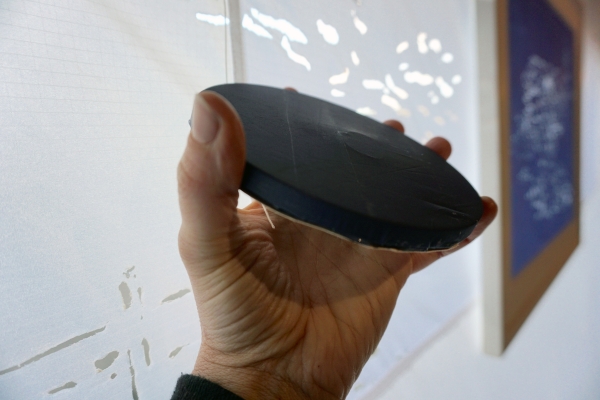
The workshop I am offering will explore amplification, sculpture and sound (including e-textiles), narrowcasting, and podcasting as a method for exploring gender equality, communication, and creativity. Inspiration for this project has come from India’s rising access to radio through mobile phones[2] and Vinod Pavarala and Kanchan K. Malik’s Other Voices: The Struggle for Community Radio in India, which credits radio with the “capacity to consolidate participatory communication into a thread that weaves through the development process and endows it with avenues to strengthen and give voice to all stakeholders.”[3]
I begin this exciting journey in mid-February and look forward to sharing my experiences there.
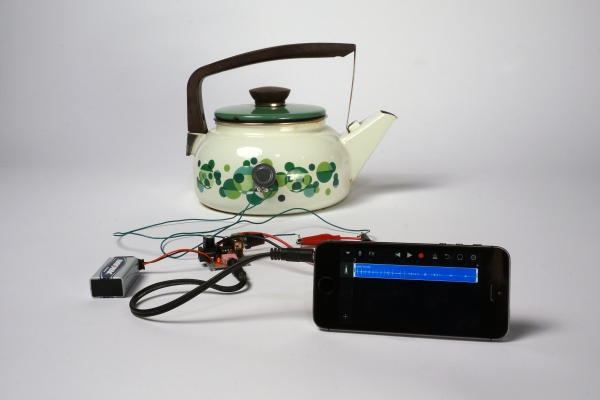
Workshop tutorials will include building speakers and amplifiers, making things “talk” through the use of transducers, audio editing and amplification, and hacking electronics to make what you want. Photo by Laura Wright.
[1] Gordon, Beverly. Textiles: the whole story: uses, meanings, significance. Thames & Hudson, 2014. pg. 104
[3] Pavarala, Vinod, and Kanchan K. Malik, Other Voices: the struggle for community radio in India. Sage Publications, 2007. pg. 182.
This has been a momentous year. 2017 has put our institutions to the test and demanded action in the streets. Making meaning in the midst of the turmoil, we have been reimagining what civic action looks like. Working in collaboration with government and individual citizens, ZERO1 has supported artists across the globe who are applying their creativity to the challenges their communities face.
This year ZERO1 artists made art that mattered: addressing homelessness in San Jose; improving disability inclusion in Moscow; championing economic equity in Guatemala City; probing water quality in Bangkok; cultivating peace in Medellín; promoting environmental health in Phnom Penh. More than ever before, we see the importance of connecting communities directly so that we may share approaches and align our efforts.

Our work is no longer just about enhancing our capacity with technology, exploring new truths with science, and representing beauty with art. We must now also repurpose our tools, apply our knowledge, and demonstrate how art can help us envision a sustainable future. To that end, here’s what we’ve been up to, by the numbers:
6 countries were sites of creative collaboration
32 projects applied art, science, and technology to social and environmental challenges
$20,000 in small grants awarded to community led-projects
$42,300 in fees paid directly to artists
$60,480 in artist travel expenses covered
68,456 miles flown to connect artists face-to-face
28.2 tons of carbon offsets purchased
5,964 people interacted with art that opened their awareness
We’re grateful to be supported by a growing community that cares deeply about using creative tools to build engaged and vibrant communities. As we step up to new challenges in the year to come, we ask that you stand with us, and renew your commitment to art that expands our vision for what is possible.
Best,

Barbara Goldstein
Board Chair and President, ZERO1
American Arts Incubator: Request for Qualifications for Artists
ZERO1 is calling innovative digital and new media artists with a love of travel and passion for community-driven public art to apply to participate in American Arts Incubator.
American Arts Incubator (AAI) is an international creative exchange program developed in partnership with the U.S. Department of State’s Bureau of Educational and Cultural Affairs (ECA) and administered by ZERO1. The program utilizes community-driven digital and new media art projects to instigate dialogue, build communities, bolster local economies, and further social innovation.
Inspired by the business incubator model made popular by Silicon Valley’s technology and startup companies, American Arts Incubator is a hybrid training lab, production workshop, and tool for public engagement. At its core, AAI is a cross-cultural exchange of ideas that showcases artists as engaged and innovative partners in addressing social and environmental challenges. Selected U.S. artists team up with youth, women, people with disabilities, and underserved populations through country-based partnerships to inspire community engagement through art programs. AAI awards small grants to local participant teams to develop public projects addressing a social or environmental challenge relevant to their community. In doing so, AAI exchanges seed opportunities for ongoing, community-driven innovation by translating creative practices into projects and programming that can be sustained long after the U.S. artist leaves the overseas location.
Participating overseas locations for this opportunity will be announced in December 2018. View countries that artists have traveled to in previous rounds here.
Dates of Participation
Program duration is June 1, 2018 - August 31, 2019. Core dates for in-person participation include a weeklong orientation in the San Francisco Bay Area, tentatively scheduled for Fall 2018. International travel for 4 consecutive weeks will occur between January 2019 and May 2019 (specific dates will be determined collaboratively by the overseas U.S. Embassy, overseas host partner, ZERO1, and the selected artist). In addition, deliverables are expected in the months leading up to overseas travel and immediately following travel (e.g., project proposals, blog posts, program reports, documentation, etc.). Artists will be expected to document their experiences and project development before, during, and after overseas travel via the program’s website and selected social media platforms.
What We’re Looking For
We are seeking creative, adaptable, and culturally-sensitive digital and new media artists with experience in socially-engaged art, group facilitation, diverse collaborative environments, and project management. Artists must demonstrate how they have used their art practice to address social or environmental challenges, and how they have facilitated groups to work towards collective goals. Applicants should be proven self-starters who can work independently, respond to time-sensitive virtual communications, meet deadlines, incubate new ideas, receive feedback, and support overseas participants to develop their skills and apply them to the creation of projects that engage local communities.
Qualifying Criteria
Emerging, mid-career or established new media and/or digital artists
- U.S. citizens at least 18 years of age
- Strong record of artistic accomplishments
- Proof of adaptability and capacity to work in international contexts
- Relevant experience working with youth and/or underserved communities
- Record of engaging with artists, youth, community organizations, and/or community members through teaching, workshops, social practice, artistic collaboration, or other outreach activities
Budget
The Artist will receive a USD $7,000 honorarium for participation, plus an assigned budget for workshop and public art production costs overseas. This budget is determined during the project proposal phase, prior to overseas travel. It is based on approval by ECA, the respective U.S. Embassy, and ZERO1. The program covers airfare, accommodations, and basic travel costs.
Deadline
All submission materials must be received via the online application by Monday, January 15, 2018, 11:59 pm Pacific Standard Time. There is no application fee.
Selection Process and Policies
AAI Artist selection will be a two-step process. Initial submissions received via the online application will be reviewed by ZERO1 and ECA. Finalists will be asked to submit a full application with more detailed responses to a second round of questions, as well as letters of reference. Finalist submissions will be reviewed by a panel of arts and social impact professionals, along with the Program Officer from ECA. This committee will recommend artists to each U.S. Embassy. Each U.S. Embassy selects an artist, and ECA gives final approval. Upon acceptance of invitation to participate as an AAI Artist, the Artist must agree and comply with the contract terms presented by ZERO1 for the duration of the program. ZERO1 has the right to accept or reject any responses received. ZERO1 is committed to diversity, and we encourage applications from people of color, women, the LGBTQ community, and persons with disabilities, as well as applications from researchers and practitioners from across the spectrum of new media disciplines and methods.
To apply, use the online application:
APPLY HERE >>
For more information about this opportunity, visit the FAQ page.
For more information about current and past AAI activities, visit the AAI website.
Download a pdf version of requirements
About ZERO1
We connect creative explorers in art, science, and technology to provoke new ideas that build engaged and vibrant communities. Founded in 2000, ZERO1 is a Silicon Valley nonprofit arts organization headquartered in San Jose, CA that aims to address and raise awareness about complex social challenges both locally and internationally. At ZERO1, we believe that art, at the frontier of technology, broadens our critical understanding of the world through experimentation, provoking new ideas, and implementing creative strategies. Through a global network of partners, we bridge the academic, corporate, and cultural worlds to foster collaboration and encourage social action. Visit: www.zero1.org
About U.S. Department of State’s Bureau of Educational and Cultural Affairs
The Bureau of Educational and Cultural Affairs (ECA) promotes international mutual understanding through academic, cultural, private-sector, professional, and sports exchange programs. The Bureau’s exchanges engage youth, students, educators, artists, athletes, and emerging leaders from all fields to increase global understanding of U.S. policies and values and to help American citizens engage with the world. More than a million people are alumni of ECA exchanges, including more than 50 Nobel Laureates and more than 320 current or former heads of state and government. Visit: exchanges.state.gov
Photo by American Arts Incubator alumnus Michael Kuetemeyer.
“Political VR”
“Collaborative trust”
“Fearless science fiction”
“Speculative architecture”
These are just a handful of the phrases captured from conversations about selected artists’ work during last week’s American Arts Incubator (AAI) orientation. The six artists comprising the 2018 exchange cohort were already buzzing with ideas for how to apply their wide-ranging art practices to address social challenges abroad, and had gathered in San Francisco to prepare for their upcoming exchanges in Ecuador, Egypt, India, Morocco, Poland, and Ukraine. The weeklong orientation was hosted at the historic San Francisco Art Institute, providing ample inspiration with its scenic courtyard, Diego Rivera mural, and rooftop views.

During the orientation, AAI artists pitched their workshop ideas to mentors from San Francisco Art Institute, California College of the Arts, Yerba Buena Arts Center, and Adobe; two AAI alum also returned as mentors for this year’s program. The group discussed the social and political implications of facilitating socially-engaged art in a foreign country, and practiced live language interpretation. Artists also had a chance to practice facilitating creative icebreakers that ranged from designing symbols representative of their artistic practice to impersonating jellyfish. Local arts enthusiasts also had the opportunity to meet and mingle with the cohort during a midweek happy hour.

After the whirlwind of orientation was over, the artists reflected on their experience. Dasha Ortenberg (AAI exchange artist to Morocco) was inspired by the diversity and commonalities she found within the group: “It was so valuable to see the different ways in which each of us merges ideas about self-understanding and social empowerment with historic spaces, traditional practices, and new technologies. It is so inspiring that we use such different methods to explore similar existential questions.”

Beatrice Glow (AAI exchange artist to Ecuador) expressed a sense of appreciation for the AAI community and the unique opportunity the program represents: “I feel refreshed to take part in a program where artists are valued for our agency as civic actors and the validation that art and tech may build towards a viable means of social change.”
With both AAI staff and artists energized from a week spent together preparing for and exploring the possibilities of international creative exchange, this year’s program is off to a great start. The cultural and artistic exchange will only deepen when the six artists begin collaborating with overseas participants during their upcoming exchange trips in spring 2018.
We received updates from the American Arts Incubator participants in Thailand! Here's what they've been up to since the exchange wrapped up in July (submissions have been edited for length and clarity).
Make It Clear
We believe that water resources and the community nearby are deeply connected and affected by one another. Therefore we are designing an activity project with the khlong Ladprao community called the "Ice Breaking Board Game." It is a new media board game which interacts with body movements and sounds. This is ideal for building better understanding about water resources within the community and making a better relationship among them. We tried our best to apply our artistic knowledge to bring concrete benefits to society.

Expected results for the community:
- Everyone works together as a team
- The activity project will be fun, relaxed, and knowledgeable
- Building better understanding of the importance of water resources
- Reducing tension in the khlong Ladprao community for those who have to move to a new place

River Voices
Our group met a new possible collaborator, Valerie, at the Bangkok Art and Culture Center in July. She was a museum art director in the USA and had recently joined the Peace Corps. Her project goal is to send Americans to help other countries.
She is currently helping a school in Thailand as an English teacher. Her school is called the Wat Thammajariya school, which currently has 290 students. Her goal is to do art in her school for her students. Since we are looking for a place to make community art about the river, we think it would be perfect for us to visit her school.

We went to her school and had a meeting with the principal and teachers. They came up with the idea of having secondary school students M.1 - M.3 (12- to 15-year-olds) do the activity, which they can then later organize for younger students in the school. We would have three camps with 30 students at a time, and students would rotate around.

These are the camp ideas:
- Bio camp: inspect small living organisms in the river
- Chemical camp: inspect pH - EO - DO values in the river
- Art activity: make art sculptures or drawings from river pollution

We also visited the canal, and it's quite clean compared to Ladprao community's. There is some trash floating but only in one area. Their community has a trash bank program where people in the community sort the waste and sell them, but it just has started.
The Cleansing of a Canal
We did a workshop with the community in August. Many youngsters and a few adults joined us. The workshop was developed to uncover participants' ideas of what kind of community art project they would like to make. Our aim is that this project would be beneficial to the community in their eyes, not from an outsider's perspective. In the workshop, we guided the participants to dig deep into the urgent needs of their community and revealed what their skillsets are, what skills they want to obtain, and what they're interested in.

We found out that they would like to have more source of income, tutors for children, and ease the general sadness from the fact that some of the community members will not be able to live there in the future. They are interested in technology and social media. They enjoy drawing, gardening, and many types of sports.

In our next workshop in September, we will guide them to combine these elements into an art project that truly reflects their own community.
We received updates from the American Arts Incubator participants in Cambodia! Here's what they've been up to since the exchange wrapped up in May (submissions have been edited for length and clarity):

The Along the Water project is in its second step version — we succeeded with our camping and training students to follow our plan. We also shared our experiences with the community and students about our environmental issues and worked well together. We also used the 360-camera to record the video of all activities during camping and got back a lot solutions from students’ analysis too.
Now we are a bit busy processing our videos and preparing all documents and our personal work but we hope to finish them and share with you soon.
We have solutions for communities now. We wish to find audiences or a small fund to build up our solution and donate to communities for sustainable community life.
Additional details and photo video documentation at https://www.facebook.com/pg/alongthewater
Bringing the Forests to Bophana

“Bringing the Forest to the City” will be the second phase of the first project “Bringing the Forests to Bophana.” We want to influence people’s mindsets to love nature, particularly forests and wildlife.
This second phase will bring another new flavor by capturing a forest on an island and in a valley by using a web mapping application as a tool to connect one location to another by using virtual reality. Our group of three has been working together since late June, and we are expanding the locations within Cambodia, specifically: Kos Seh Island in the Kep archipelago and Areng Valley in Kos Kong province so users can explore more forest types since the previous project focused on dense and semi-dense forests.
This current project is working on shooting new underwater worlds and locations deep in the forest, and once completed, an exhibition will be held in various locations including the Farm To Table restaurant, Kid City playground, and Bophana Center.
Trash is Not Bad! Plastic Commune Project

For the second project supported by American Art Incubator — Cambodia, Plastic Commune group will shoot video using the 360-camera about the feeling of the bottle which we would like the people know how they feel and take care of them from now on. In the meantime, we are also growing our social media in order to address the waste issue in Cambodia. Basically, we focus on the Facebook page and our website. We are also preparing a proposal for an NGO which has a creative incubator. They would be able to give us support, space to work, funding, technological support, workshops, business training and support, and mentors.
To finish this project, we will select one educational location to teach children about the trash issue by using our tool that we already prepared from our first projects. We will teach children how trash can be recycled to be a souvenir or useable material.

This team sent us a video as their project update, which can be viewed here: https://www.youtube.com/watch?v=kNmzY6qwpoY
We received an update from the American Arts Incubator participants in Guatemala, who combined their four community projects into one effort — the REDCREA Makerspace. Here's what they've been up to since the exchange wrapped up in April:
My name is Angel Castellanos, and I am part of the Design and Communications team, along with my colleagues Diana Castillo and Daniela Briseño. It's a pleasure to share a short review of what we have accomplished as a team. Right now, we are in the process of creating an educational establishment in the municipality of Santa Catarina Pinula.
We are researching the target audience, or as you would say in the field of marketing, a "target group." Currently, we are finding quotes for t-shirts with the REDCREA Makerspace logo in order to incentivize the target audience and draw them in through an impactful design.

In this process, we are making educational materials in the areas of design, layouts, and electronics, which was the most requested by this group of youth.
We are designing pamphlets with more specific information on the REDCREA MAKERSPACE with the intention to re-launch the project and attract public attention for its growth.
We are designing both electronic and paper collateral in order to spread the word in educational and artistic spaces.

As a process to reach more youth with the desire to learn, and with us as professionals that can offer the necessary education in order to encourage a future with more entrepreneurial and creative prospects, we are aiming to invest in these networks in order to expand our reach.
As we are still in the process of investigating our pilot, we will surely find new needs in order to keep moving forward, and using the support we've received from ZERO1.
As part of the REDCREA team, and specifically as part of the Design and Communications group, we're pleased with the collaboration and grateful for the support. I am looking forward to the future success of this project.

Original text in Spanish below:
It’s hard to for me to believe that it’s been a month since the exchange has ended. The time was intense, rewarding, and the effects of the experience difficult to describe — but I’ll do my best.
I’ve never done anything quite like this: worked for a month in a foreign country where I’ve taught a workshop, facilitated projects, and worked on my own new project. It was a lot in a short, 28-day period.
Bangkok is intense and wonderful at the same time. It is the most urban of urban places that I’ve ever lived in, with very little green space. Cars, motorbikes, people, street vendors, and shopping malls were everywhere. Yet despite the craziness, I felt a warm hug of the humidity everywhere I went. Thai culture is relaxed compared to what you’d find in the United States, so bumping into and around people doesn’t create anxiety and tension as you’d find in other places. I was happy there.
The next step is for me to talk about the experience publicly. Just a few days ago, I presented my Sonaqua project at Dorkbot SF and spoke about the American Arts Incubator Program.

We also have the three projects that were given sustainability grants. One of the projects, River Voices, will go on to have a series of community engagement workshops. In this case, the word “community” means a slightly different thing in Bangkok, where “communities” are more cohesive political entities and are usually situated in low-income areas, often isolated from the rest of the metropolis.

Finally, I will further develop my Sonaqua project, where I sonify water quality. This project will travel to Santa Fe in September. Bangkok was the first step for my work.

I do hope to come back in the future to do work in Thailand. It holds a special place in my heart. I hardly did anything touristy and instead spent time almost exclusively with Thai folks. I absorbed a much deeper cultural understanding than just about any tourist will get. My fantastic production assistant, Ekarat, was my guide throughout. He would frequently joke about things being done “Thai style,” which could be interpreted a number of ways. Often it meant that matters looked disorganized but always came together magically at the end.
After a short vacation outside of Thailand, I came back to gather my belongings and fly back home. I ended up having a farewell dinner with a few of the workshop participants as well as Ekarat. Here we are eating food on the banks of the Chao Phraya river and drinking Thai beer in the midst of a hard rainstorm that alleviated the humidity for just a few hours. I will miss the friends I made during this special time.
