My time in Medellín, Colombia has been transformative to say the least. The people, art, communities, music, and dance — all surrounded by sweeping landscapes of green coalesced to create the vibrance that is Medellín. And in between the empty spaces of this city is where the heart fills first. This emptiness is where new ideas come to fruition. A space is born to breathe and take pause for a moment in silent contemplation; these are the spaces between the notes, where the music is formed. In Medellín, you find a rampant city of exuberance, noise, and commotion right beside the raw-natural beauty of the flora and fauna of a serene landscape.

Our goal with the American Arts Incubator program was never to solve any issues, but rather to address difficult topics through digital arts and to bring about awareness. The topic for Colombia was admittedly a difficult one to address: peace and social inclusion. How do we as individuals address this in our day-to-day lives? How do we create inclusive spaces and communities? This main investigative question is still very much active and in debate (as it should be).
There were hardships, growing pains, and even conflicts within our own groups while discussing this heavy topic, but this was key to the very idea of inclusion itself. We sought different angles of engagement and created the necessary dialogue. This was where the work of many individuals combined to create one inclusive view — a view that included different ideals presented within a single framework. With these unique perspectives combined as a whole, we could begin to highlight the diversity of a culture striving towards peaceful and inclusive community interactions.
For me personally, I learned perhaps the greatest lesson of all, and no less than through my own words that I preached over and over — that of listening. In the beginning I failed to do so with my whole heart. I realized at an important turning point in my exchange that the process of using an interpreter had led to my own disregard of the country's language.
The majority of workshop participants did not speak English, but gradually each one of them began to try. They spoke whatever English they knew in order to include me. This was when I began to see the true humility of the Colombian people. Though many of them were not fluent or even confident in their words, they tried for my sake and from their desire to spread compassion and inclusion. This act made my heart grow heavy. Through translation, I was missing out not only on the meaning of the words, but the very sounds of their voices, speech patterns, and subtle inflections. By relying on my interpreter, I had trained my ears to tune out the Spanish language just as one would tune out the drone of an air-conditioner or the hum of a fan. Their voices became white noise and I was no longer actively listening.
This realization hit me with a force so strong that it sent my heart to the floor, so I began to ask my new friends to speak to me in Spanish. I asked questions en español, and for the first time I fully engaged myself in the process of learning the language. I figured if they were brave enough to try with me, that I should at least return the gesture. As soon as I began to try, an entire world opened up to me. A new bond was formed and I can say with full confidence that we all became closer friends.
In the following days I awoke with Spanish vocabulary on my mind. I engaged and participated in ways not previously explored which created an exciting feeling that stormed my bodily presence with an epiphany of pure love. And this love was something that I had been disconnected from at the beginning of my exchange. The simple act of listening and letting go of my own inhibitions created a new awareness within myself.

This exchange has been one of the most profound experiences for me, and I owe it all to the amazing people that showed me the way to social inclusion. Through their welcoming and accommodating ways, the Colombian people have given me the most valuable lesson of all, and I thank them dearly for their compassion.
I don’t know what comes next in the coming months or years beyond, but I do know that some very valuable relationships were formed and I can say with certainty that it changed at least one person's perception of what social inclusion can mean.
We had our exhibition last week at the Bangkok Art & Culture Center (BACC) and it was a huge success.
I made just two rules for the artworks:
- There had to be some physical expression of data in the work (a loose interpretation of the word “data sculpture”)
- It had to be about the rivers and khlongs
Every exhibition is full of surprises and this one was no exception. Several days before the exhibition, we found out that we had about four times as much floor space and walls available than we had expected. Whoa.
Fortunately, three out of the four groups had works they were planning that would take advantage of the curved walls of BACC. I have no idea what we would have done otherwise.
The exhibition site at BACC was not part of their formal exhibition space. We would set up on the fifth floor, which displays work but is also a public thoroughfare, so our challenge was viewer engagement.
The dirty t-shirts were the most striking thing you saw from a distance. What were these? Hopefully people would get drawn in by their curiosity.

A good exhibition means that people have different levels of engagement.
Some spent a good amount of time with The River Voices — the hanging shirts (above), which were part of a t-shirt exchange with the Ladprao community.
Others were very much interested in the abstract group sculpture on pH, electrical conductivity, and dissolved oxygen: Reflection.

The Cleansing of a Canal
was a storytelling piece that grabbed exhibition-goers who were intrigued by media and direct interpretation of the river/khlong experience.

And Make it Clear was an interactive painting that used thermo-reactive paint and mapping of pipe data. This piece was a solid, fun interpretation of the term “interactive.”

Part of the Incubator included making my own work, Sonaqua — a sonification of water quality. This too felt overwhelming, but fortunately the four teams were doing quite well on their own during their production period, so it let me investigate my own work.

We also got full engagement from the Ladprao community, which is one of the communities that the embassy put us in touch with. They are actively cleaning up the khlong in their neighborhood, and in the process, relocating many of their community members.
We also got lots of media coverage, which is always an important component. We were spotlighted on both Thai PBS and The Matter.
In the end, I can say one thing for certain. The workshop participants were amazing. We had four teams of five people each and they all cranked out work — some until the last minute, maybe a bit too close for comfort — but I think this is the often the way.
As a representative from the United States, it was inspiring to see that addressing environmental issues is such a high priority among so many people in Cambodia. Leaders young and old are working hard with beautiful creativity to heal our world.
The American Arts Incubator – Cambodia Facebook page continues to be a vibrant hub for workshop participants, environmental activists, and media artists in Cambodia. The four teams are continuing their projects, launching their own social media campaigns, and are well on their way to Phase 2 project production. I am excited to be a long-distance advisor as their projects continue to grow. The 360 Ricoh Theta S camera and virtual reality (VR) goggles purchased for the workshop are being shared in an ongoing equipment pool for the groups. The installed solar electric system for the Bophana Audiovisual Resource Center continues to provide power each day for screens to show artwork and fans to keep everyone cool. It is inspiring to know that when the sun is setting here in Philadelphia, it is rising over the solar panel in Phnom Penh.
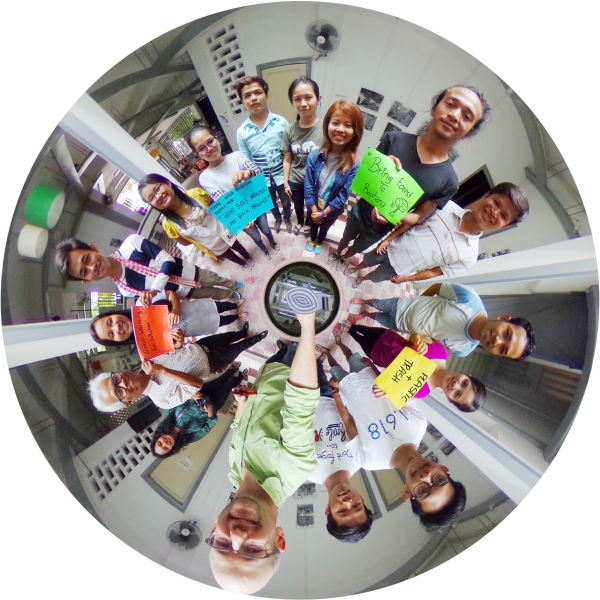
I feel honored to have led the Incubator at Bophana Center in Cambodia and thankful for all the support and enthusiasm of the Bophana Center staff. I was most impressed by the dedication and commitment of the participants. The teams worked really well together considering the strain of creative deadlines. Fortunately, there were no breakdowns or ego battles in the busy final days. A real sense of camaraderie developed among the teams as well as across the whole group. The final exhibition was a tremendous success and groups of visitors continued to come in for the month-long duration of the exhibit.

One of the installations created by the Plastic Team featured a statue of the mythological mermaid, Suvannamaccha, made out of plastic bottles and newspaper headlines. The statue had trigger images of sickly fish and some fruit. When looked at through the augmented reality (AR) app, the fish and fruit disappeared to reveal an image of the mermaid. The installation's purpose was to warn us of a future where ocean life disappears because of trash and other pollutants.
Usually, AR projects are about adding a new layer of information on top of the trigger image. This was a learning moment for me as the participants expanded my horizons to look at the technology differently. Their project conveyed how adding something can have a subtractive effect. Perhaps this approach can provide new and unique solutions to the seemingly futile pursuit of environmental sustainability.

While a couple of workshop participants had experience with virtual reality, none of them had ever experienced an augmented reality project. It was powerful to realize that in Cambodia, their first experiences with AR and VR were as art projects and not simply commercial applications for a corporate product. During the American Arts Incubator workshop, I watched them realize their potential as makers and innovators, not merely as passive consumers. They are now at the forefront of developing the aesthetics of these new mediums.
The one exciting potential of new media technologies is that peoples' use of it has not been trained by a lifetime of cultural influence. Through the workshop, participants were able have a more pure and personally pioneering experience in imagining the potential for AR and VR as tools for art-making and creating social change.
American Arts Incubator (AAI) is an international new media and digital arts exchange program developed by ZERO1 in partnership with the U.S. Department of State’s Bureau of Educational and Cultural Affairs. AAI was created to support the collaboration of American artists and underserved communities abroad to create impactful, community-driven public art projects that address local social challenges.
After a rigorous selection process, we are thrilled to announce the six artists chosen to participate in the 2018 American Arts Incubator:
- Beatrice Glow -- Ecuador
- Tiare Ribeaux -- Ukraine
- Laura Wright -- India
- Dasha Ortenberg* -- Morocco
- Gene Felice -- Egypt
- Amy Karle -- Poland
Each of the selected artists will lead a training workshop, production lab, and public exhibition addressing a social challenge during a month-long exchange to each country. Through AAI’s experience-based learning methodology, participants will engage in discussions, activities, and experiments around an issue of local importance. Small grants will be awarded to participant groups from the local community, creating new opportunities for collaborative innovation. By applying creative practices to social challenges, participants will develop their own arts-based explorations that bolster local economies, influence public policy, and further social change.
The six American artists will act as cultural envoys, using artistic collaboration to foster new relationships built upon common social values and the collective exploration of differences. They will share their technological skills and aesthetic sensibilities with international creative explorers working in the burgeoning fields of social entrepreneurship and arts-based community engagement.
ZERO1 is proud to welcome this year’s AAI artists into our ever-expanding network of hybrid explorers in art, science, and technology. In the upcoming year, we will be working together to provoke and explore new ideas that build more inclusive, engaged, and vibrant communities around the world.
*Updated 11/12/17: Artist Emilie Baltz, who was originally slated to travel to Morocco, has been replaced with Dasha Ortenberg.
Opening night.
The exhibition at Colombo Americano was a huge success! All of the teams came together to pull off an amazing show. In total, we had four groups who produced seven projects now on display in the gallery. The work ranged from video projection mapping, live performance, photography, sound installations, and community outreach programs.
We had a tremendous review from the crowd, and as you can see from the photos, opening night was packed!

Here you can see the project entitled Escucha, which aims to give voice to all by allowing visitors to record their stories and explain what peace means to them. After the exhibition, these boxes will be passed from person to person and track the path of each individual's story and record sounds of their environment. The escucha box becomes a mobile platform for sharing stories as well as a living time capsule. Please visit www.escucha.org to learn more and contribute to the project.
The project Dame un Minute was based on one of our first workshops where we had participants listen to each other for the duration of one minute. Here you can see the project in action:


Reloj de Paz
or "clock of peace" is a wooden clock in the typical style of Salvador Dalí. The clock uses hour markings to represent the history of conflict in Colombia from the 1950s until the time peace negotiations started in the country. These milestones are expressed by images and archival sounds around the clock, which eventually enters a time zone for peace with sounds that are generated by the community.
The experience I’ve gained as an artist in the American Arts Incubator (AAI) program both abroad in Moscow, Russia and locally in the States has been a journey, to say the least. I’ve made many acquaintances and seen how different and similar it is to live in Moscow for a time. Great insights from the participants were generated throughout the four weeks of AAI workshops and project development.
The participants gained the most when we used the workshop time to interview people at areas of interest — whether at Garage Museum of Contemporary Art or Preodolynie Rehabilitation Center, each had their unique perspectives into the local issues surrounding social inclusion for people with disabilities. Collaboration across cultures and institutions were made as participants of AAI got a first-hand look into those they were creating their projects for, and an in-depth understanding of the topic.
It was exciting to see the projects take off, despite intense deliberations in the choosing of projects, as there were many good ideas among the participants. The projects are headed off to a good start…
The Art to be Open app is progressing into the implementation phase as roles are being reassigned. They want to move forward with their prototype as well as get the message out about their project, reach out for funding, and get help with development.
If you're looking for a meaningful project and a great team — join them! Marina needs a developer to create a platform prototype and mobile app for people with disabilities on the search for affordable recreation.
Also, check out a recent article written by fellow team member Nika Parkhomovskaya published in the journal Такие Дела (“Such Cases”), a media outlet for articles on social projects and a source of funding for innovative charities and community projects.
The Traveller on a Wheelchair team is also continuing with their project. Recently, they began promoting it through various channels and created a fan page which you can like and follow to stay updated.
Still to come is the US Embassy’s video about the projects and what went on in the AAI program in Russia. Stay tuned!
Our four teams have been working diligently on their community projects. I asked each one to submit a progress report and got different types of responses. Here they are in raw form with just a bit of editing on my part. Each one is headlined by a nickname for their team, followed by the project name. You can reference my most recent blog post, Community Projects Underway, for short descriptions of each project.
Team Hydra — The Cleansing of a Canal
When we first arrived at Ruamjaipiboon 2 community along Ladprao canal, we were instantly hit by the smell of its polluted water. How could someone live like this? It’s right on dark water with all sorts of garbage? Does this affect their health at all? It certainly gave us a headache after spending a few hours there. We couldn't stand the smell.
We met up with members from the community — Auntie Tuk, who talked cheerfully of her granddaughters and her terrible health. She took us to see Auntie Noo who runs a small food stall, feeding the community with her delicious meals. They talked candidly about the housing situation. Where do we go? What can we do? We chatted about life, we ate, we laughed. What is it with this place? It might not be the ideal place to live, but it certainly felt like home.
Team Hma Ngoy — Reflection

Today we went to a stationery store nearby and bought some materials and tools such as cutters, glass paint, and couple of acrylic sheets which we decided to use instead of stained glass. We also began to design how we are going to transform our hard data into each acrylic sheet. Last but not least, some of us volunteered to clean up the box which will be the standing base for our final work.
Team Sansab — River Voices

Our project's name is "River Voices" and our main idea is to work with the Ladprao community and to create collaborative art. So in this sense we are very dependent on the community people. On Thursday, we had the first site visit and it was a very strong impression! The community is living in very poor conditions and people living there are vulnerable with lack of education and suitable jobs. But they are a very curious and hospitable people. There are community leaders who are doing a lot of good and right things for these people and trying to create links between this community and the outside world.
So here we were! Our activity consisted of two workshops. The morning "t-shirts workshop" idea was to collect around 30 t-shirts from the community people of different ages and to dip these items in the canal water on different levels. Then we collected all the data needed (t-shirt owner’s information and their house coordinates). In the second, after-lunch “children's collaborative art" workshop we discussed the present canal condition and asked children to draw their ideal canal/water life. We will extract the healthy water "ingredients" from the children's drawings and create a logo which we are going to print on the new t-shirts and gift to all the community people who were participating in the workshops.
The great, hot, very intense and amazing experience of Saturday workshops has taught us so many new things — to be flexible working with the community people, to be ready that what you have planned would not necessarily work exactly that way (which is fine as well), to always keep in mind that this is not only you who is sharing something with the community, but this community is sharing a lot with you too! Amazing!
Team Tum Raud — Make it Clear

We were planning to collect data from Ladprao community 45's canal. Then we found more than 50 sewage pipes, which we measured and mapped. These are waste disposal drainage for stormwater before going out to the Chao Phraya. After this, we will transfer our data target into artwork.
How do you figure out who will be in the four (and only four) groups to develop collaborative artworks — what we call community projects? With 20 workshop participants, I was hoping to get five in each group, and this was a challenge for me to tackle.
On a sheet of A4 paper, I asked everyone to write down at least three types of water data they were interested in on the left side, their skills on the right side, and of course, their name.
I put them all on a wall and we did a mix-and-match of physical data-visualizing for each group. This was highly effective as within 30 minutes we had our four community projects defined.

And here they are —
Reflection
They will use stained glass as sculptural material to present hard data measurements of pH, electrical conductivity, and dissolved oxygen along five khlongs (canals) as a group sample. Their piece can be seen from any angle and it will reflect colors up to the ceiling.
The River Voices

This project looks at the t-shirt as an artistic medium. They will be collecting data from the Ladprao community and convert it into data patterns on t-shirts which the community can wear. They're also looking at creating an environmental alphabet.
Make It Clear

This team is also working with the Ladprao community, but in a less direct way. They will be working on a mapping project of the sewer system where runoff drains after heavy storms. The medium they will be researching is thermochromic and photochromic ink on physical panels.
Silent Opinions
This is a documentary-style data story project, also with the Ladprao community, which is experiencing issues with displacement due to reconstruction of the local canal. The houses along the bank of the canal will be destroyed, which means some of the residents will have to move out of their community. This project will include video and sound documentation along with a physical installation to create a storytelling experience.


The community project descriptions below were written by participants in American Arts Incubator — Cambodia and focus on environmental health in the country. These projects were initiated during Michael Kuetemeyer's Incubator workshop and will continue to develop after the Incubator is complete. They were presented at the New Media Exhibition at Bophana Center from May-June 2017.
Trash is Not Bad
Artist team: Chum Mab, Chhit Vannat, Mok Sina, James Speck, Soin Vanda, Hul Hunsopheary
The Plastic Commune team is building statues of the god Hanuman and the mermaid princess Suvannamaccha out of recycled plastic bottles and newspaper. Images on these sculptures trigger augmented reality 3D models of these miraculous modern materials we are able to create but then treat without respect. Hanuman saved the world once upon a time. Can we all join him in this current epic quest to rescue the earth?
They are also producing the documentary, Our Health Our City, asking the residents of Phnom Penh about how trash impacts their lives.
We Destroy Our Own Planet
Artist team: Sanuch Svay, AN Sopheaktra

The Global Warming team is developing infographic posters that trigger 19 separate overlay video segments via augmented reality. The challenge of global warming is investigated in three phases: 1. the human activity that is causing global warming 2. the risks we all experience as a result and 3. the solutions we can employ to avoid the on-coming collision of wasteful prosperity with environmental destruction.
They have started a new project of personal community outreach and education using AR and VR new media.
Along the Water
Artist team: Tum Yuryphal, Seng Mengbunrong, Heng Lida, Bun Sreymom

The Along the Water team is producing an immersive 360° documentary about how our water became polluted and how it affects the living surrounding it. The video explores the life of a family living on a floating house and the close strings that tie water and life. A sculpture of a huge blue water drop covered by the waste it holds connects us to this precious resource and shows how “what goes around comes back around.”
Bring the Forest to the City
Artist team: Prum Bandiddh, Khim Darath, Mech Sereyrath

The Bring the Forest to the City team is traveling to three separate Cambodian forests to document them with 360° images and sounds. They are building these into web-based interactive VR experiences of the Areng Forest as well as the Chom Bok Forest in Kirirom National Park in Kom Pong Spuer. The goal is to connect the residents of Phnom Penh, particularly the younger, with the diverse biosphere that is at risk of consumption.
My month-long American Arts Incubator workshop in Cambodia focused on new media and global challenges. The question posed to participants was, “How can environmental health be supported by new media art projects?” Throughout the workshop we experimented with 360 virtual reality and augmented reality as storytelling tools. We talked about using art to engage communities and promote innovations that could lead us on a path to an environmentally sustainable future.
The culmination of the workshop was a new media exhibition at Bophana Center in Phnom Penh from May 17 to June 16, 2017. We had an enormously successful opening reception with guests and panelists from the U.S. Embassy at Phnom Penh and organizations like Development Innovations and Eco Life Cambodia.

The four community artist teams worked hard to put together this fantastic new media art exhibition, which was the first of its kind in Phnom Penh (according to folks who attended the opening reception!). Audiences were enthralled by the inventive uses of new media — from a VR documentary bringing you right into a family's living space on a floating house to augmented reality triggers on a mythical mermaid goddess that made objects in the frame disappear. It was exciting to watch people interact with all the VR/AR projects and engage in discussions about the environmental issues that the projects tackled. We couldn't have hoped for a better opening night.

In keeping with the theme of environmental sustainability, the project installations were powered by a 260-watt solar panel that we installed at Bophana Center at the start of the workshop. Low power devices such as 13-watt fans, 11-watt HDTV monitors, and LED projectors were in play during the exhibit – and they all used the power of the sun!

As lead artist for American Arts Incubator — Cambodia, I also premiered a new augmented reality installation “Circle Time” in collaboration with artist Anula Shetty. This installation uses hand gestures from classical Cambodian dance as triggers for a series of documentary videos exploring the new environmental/recycling-focused "Coconut School" being built in the Kirirom Forest. The participants were excited to see that there was a fifth artist team and were helpful as we all worked together in the mounting and installation.
All in all, the technology and internet cooperated throughout exhibition which created a real sense of accomplishment for all artist participants.
The community project descriptions below were written by participants in American Arts Incubator — Colombia and focus on social inclusion and peace in the country. These projects were initiated during Nathan Ober's Incubator workshop and will continue to develop after the Incubator is complete.
Bordes
Discrimination by race, prejudice, or stereotypes are boundaries that generate loneliness and exclusion. The bus is a public space where people are solitary — they sleep, they stare at the sky, or look at their cell phones. We want to intervene in this experience by creating an interactive map of these stereotypes in which the bus's regular route crosses these boundaries.


Ciudad Sensible
We will set up our project at different bridges in the city, which are symbols of transit but also symbols for the possibility to advance to different states of consciousness in which we do not seek to define the word "peace," but to investigate the different experiences and sensations tied to it. By sensations, we mean the ways in which we understand our existence and the existence of others.
We're proposing a modular installation which would combine different inputs such as ambient noises and vital sounds from the body: heart rate, breathing, swallowing, etc. to create new sounds and environments. These transmissions would pass through an interface which the user can manipulate according to their choice because we believe that "peace" is a personal decision. We want to create an opportunity that takes people out of their regular routine and allows them to reflect on the presence of and connection with others in their daily lives.

Reloj de paz
Reloj de paz, or "clock of peace," is a wooden clock in the typical style of Salvador Dalí. The clock uses hour markings to represent the history of conflict in Colombia from the 1950s until the time peace negotiations started in the country. These milestones are expressed by images and archival sounds around the clock, which eventually enters a time zone for peace with sounds that are generated by the community.


Tómate libre
We're forming a group of people from different campuses of the University of Antioquia to activate a creative space in the Niquitao neighborhood of Medellín. We want to connect with communities that are usually out of reach of established programs and help them access an interactive space where young people can experiment with different technologies and gain artistic skills.


Last week, I took a small group on a field recording expedition. We hiked up a short mountain peak close to where I've been staying. As we traveled further up the side of the mountain, the city sounds began to dissipate and blur into a sea of fragmented voices and passing cars. Here we could hear the birds, and the wind blowing through the grass and trees. Here we could see from a tall vantage point all that lies below. Our mission was to record these sounds and plot their locations for an upcoming exhibit mapping the sounds of peace.


We were looking for some good spots to create multichannel audio recordings. We recorded with the Zoom H6 using its X/Y stereo imaging capsule along with two shure sm57 microphones and two custom built piezo-electric contact microphones.
At our first spot, we sat tethered together with headphones, silently listening to the world in contemplative meditation. We recorded for ten minutes and then moved along to our next destination. As we climbed to the top, we found a large metal tube and decided to attach our contact mics here and create a short performance of banging on the metal structure.


In our last spot, we sat beneath a tree and I attached the contact mics directly to the tree. We were all mesmerized by the sounds that were presented to us by this strange juxtaposition. The tree actually sounded like running water, and each time the wind blew across its branches we were able to hear the branches gently nudging and colliding with each other. The sounds were quite amazing and a pleasant surprise to us all. This was actually the first time I had ever performed such a task. I think from now on, I’ll be listening to trees more often.


This experience gave us all some new ideas and perhaps even a few epiphanies. For the next week I’ll be collaborating with Monika Marquez for the upcoming exhibition. We'll set out to record the sounds of city of Medellín, including nature, urban environments, and the stories of the people of this great city—all within the context of listening to the sounds of peace.
Wow, this exchange has gone fast! I can't believe how quickly things have moved along. Below are videos from days three, four, and five of the workshop series.
On day three, we worked on prototyping and idea conceptualizations while day four was focused on video. Each participant was put into a group and given the task of creating a short video. The videos were meant to convey each member's interests and goals for the upcoming weeks. They turned out great, and each short video was truly unique and creative.
On day five, the participants were challenged to brainstorm and list out every project idea they wanted to pursue. This led to many long discussions on how to act as a community, and whether to vote for their favorites or choose more organically how each group would be formed. In the end, we had to table the decision for the weekend and come back on Monday morning for final picks.
DAY 3
I arrived in Bangkok a couple days ago. Here, you cannot escape the physical effects of the place. It is humid and muggy outside, and once you're inside, your sweat dries from the blasts of AC and you become very cold.
This is the dialogue I quickly experienced: man-made versus nature. Traffic is omnipresent and there are air-conditioned shopping malls everywhere. However, nature still looms large with adverse weather, flooding, and of course, the Chao Phraya river.
On my first day, as I wandered, I also wondered. How many people actually have a relationship with the river that runs through Bangkok? How often do they think about the lifeblood of this city, which provides drinking water, transportation, and in the past, food?
 Raining in Bangkok, May 30. Photo: Scott Kildall
The next morning, I visited the Huay Kwang community. This group of people has lived on the banks of the Chao Phraya for many decades and are low-income, often forgotten by the business and shopping districts. When it rains, the sewer infrastructure backs up and floods the river. Like many cities, the pavement and cement prevents water from flowing naturally into the ground.
The community is currently developing a master plan to relocate their residences to higher shores. It isn’t easy. After all, no one wants to lose their home. Their plan also details widening the canal, dredging it, and establishing a transportation lane for tourism and commerce.

I listened to community leaders and their hopes for the workshop. I made several points, but one of the most important ones was to set expectations for what I can really do here. Since I’m only here for a month, we decided to focus on how to create sustainable projects and make public art with water data.
I also met my assistant, Ekarat, who is super helpful and will be assisting me throughout this experience. I can’t imagine how I would make this project a success without him.

Yesterday, we spent an entire day procuring items. The best find was these small containers. They are often used for hot sauces, but we will use them for water samples on the Chao Phraya. They were a bargain at 10 baht (30 cents USD) each!

The days between the development building phase and prototype presentations on April 22nd were absolutely crazy. The four project teams had a mere two weeks to design, build, and prototype their initial project ideas around themes of inclusion that could be incorporated into their local communities. All of the teams worked hard to solidify their ideas and used rapid prototyping to mock up something tangible for their presentation pitches.
The pitch structure took inspiration from Silicon Valley, and gave each group a chance to show off their work using art as a tool to engage users in thinking about ways their prototype could make a difference in their community. It also motivated them to move their ideas forward while making the right connections along the way.

The day started with Marina introducing Garage’s partnership with ZERO1 and their focus on the topic of inclusion for their spring programming. I introduced the American Arts Incubator workshop and gave an overview of the topics around inclusion we had discussed as a group, the field trips we went on, and our interviews with people with disabilities over the past three weeks. After congratulating the teams on all the hard work spent on their initial prototypes, we kicked off the event with a series of pitches by the teams which included time for feedback, discussions, and Q&A from the audience. 
It was important for teams to present a tangible prototype along with their pitches to help the audience connect to their ideas and messages. It helped bring them into the reality that each team was trying to create: a vision of a future world where inclusion is tackled by technology, second-nature apps, customizability, and unique fashion tastes. At the heart of each project was a message for the general public to start actively addressing inclusion in the community — through education, breaking stereotypes, instilling healthy public perceptions, and co-creating opportunities of inclusive collaborative play. As each team worked to solidify these themes, they had to find opportunities in design, whether their message was a call for more inclusive museums or normalizing communication through emotions. It was important to emphasize the prototyping process in the weeks leading up to the exhibition. 
The day ended with a round table, trade show-style setup. I was inspired by my experience at SXSW where finalists had their prototypes out by their booths for demos and conversations. In the space we had at Garage’s Educational Center, we set each of the prototypes along the walls. As the presentations ended, the audience was invited to move around the room to each table and interact with the prototypes and ask the group any further questions. This allowed for more casual and candid conversations among well-connected artists in the theater scene, the art and gallery spaces, and those from the disabled communities working between art and inclusion.It was great to see the excitement that ran through the whole room and the genuine curiosity everyone had for how technology could be integrated with both art and social inclusion. It advanced the topic of inclusion into the realms of designing services, apps, and products that could one day inspire ways to address inclusion all over the world.
Sensory Light Spaces Installation
by Elaine Cheung

In addition to the four community projects, I created a project that I did research for on the ground in Moscow and in America before I left in April. Garage MCA’s Department of Inclusion had been interested in adding future sensory rooms and universal playgrounds to their future expansion efforts at the museum. Sensory rooms are generally used in hospitals or schools where kids on the autism spectrum can explore their tactile senses in a safe setting, as opposed to the often overly stimulating environments of our cities which can lead them to sensory overload. Sensory rooms are meant to be mentally calming spaces to help facilitate learning and play. In approaching the concept of a sensory room as a designer and artist, I questioned how this kind of room could be designed in our smart technology era. 
Technology enables people with disabilities more freedom and independence due to the adaptability and computing power of smaller devices like phones and microcontrollers. The next step would be to think beyond adaptive technology and consider the design of experiences and environments for those with disabilities. What if our environments were able to pick up emotions and calm us down in ways that delight and move our senses? With the therapeutic aspects of sensory rooms, I created my own version that aims to visualize ways in which environments can be more friendly and responsive to the needs of someone with a disability — allowing for interaction in an environment where they can play and learn simultaneously. The installation broaches ways of creating alternative healing experiences with technology and attempts to view disability through the lens of play, access, and sensory creativity. 
When people sat on the pillows, low and relaxed chords would play as the other pillows joined in unison. The LED lights on the wall mimicked the effect of water bubbles in the Sensorium room. But instead of using water and light, the animation of the LED strips flowing up and down at a slow and steady pulse created a calming effect with purely digital outputs. To further encourage social play, proximity sensors were installed so that when viewers moved around, they could change the hues of the light. The installation was placed alongside the other four community projects and it was exciting to watch as participants engaged with the work.


I was really excited by all the enthusiasm participants had for the subject of inclusion in art and for speculative design thinking, even at the level of looking at how sensor and DIY electronics technology can impact the lives of people living with disabilities. The Incubator brought people from different backgrounds that have the same commitment to creating inclusive experiences. It would be inspiring to see American museums consider disability and inclusion in their future programming and exhibitions. Here in Russia, participating artists displayed grace, commitment, and passion to building communities and creative experiences accessible to truly anyone.
Exhibition on April 22, 2017
Official Event Postings:
Garage Museum of Contemporary Art’s Website