Meeting with the locals at our site in Banilad, we asked them what the biggest problem was in their area. They unanimously said the same thing: garbage, trash, basura.
Not only is there a lack of trash pickup on land, resulting in discarded bottles everywhere, but trash from up the island accumulates along the ocean's shore. Sadly, the nearby reef can also act as a filter, catching a lot of this garbage. During our scouting snorkeling trips we ran across many examples of this.
The video below discusses just one instance of how nasty some of these problems can get.
The sun goes away here each day in a glorious explosion of colors. The darkness doesn't cause anything to slow down though. The fast-paced Waterspace teams keep on trucking throughout the night. The crew is excitedly tinkering away on a million different little projects.
Here are some examples from just one night:
The performance art team prepping for night rehearsals.

Neil tinkering with LED control libraries to plan out our visualizations.

Andrew hunting down speakers in local shops (so that the BOAT lab can rock out).

Carl and Mein building the case of their own fog machine / video display from scratch.

Testing out the Weather Station.

Calibrating the water quality sensors.

Andrew building his own LIPO battery chargers. After our struggle finding a source of LIPO batteries for the submarine (and building a custom holster for them), we were still only able to find a single charger in town that works for them. So time to hack together our own!


And a bunch more glowing, sizzling, beeping projects all going at once. It was a noisy, fun night, like they all have been. Only a week left until the big reveal!
We are excited to be kicking off our work with ZERO1. The American Arts Incubator is an opportunity to work with international artists, designers, and scientists on global and local climate change issues, digital tech, and forms of civic engagement. This involves a lot of interdependent parts, and we will be pulling apart this constellation of components through these posts. The starting point for us is the City of Dunedin on the South Island of New Zealand. Our residency in Dunedin will coincide with The New Zealand International Science Festival in July, creating an amazing springboard for this cultural incubator.
Dunedin is the southernmost city of New Zealand, putting it in direct proximity to the Antarctic Ocean, the west coast Glaciers in the Southern Alps and the 600km Alpine Fault line that has produced four earthquakes around magnitude 8 in the past 900 years.
New Zealand is under an increasing number of climate stresses. New media and research methods, such as crowd-sourced content, real-time climate sensors, and community mapping allow designers and artists to engage scientific and environmental scales of work. Dunedin has active science and climate research communities, including interesting work developing at University of Otago, Otago Museum, and the Otago Climate Change Network. We look forward to learning from these institutions and developing an understanding of their on-the-ground perspective of Dunedin as a cultural and climatic intersection.
Artist Core Project Overview
Climate change and natural stresses are impacting every aspect of life. Designers are in a unique position to identify and amplify new scenarios and potentials that engage the public about this changing world. Drawing from scientific and artistic field-research practices, we will develop ways of seeing the changing landscape in the Anthropocene. This will develop as ‘field kits’ and ‘field guides’, as a way of bringing this work back out into the environment in various ways.
We will develop a further understanding of the scope of this project during the pre-trip, so that it can respond to local knowledge and priorities. However, we anticipate the project to be have a crowd-sourced component, collecting tools and methods of research from climate practices, both scientific and artistic. We will collect (through our core project and connected community projects) weather and air quality data through sensor technology, and anecdotes related to the changing relationship of climate in daily life. These will be developed into physical artifacts and/or video installations for the final Exhibition.
The workshop phase of the Arts Incubator went into full force this week. The goal was to fill the participants' brains with new ideas, complex issues, practical experience, and technological know-how until their minds were completely blown, then to clean up those mangled brains and distill all those experiences into four projects teams. At the end of the week, we presented all the projects to a community panel including a special guest from the US Embassy in Manila and the President of the Banilad Bantay Dagat (Marine Guardians).
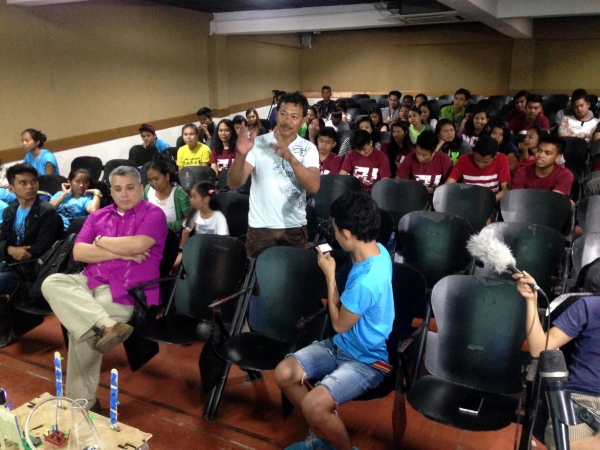
At the beginning of the week, we made some site visits, tested out the first part of the BOAT Lab, and interviewed locals about the issues that matter most to them. Our site location is Banilad, a sleepy little fishing community with a hidden treasure of a coral reef right offshore. We found their biggest concerns were the pollution in the area and how the water quality might affect both the beach and the marine protected area.

Then we came back to our (non-floating) workshop to dive into these ideas and create prototypes.

From this grew four strong teams each addressing an issue of how to combine art, science, and technology to help combat and increase awareness of ecological destruction. I could tell you about each team right now, but it’s been an exhausting week, so you can learn about what each team is going to do in the next post!
In the meantime, here's a great way to immerse yourself in our process. We've been fortunate to have a world-class student documentary team from Foundation University capturing all the amazing work that's being done. Check out some of the videos they have been putting together daily covering our projects:
Guest blog post by project photographer, Yen Nguyen.
Over dinner one evening, I talked to my husband and our two sons about an LGBTQ art project I was about to engage in. Lesbian, gay, bisexual, and transgender (LGBT) are terms we all are familiar with, even for our boys aged 15 and 11, however we couldn't work out a definition of “queer."
More Than Love on the Horizon is the art project originated by Vietnamese American artist Erin O’Brien, who identifies herself as queer. The project aims to increase the visibility of the Vietnamese LGBTQ community through the use of digital media art. Prior to this project, I didn’t even know that the “Q” had become the fifth initial and an integral part of the community.
In Erin’s artist talk, the first project activity, she explained her queer identity and what's Really Queer or Queerly Real about her art, which is mostly performance based and dedicated to enhance social justice for the LGBTQ community. As the project’s other activities unfolded, it was clear that she wanted to experiment using these art practices with members of the LGBTQ community in Ha Noi.

I was amazed by Erin’s energy and ability to engage the young participants in different activities - from a creative workshop, to shooting hologram videos, to proposing their own projects. Her ‘craziness’ is contagious. She managed to get them doing many things, like running around, shouting, laughing, posing, dancing and acting, some of which they are not used to or probably never been exposed to.


Erin needed translation while doing the activities. She admitted she can understand words in Vietnamese as long as they are related to food because of years eating Vietnamese food which, by the way, she can cook, too. She could cook for a family several weeks in a row without repeating any dishes, and apparently, she cooks for her dogs back home in LA. Before coming to Vietnam to work on this project, she filled the freezer with her homemade food; enough for her dog to eat for all the weeks she is away. Erin also expresses her art in the culinary realm by creating her own artisanal sausages with recipes inspired by her family and friends’ stories, under the brand "Meat My Friends."
Despite her limitation in Vietnamese comprehension, I saw that Erin could understand LGBTQ stories before they were even translated, particularly while we were shooting for the holograms. She laughed, she cheered, and she cried as individuals shared with her their emotional stories. Stories that demonstrated the clear need for Erin’s work, even when there have been remarkable recent achievements in increasing LGBTQ visibility in Vietnam.
After just a few days of working with her on her project, I began to understand Erin's queerness. I felt comfortable explaining to our sons: “Queer is simply being different, and it is okay to call people queer."
Once I land in the Philippines (after a 30+ hour series of flights from Atlanta), I have 29 days to fit in as much as I can. So I have to hit the ground running.
Luckily we managed to assemble an awesome team before I left!
Loushan (Yatta): Logistics Lead
Loushan has volunteered as the lead secretary administrator of the whole Waterspace program. This will be particularly useful for me when I am gone. She has been checking in on each of the project groups. She, herself, is from the youth performance group in town, YATTA.

Zorich (FU): Construction Lead
Zorich is leading the Estudio Damgo crew as they assemble the initial pilot raft project that will be used to test out laboratory gear. His target was to have an approximately 4m x 4m raft ready by the time I got back in April, and he totally nailed it! He got together the construction crew and using recycled old parts they put together the first module! We hope to get it on the open ocean any day now.


Zorich and Loushan are also leading the way in constructing the submarine. They are rocking it so hard!
Murray, Juliet, Fry and Greyhound Studios (FU): Documentation Lead
Greyhound studios is Foundation University’s in-house video production group. They are amazing, motivated, and quick. Having created lots of videos about all sorts of topics around the University and Dumaguete they already are on top of how to handle many logistical problems, so they are super helpful in the general production of the program as well. They have a rotating schedule with three helpers documenting each day of the program. I brought some of my own documentation equipment for them to utilize as well.

Carl-Mat (FU): Technical Lead
Carl and I have been diving into the world of programming arduinos and sensors. He already got an ocean wave detecting sensor hooked up to some nice waterproof lights.
He's agreed to lead some workshops training some of the (pro-active and dedicated) Yatta crew-members in weekly workshops until i come back!

Zing (Yatta): Graphic Design
Zing put together amazing logos to help the community organize around the big ideas of this program. There are two different logos. There is the BOAT lab (Building Open Art and Technology Lab) logo, which we can use for the physical space and the floating hackerspace we make. It looks like this:

And the other logo is for the entire American Arts Incubator program in Dumaguete:

These logos are a terrific way to share complex ideas with simple graphics that the participants can all rally around. T-shirts are on their way!
This awesome crew made excellent use of the interim time between my scouting trip and the upcoming workshop. Things are just going to keep getting more exciting as we add and expand upon these initial teams.

And last but not least, we have our incredible production assistant, Geline. She’s ready to tackle any problem, and is a vital resource to keeping our whole operation going at full speed!
We just wrapped our Community Panel Review and, wow, I can’t believe this... I was worried we wouldn’t have enough interest, but instead of four proposals we had six! The house was packed with community members and artists. The panelists were so thrilled today to hear the proposals for the creative community projects, each proposing to highlight the issue of LGBTQ visibility and equality in Vietnam in a unique way. Much gratitude to our partners Nhà Sàn Collective and U.S. Embassy in Hanoi, the Exchange Programs - U.S. Department of State and ZERO1 for creating such a successful event. Thank you to our amazing panelists Clayton Bond, Nguyễn Quốc Thành, Truong Que Chi, and Tran Phuong Thao for such insightful feedback for the artists. Extra special thank yous to our producer Linh Phan and Production Assistant Maia Do for making it all happen! And to the translators facilitating mutual understanding -- not always an easy task. Super loud shout out to our fabulous photographer Yen Nguyen for documenting the afternoon. I can't wait to see all the projects come into being, and to share the experience of LGBTQ life in Vietnam at our Aprill 22nd exhibition at Nha San Collective.


More photos of the panel can be seen in this Facebook album.
Here are the community artists who will be working hard in the next two weeks to highlight the visibility of LGBTQ community in Vietnam.

Meet our community artists and their projects:

Bùi Hoàng Long
Hoang Long is an independent filmmaker and a photographer who has a keen interest in community engagement projects. He has over 2 years of experience working as a social worker helping street children and the homeless in Hanoi. His works revolve around the lives of vulnerable people in the society with the desire to give them a voice.
Bùi Hoàng Long’s project "HANOI LOVE" shares beautiful messages about LGBTQ love in Hanoi. And just like any other types of love, it has its own distinct qualities.

Đinh Nhung
Nhung Dinh graduated from Clark University, USA in 2013 with a master degree in International Development for Social Change, is one of the main curators and organizers of the “Unstraight” exhibitions in Vietnam, “The Cabinet” (Hanoi of March 2015), and “Love, Pain and History” (Saigon, April 2011). In 2015, Nhung was a consultant of several projects including collecting stories and making an online queer archive in Vietnam, as well as LGBTQ exhibitions and archive projects in Cambodia, Serbia, and Russia. She collected stories of transgender people’s livelihood options and HIV risks in Vietnam in September 2015.
One of Nhung’s story-collecting methods, which she has been using consistently since 2010, is to invite communities to create art works inspired by their life experiences and tell their stories that relate to sexuality and violence as well as several taboo and sensitive topics. Currently she leads a Vagina Talks project and is working on a Vietnamese queer lexicon.
Đinh Thị Nhung's project "Vừa đi vừa kể // Roadside Stories" creates a map of queer space, time, and feelings. This is a part of her ongoing project of archiving queer culture in Vietnam.

Vũ Kiều Oanh
Oanh Kieu, based in Hanoi, is interested in the culture of the LGBT community, sexual health, and Mother goddess religion. In 2012, she made an over 2,000km cycling trip across Vietnam to bring a message of support for LGBT community. She is a founding member of 6+ (six plus) - an independent organization that connects the LGBT community and supports their health. She holds meetings to share knowledge about sexual diversity at universities and organizations. She also provides psychological counseling for LGBT people and PFLAG. She is a mentor of one of their programs to develop the leadership capacity of young LGBT people and activities in the other regions. From 2013 to date, she has been a core member of the organizing committee of VietPride - the largest pride festival for the LGBT community in Vietnam.
Shelter for LGBTQ:
Vũ Kiều Oanh and Group 6+ are inviting members of the LGBTQ community to share their experiences, points of view and desires, to expand the safe queer universe of their project "Vùng an toàn rộng mở - Shelter for LGBTQ". In that shelter, voices are heard and stories of abuse, prejudice, and love are waiting to be shared.

Ian Quee and Quyên Nguyễn
Quyên Quyên and Ian Quee met at an LGBTQ visibility workshop in Hanoi and decided to make a zine together. It’s a collection of comics, poetry, low-key art and film reviews. The first issue is titled Ế/Unsold and deals with gender and identity questions/thoughts/jokes.
Ian Quee is trained in the science of psychology. In reality, it's part of his scheme of becoming a better artist.
Quyên Quyên studies a mixed bag of literature and art history at Stanford University.

Nguyễn Quang Duy
Quang Duy is 30 years old and holds a Bachelor’s Degree in Economics. With his project called “VNLGBTQ247” he is looking to maximize the visibility of the LGBTQ community all over Hanoi as well as the rest of Vietnam. By inviting people to participate in taking photos, checking in on Instagram, and sharing posts on Facebook using hashtag #VNLGBTQ247, he intends to provide society with a better and closer look at the life of the LGBTQ community.
Nguyễn Quang Duy is launching a social media project. The project titled "#vnlgbtq247" will fill their Facebook page with images depicting everyday life of LGBTQ people with the hashtag #VNLGBTQ247.
https://www.facebook.com/VNlbgtq247

Lê Đức Anh
Le Duc Anh is currently a student at Hanoi University of Social Sciences and Humanities. His project “Touched by the Rainbow” is an action campaign to maximize the visibility of the LGBTQ community in Hanoi through Instagram. By showing short video clips made by members of the community, we hope to eliminate prejudice and homophobia.
Lê Đức Anh’s social media project "Touched by the Rainbow // Điểm chạm cầu vồng" records the LGBTQ landscape with short video clips made by members of the LGBTQ community that are then posted on Instagram and Facebook with the hashtag #diemchoncaucong
https://www.facebook.com/diemchamcauvong
In March, I had both my first scouting trip for the Arts Incubator as well as my first experience ever with life, culture, and nature in the Philippines, and more specifically, in Dumaguete. As an outsider, I wanted to collect my initial impressions of this fascinating place that soon would be my home. As I venture into the intense experiences living and working in Dumaguete, it is my goal to use these first observations to help process the experience and understand how my own ways of seeing this place will shift and evolve. Sharing these impressions also can help those with whom I will be working and living get an idea of how I am experiencing their world and how that's different from my experiences in other places. Then they'll be able to share contrasting points or different opinions. This post also will reveal how much of a noob I am about Filipino culture and how much more I have to learn!
Of course my initial impressions are generalizations, and there are counter-examples to all of these.
Everyone is super nice
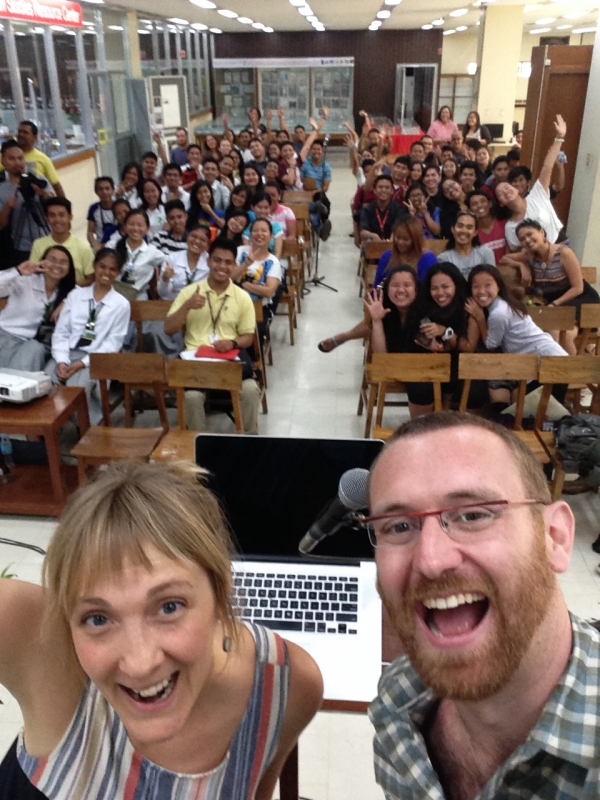
This is a positive stereotype that really rang true. Everywhere I went, Filipinos constantly went out of their way to help me; from the Tokyo-Manila flight attendant giving us a ride to our hotel, to folks walking with me for blocks to show me where to purchase a used bicycle. While walking around in public areas, I did not seem to be put into the “outsider” box, but rather was welcomed. I felt more accepted than other foreign places I have visited.
Dumaguete has harsh ecological contrasts
The town has an unending sea of motorized tricycles flooding its streets. They are loud, smelly, and make walking through town difficult. Moving through the town chokes you with exhaust and deafens you to anything but the busy city. That being said, a 10-minute walk to the edge of town brings you to some of the most beautiful areas I have ever encountered. The city ends abruptly, the trikes quiet, and the fresh air moves in under a clear, starry sky. With the city growing, and major concerns like the energy plant’s developments on Mt. Talinis, though, the peaceful and beautiful parts of this region appear to be losing the battle.
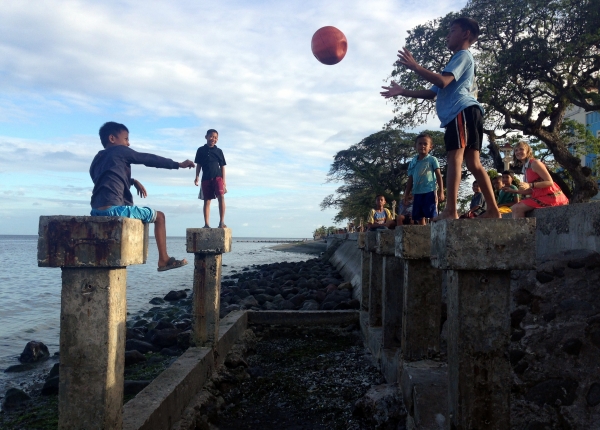

I just have no idea what lots of things are
Like this thing... It was beautiful! This whole part of the ocean filled with flags blowing in the wind.
Everyone is super enthusiastic and itching to do something fun
During our initial visits with different groups of artists, activists, engineers, and students, we were blown away by everyone's enthusiasm. Person after person came up to me, spouting all kinds of different ideas that interested them. While I have run many different workshops, the participants here had a different attitude than I have experienced. I would say that one of my roles during a typical workshop in the US is to try to take in a bunch of wild and crazy ideas from a group and help them realize these thoughts with technical skills. In Dumaguete, I almost faced the opposite. The people I met represented a vast wealth of technical, social, and artistic skills. They were sophisticated architects, activity organizers, or meticulous artists. Their questions to me instead were about how to turn these valuable skills into something fun. More than one person asked me “Can you teach me how to be creative?” This is a question I have never been confronted with, and it will pose an interesting challenge for me!
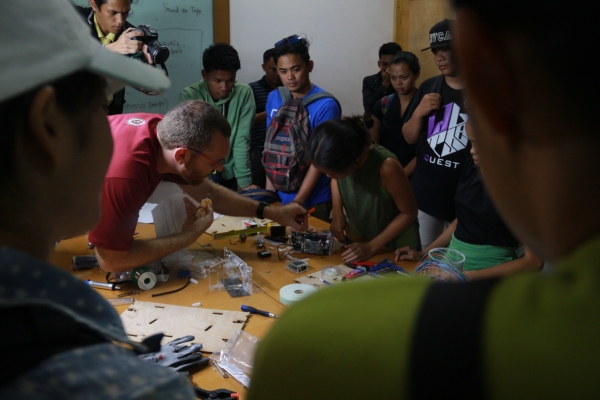
There is way too much sugar
I’m a person with a major sweet tooth. In the US, I go nuts for candy and often finish huge bags of M&M’s before the trailers even finish at a movie theater. Everyone had told me that the Philippines had a big issue with sugar infiltrating all food, but I had not expected what I encountered. Fried and sugared food is ubiquitous in an almost depressing way. For a person who usually craves sugar intensely, I was so inundated with it that I began craving vegetables and leaves! My favorite food became a salad of bland, boiled ferns. The entire town feels like a food desert with only heavily processed cheap “fast food” available. Some folks seem to react to this by aggressively only going for certain types of healthy foods, but most seem accustomed to this style of food. I remember when I tried ordering snacks for a group meetup... I wanted to purchase the most “authentic” pizza I could find, but nobody was happy; apparently the pizza was "too bitter, not sweet enough."

It's the most diverse mix of cultures I have encountered
Owing to it's fragmented island nature and waves of imperialism, the Philippines is hands-down the most interesting mash-up of cultures I have been lucky enough to experience. Just in the language, there's a seemless flow between bits of indigenous cultures, nearby islands, Spanish, and English. People's names were one of the biggest displays of this hyper cultural diversity for me. For instance I met amazing folks with names spanning from the super familiar to the incredibly foreign to me. Some examples include names like Mark, Henry, Dan, Humphrey, Zorich, Fry, Apple, Ying, Ritchley, Prexyl, Zing, and Irish (as she introduced herself, "My name is Irish, but i'm actually Flipino). It's an awesome blend of cool names and cool people!

I’ve been knighted
Everyone calls me “Sir Andy.” I’ve never had this honorific before, but it’s pretty fun! I recently earned my PhD, so it’s been fun getting the occasional “Dr. Andy,” but “Sir Andy” is way cooler!
An Endeavor in Failure
Having arrived in Hanoi, we had only one day to settle in and wrap up any loose ends for pre-production. We lost our production assistant and workshop location space at the last minute and were scrambling to do location scouting. As I always say, if you aim for failure you can only succeed. We were starting at a loss so it could only get better. Gratefully, we found a space in the same building as Nha San Collective on the top floor. The [REC] Room is a music space just opened by a really tall Danish expat, Jørn Wind, and a Vietnamese musician, Trang Le, but her nickname is Chuoi (banana). They are hosting sound experiments and punk rock bands and other music. With a wide open area and movable walls, the space worked out for our workshops AND as a space to film my hologram project.

Really Queer
We had a small but eager turnout for my artist talk on Friday. Nha San Collective hosted the talk in their space. I showed some of my work, posing the questions: What makes art Queer? Is the artwork Queer because I am a Queer-identified artist? Is the artwork Queer if it figures Queer people as the subjects? Is artwork Queer if it queers our understanding of the dominant landscape in some way?
Really wonderful questions about the artistic process and themes of “failure” and the “Queer horizon.”

We wrapped up our week of workshops with local LGBTQ participants in Hanoi reflecting on the many challenges encountered; some we were able to resolve and some remained. We had such a strong showing in our workshop enrollment numbers and yet actual turnout was about 60%. I’m told these are good numbers for Hanoi but it’s frustrating when people seem excited, they go through the steps of registering and even with follow up emails, reminder phone calls and texts end up not showing up. I'm sure there are many reasons why. I can't help but wonder if it has to do with the sensitivity of the topic. Although, it simply may be unusual culturally for Vietnamese to take a week to participate in a workshop, even if it is free. It is my understanding after talking to many people that in Vietnam it is often expected that workshop participants are paid for their time. (I wish I could get paid to go to workshops.)

Queerly Real
It has been wonderful to meet LGBTQ activists and community members here in Hanoi. I am learning so much about the contemporary issues that the community faces, both the struggles and the joys. The group of participants is fairly young; the average age is about 21. We are all getting to know each other and exploring the issues in the community together.

We spent quite a bit of time mapping the landscape of LGBTQ Vietnam and while Vietnam has made some recent advances including decriminalizing same-sex marriage and legislating some protections for Transgender rights, there is much that has yet to change. The biggest change ahead is social -- the cultural and gender norms and expectations here make it incredibly challenging for LGBTQ Vietnamese.

Participants talked about a variety of issues that go beyond same-sex marriage, including lack of sex education, lack of job protections, access to healthcare, bathroom accessibility, and other issues that affect the community. Many particpants felt strongly about having a family and were concerned about what their options might be for the future.

As we got to know one another in these workshops, I could tell participants were clearly feeling outside their comfort zones. Most people don’t run around the room making animal noises or moving like their favorite food. My approach to performance is not a familiar one to many people in the U.S., let alone here in Vietnam!
I am looking forward to working with the workshop participants to identify creative solutions to the issues they have detailed. I am looking forward to queering the landscape with this community.
I write this from the plane en route to Hanoi to kick off the Vietnam Arts Incubator program. As with all pre-production, just when you think you have everything together, some things fall apart. I have the most amazing producer on the ground handling the details, like securing translators, a production assistant, a director of photography, and location scouting. Some things fell apart before I got on the plane but, when I land, I know everything will all fall together.
My carry-on handbag is full of electronics — iPads, tablets, iPhones, Androids, and a couple Kindles. I spent the past few days driving around Los Angeles trading 2 gallons of homemade kombucha, sea salt caramels, and my goodwill for the use of these electronics for our exhibition at Nha San Collective at the end of the month.

I’m excited to put these to use in the exhibition as displays for the holograms we will create. Gallery visitors also will be able to pull up the hologram videos on their own devices from our website. The DIY hologram projectors convert smartphones and tablets into mini hologram projectors, making visible the Vietnamese LGBTQ community in Hanoi.
Before I left Los Angeles, I prototyped a smaller, lighter DIY hologram projector for the project. These new prototypes are made with overhead transparency paper and can be cut more precisely and faster using scissors instead fighting the CD case plastic with an exacto blade. This new DIY hologram projector is lighter, pliable, and portable and can be made in less than 5 minutes.
As soon as I touch down, I will have to start running. The enthusiasm for the Vietnam Arts Incubator project has been demonstrable. I’m beside myself knowing that there are over 40 LGBTQ participants registered for the workshops I will be facilitating. Glancing through the registrations there are gays, lesbians, queer identified, and a few transgender participants. I’m learning new terms and surprised how many folks identify as queer.
Gay - Đồng tính nam
Lesbian - Đồng tính nữ
Bisexual - Song tính
Transgender - Người chuyển giới
Queer – Queer

I am hoping that the workshops will be not only engaging and transformative for the participants but also generative. Out of this week of workshops, participants will develop projects that creatively engage LGBTQ visibility and equality in Vietnam using a digital media platform. Four of these proposals will be the recipients of small grants to carry out their own projects.
Meanwhile, I will be filming participants and community members to create holograms. We have to do this all very quickly because, as it turns out, in order to put all the work in the April 22nd exhibition we have to get all the finished projects submitted to government censors a week before they’re made public.
Update: I have landed in Hanoi and would you believe, unbeknownst to me, the apartment we are staying at is called “Rainbow Building.” Serendipity!
A community panel was assembled to judge the presentations by workshop participants. The panel consisted of:
- Yiyi Elizabeth Wong, Associate Professor Hubei University of Economics
- Carlos Castellanos, Assistant Professor, Digital/Experimental Media, Department of Art, Kansas State University, Artist in Residence K11
- Summer Xia, Senior Editor, Sina Hubei (Media)
- James Dragon, U.S. Consulate General Wuhan
- Bu Shi, Assistant Manager, K11 Art Projects Department
The Augmented Reality Workshop participants produced six very thoughtful proposals by six very diverse teams. Four of these proposals were selected as finalists by the community panel:
Team One is proposing a city-wide project titled A Crow Drinking Water, which uses Augmented Reality (AR) to document and respond to the loss of three quarters of Wuhan’s lakes to land reclamation and development.

Team members include Xiaoxin Wang 王晓新, Penghui Lai 赖鹏晖, Xiaoting Gan 甘逍婷, Chenqiang Zhou 周陈强, Zhang Zhou 周璋, Qingxi Wang 王清茜, and Shanshan Zeng 曾姗姗.
Team Two will investigate the history of the original Wuhan Dazhimen Railway Station, a beautiful French style building from the 1920’s which was once the most modern and important railway station in China, and helped to shape Wuhan’s image as a transportation hub. The building stands abandoned today and the group is proposing a kind of AR museum, accessible from the street.

Team members include Wu Jun 吴君, Yin Chuang 尹闯, Li Ziwei 李子威, Zhao Mengdi 赵梦迪, and with consultation by Chen Yong 陈勇.

Team Three will focus on the site of the former Wuhan Airport in Wuchang in their project titled The Vanished Nanhu Airport. Although the flight control building is still extant, it has been redeveloped as part of a sprawling housing development. Indeed the former runway is a traffic congested street artery which, if all goes as planned, will one day have period planes taking off and landing on it again, at least virtually.

Team members include Zheng Fugui 郑富贵, Deng Fugui, Cao Xiaoli 曹晓黎, Yao Leyue 姚乐月, 邓佩, Deng Pei, and Liu Fan 刘凡.

Team Four will continue the portal gate concept in their project, Through Gate, to include creating a network of portals connecting the institutions and students at several of the important universities in the city, which all have gateway entrances.

Team members include Yuetong Wang 汪玥彤, Zhuojun Hu 胡卓君, Feng Xiong 熊峰, Peng Liu 刘鹏, Yaming Wang 王娅茗, Tian Meng 孟天.

Everyone that was not part of a finalist team was invited to join one. We have scheduled individual meetings with each of the four teams this coming Tuesday, to answer questions about the contract, sign it, distribute the first installment, and discuss the next step of their projects during the implementation and engagement phase of the Incubator.
Each team will distill their idea to be represented at the portal gate in the courtyard of K11 Art Village for exhibition on May 7th. At that point, the teams should have the skills they need to complete the larger concept on location throughout the city and sustain the results of the American Arts Incubator program after I leave.
I arrived in Wuhan on Thursday, April 14th. The trip was long, but I was anxious to get the project underway so on Friday we got the production team together at the K11 Art Village to hammer out some of the details and plan for the weeks to come.
Importantly, the test of the GPS location in the courtyard where the portal will be built proved a success. Here are a couple of screenshots:

We hope to get the construction of the portal moving ahead in the next couple of days. Here are the final plans:


I am settled in now and things are moving forward! The Opening Ceremony and Artist Talk took place Sunday April 17th at the Wuhan Art Museum and the Augmented Reality Workshops got under way Monday April 18th. We seem to have generated significant buzz in the community. So exciting to have it happening after months and months of preparations! We had 53 participants the first day which thinned down to about 35 five regular attendees.
Through a series of exercises, particpants are learning how to create geo-located augmented reality. Geo-located Augmented Reality allows people to experience alternative realities at site-specific locations. The public can simply download and launch a free mobile app and aim their devices’ cameras at the surrounding physical place. The application uses location detection technology to superimpose virtual objects, people or scenes at precise GPS coordinates, enabling the user to immerse themselves in the work as if they existed in the real world.


Community participants include faculty and students from the Hubei Institute of Fine Arts, the Central China Normal University, the Wuhan Textile University and other community members at large.
Each participant will be given wall space and a projector in K11’s exhibitions gallery to prepare poster style proposals for the micro-grant competition. On April 23rd the public will be invited to a community exhibition event where a panel review will be conducted to choose the four micro-grant recipient finalist teams.
During the implementation and engagement phase of the project, four micro-grant recipient finalist teams will be dispatched out into the city to create their own augmented reality scenes that document those parts of the city which best represent their sense of the change.
The resulting virtual work will then be placed at the precise GPS location of the portal gate in the courtyard of the K11 art village.

ZERO1 Friends and Family,
After eight years as Executive Director of ZERO1, I have decided to step down to set the stage for a next generation of leadership. It’s been quite the ride, but the time has come to turn my attention to new challenges including my own art practice. During my tenure, ZERO1 featured over 600 artists from around the world, emerging the ZERO1 Biennial as one of the most significant art and technology festivals in North America. I am proud of the many ZERO1 exhibitions, public art initiatives, Fellowship Program and the American Arts Incubator, all of which have provided unique platforms for artists to experiment, provoke, and inspire new strategies and critical discourse.
ZERO1 represents a network of organizational partners, stakeholders, funders, and individuals who relentlessly offered their guidance, support, and expertise. Thank you all. I often described my job as network facilitator, when actually it was the other way around.
Lastly, I want to acknowledge the ZERO1 Board of Directors and my incredible staff for their dedication to this amazing enterprise.
Sincerely,
Joel Slayton
A note from the ZERO1 Board Chair, Barbara Goldstein
On behalf of ZERO1’s Board of Directors, I want to thank Joel Slayton for the important and ground-breaking work he has done for the organization, first as a founding board member and later as Executive Director. Since ZERO1’s inception, Joel has been a visionary leader who continually promoted new ways to showcase the work of groundbreaking artists who are working with technology and science to reflect and comment on the world around them. Joel built partnerships with industry, academia, and government bringing the power of art to hundreds of thousands through ZERO1's programs.
A recognized artist himself and former Director of CADRE Lab at San Jose State, Joel elevated ZERO1 to an international brand, perhaps better known beyond San Jose than in its own hometown. Beginning with the 2006 ZERO1 Biennial, when he chaired the International Symposium on Electronic Arts (ISEA), Joel’s clear vision brought the work of national and international curators and artists to a worldwide audience, stimulating dialogue and action.
After more than eight years as Executive Director of ZERO1, Joel has decided to move on to pursue other artistic and personal interests. Concurrently, ZERO1 is re-examining its core mission, moving away from producing a Biennial and seeking other ways to connect creative explorers in arts, science, and technologies to affect change in their own communities and beyond.
During this interim period, ZERO1 will be led by Brad Maihack, an Encore Executive Fellow and former HP executive, whose expertise in strategic business development, turnaround, partnerships, and alliance management will provide the organization with the skills it needs to face the future.
We wish Joel a bright and productive future and welcome Brad to ZERO1!
Warm Wishes,
Barbara Goldstein
ZERO1 Board Chair
During the ZERO1 American Arts Incubator orientation meetings, it became apparent that there will likey be support to build a counterpart portal for an exhibition at Fort Mason Center for Arts and Culture here in San Francisco! People will be able to look through the American portal and see China, and vice versa.


If you have access to any late mobile device and would like to view the work on location at Form Mason Center, I have created a quick set of instructions below.
Instructions:
• Install the free Layar Augmented Reality App, http://layar.com
• Scan this code
• Consult the map for a portal near you

Justin Hoover, the Creative Director of the Fort Mason Center, was able to verify that the augmented reality scenes from Wuhan I placed before my departure were indeed there and working.
Before we were due downtown for the morning meeting on Wednesday, January 27th, Sara Dean (a fellow AAI Artist) and I managed to steal a few minutes to walk up to my old neighborhood at Haight and Masonic, where I created an avatar of her in the context of the street corner. So now I have virtual reality of San Francisco to place in the courtyard of K11 in Wuhan, where the portal will be built, to complete the conceptual opening of the virtual portal.
Sara Dean, Haight and Masonic by johncraigfreeman on Sketchfab
Just prior to the Uber arriving, I was able to knock out another virtual scene in front of the Airbnb where the Arts Incubator artists are staying for the week, with all but Beth Ferguson present.
Andy, Sara and Erin, Fell Street by johncraigfreeman on Sketchfab

It worked! I was able to make the DIY projector device in about 30 minutes with just recycled plastic, an exact-o knife, some tape, and a ruler. Our esteemed mentors were just as excited as I am about this simple DIY technology as a way to share the voices of Vietnam’s LGBTQ community.
I am looking forward to collectively identifying and creating strategies to amplify these stories. To reflect on contemporary LGBTQ Vietnam and what an imagined future could look like for the community, I hope to ask project participants to share their visions for Queer Vietnam’s Future.