Last month wrapped up the ZERO1 American Arts Incubator in Gwangju, South Korea in partnership with the Gwangju Cultural Foundation. Gwangju is widely known as the site of the Gwangju Uprising (or May 18 Democratic Uprising), when the public responded to martial law instituted by the government, the closing of schools, and the banning of political activities with a large-scale civil uprising. The uprising began at Chonnam University with students protesting, and quickly spread with tens of thousands of protesters, hundreds of deaths, and thousands of injuries. This uprising paved the way for the democratization of South Korea in the late 1980s, and the event is a major part of South Korea’s history and is still extremely present for many in the country. Working in this very politically and socially engaged city, it was interesting to learn about the current issues of social inclusion that the participants were experiencing, that ranged from issues like processing trauma in the body to dealing with the complex relationship between younger and older members of society.
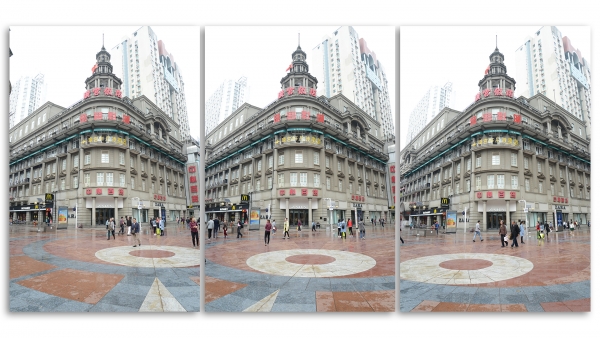
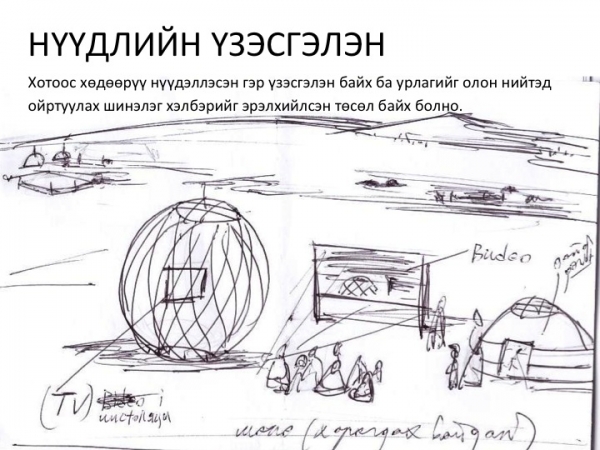
We began with a one week workshop, where we got to know one another, talk through the themes, and learn some new skills. My approach to the workshop was to use the concept of “home” as an entry point to the issue of social inclusion. “Home” is an idea we can all relate to—we have all felt at home at some point, whether it is a physical place, a group of people, or a mode of being, But what makes someone feel “at home” and what does it mean to belong in a space, community, or city? What might a future home look like, if we imagine one that is more inclusive?
Artist Joo Hong visited to talk about her social performances and interventions in Gwangju, around Korea, and in New York Times Square.
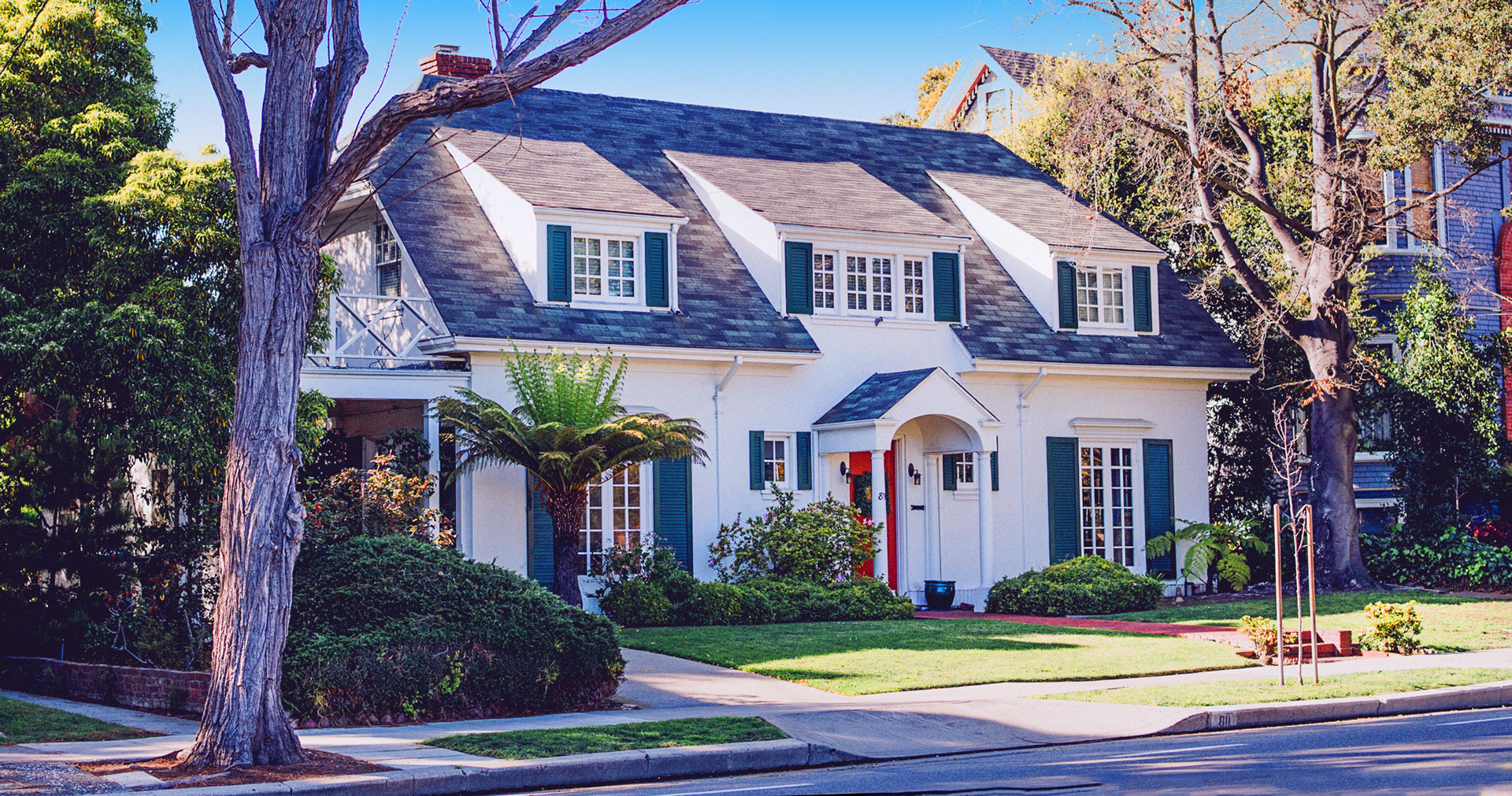
We tried to learn through action and our bodies. Participants brought objects that captured their feeling of home and improvised with them. Through these activities, we got used to the idea of creating space together, negotiating, and imagining. We were building a framework for ourselves.
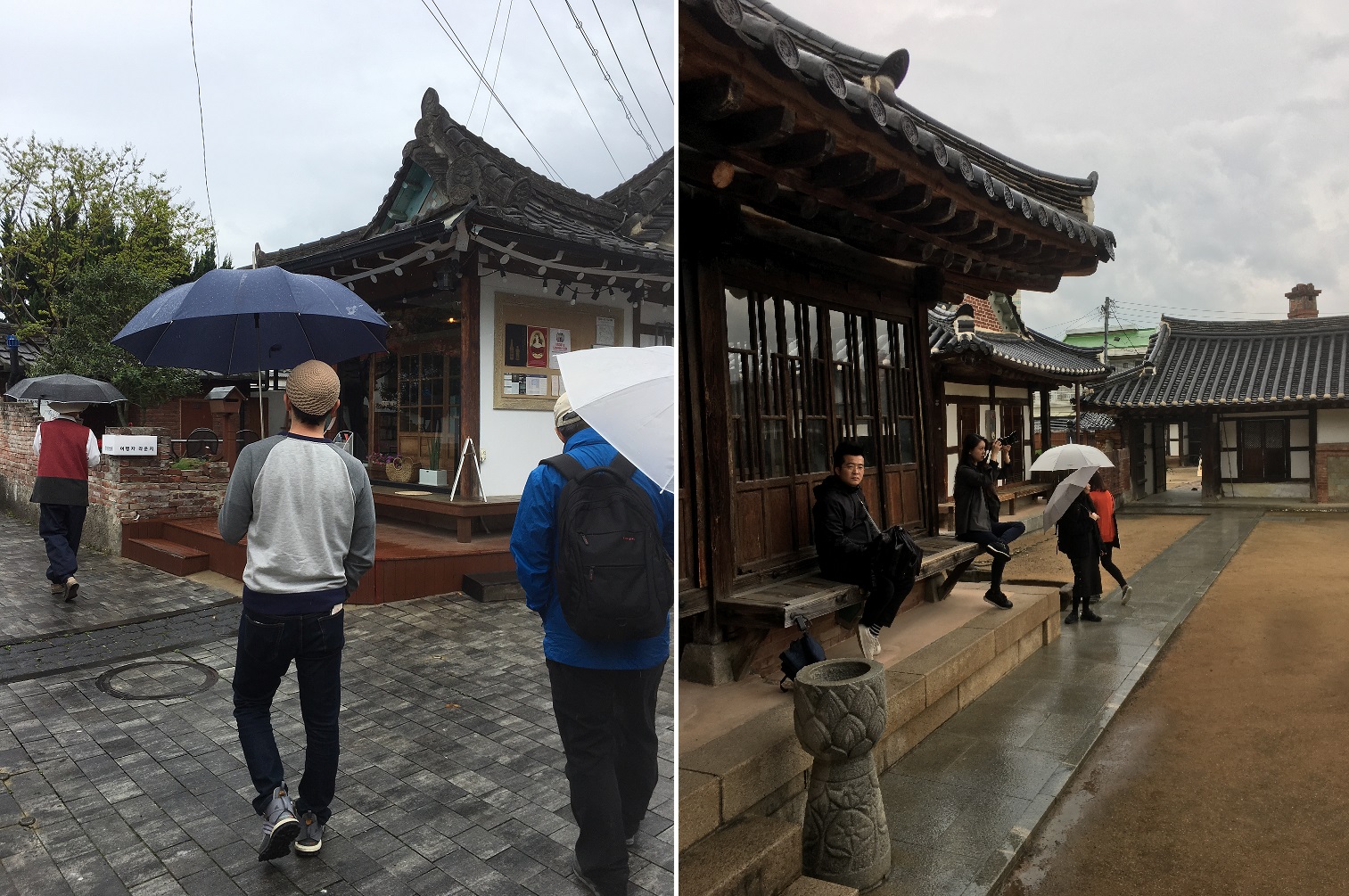
We also visited Yangnim-Dong and thought about the meaning of doing this work in Gwangju today. We toured the beautiful Chinese Holy Tree (Horang Gasinaumu) Guest House and learned about the missionaries and religious and spiritual roots of the city that put a priority on caring for family, city, and justice. This felt very relevant to our themes of home and social inclusion.
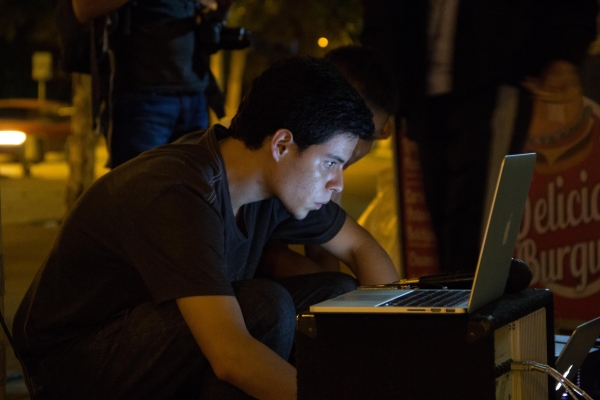
We also spent time learning technical skills to make the projects. We learned coding to create interactive drawings using p5.js. We used machine learning to train simple systems to recognize things like facial expressions, body positions, or basic objects. Then we thought about how to create interactive installations combining elements of camera input, projected content, and audience interaction.
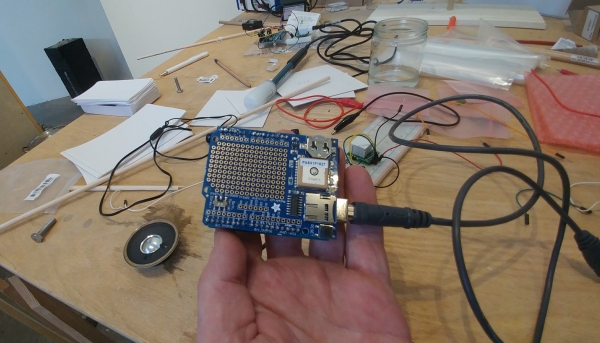
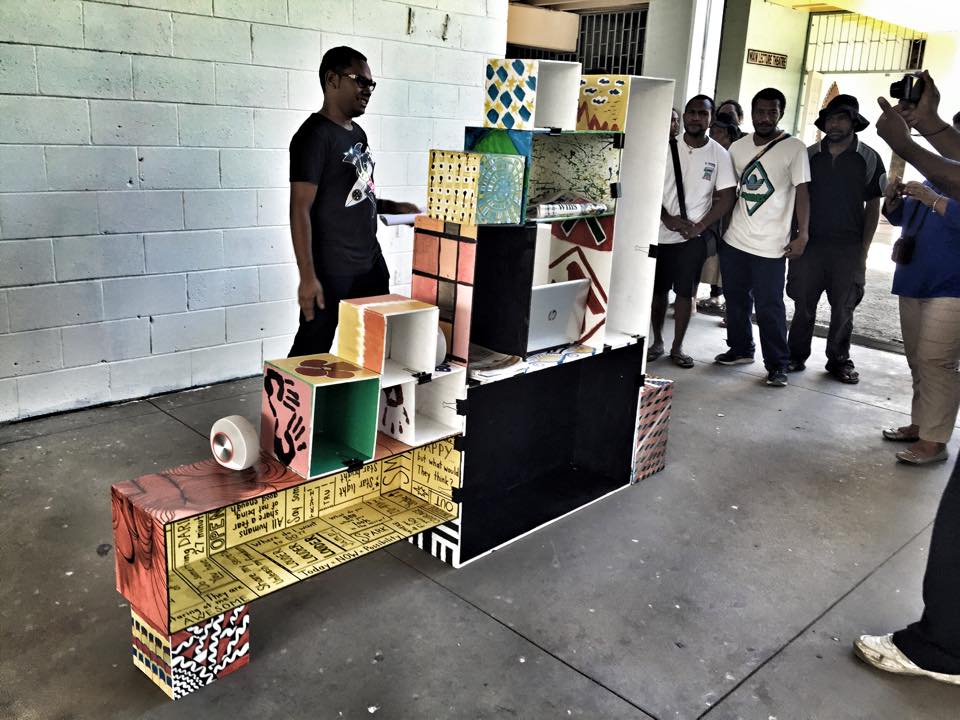
After that busy week, we formed four teams and began developing team projects that would make up one bigger installation. The “Smarter Home” project reimagines smart homes of the future, trying to bring technology into personal space on our own terms. Each team selected an issue within the broader scope of social inclusion to address through a conversation room they created within the larger structure. They then developed one mode of interaction to use as the mechanic for their piece. This meant incorporating machine learning, audio processing, and computer vision techniques to track and respond to the presence of participants.
Nawon Paek, Taeguen Lim, Gaeyang Park, and Inhwa Yeom’s project III-iteracy raised awareness about illiteracy and the difficulty some people face in navigating the city. Creating an installation that reacted to eye blinks, they used coding techniques and visual effects as metaphors for understanding different experiences of seeing and reading.
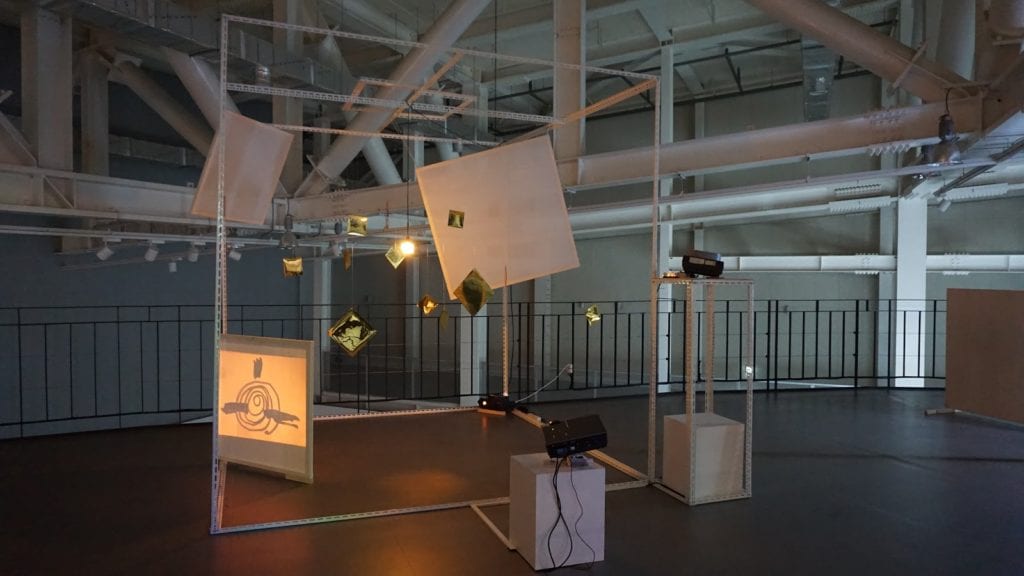
Do Won Kim, Jung Suk Noh, Yun Jeong Kim, Ho Jong Jeong, and So Jeong Yun’s project took on imagined roles of family members to create their project I LOVE YOUt. Expanding on the traditional Korean pastime yutnori, they envisioned it as a means to communicate with family members and understand the history and spirit of Gwangju. It used machine learning to introduce a new game format that combines the past and the future by digitally linking analog games, and presenting the audience with image or text questions to share experiences from different moments in time. The experience drew on a shared sense of sorrow to form a community of hope.
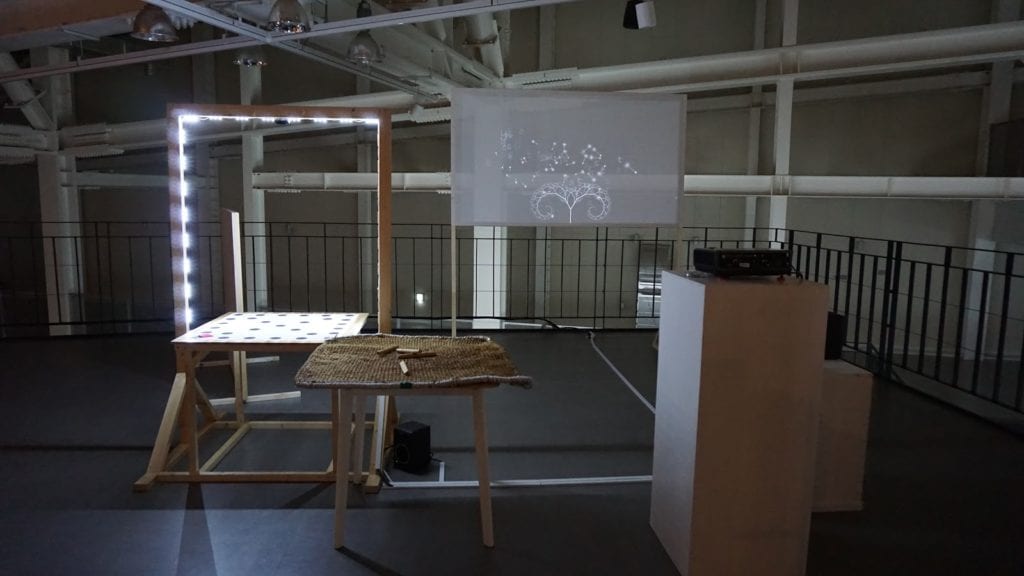
Changwan Moon, Hyewon Kim, and JeongNang Choi’s project Feel-Fill investigated the way emotional pain is experienced in the body. After surveying local community members about their embodied pain, they created an interactive visualization that reacted to voice. When someone screamed in their room, a large portrait of the body would illuminate with mapped projections at the pain points.
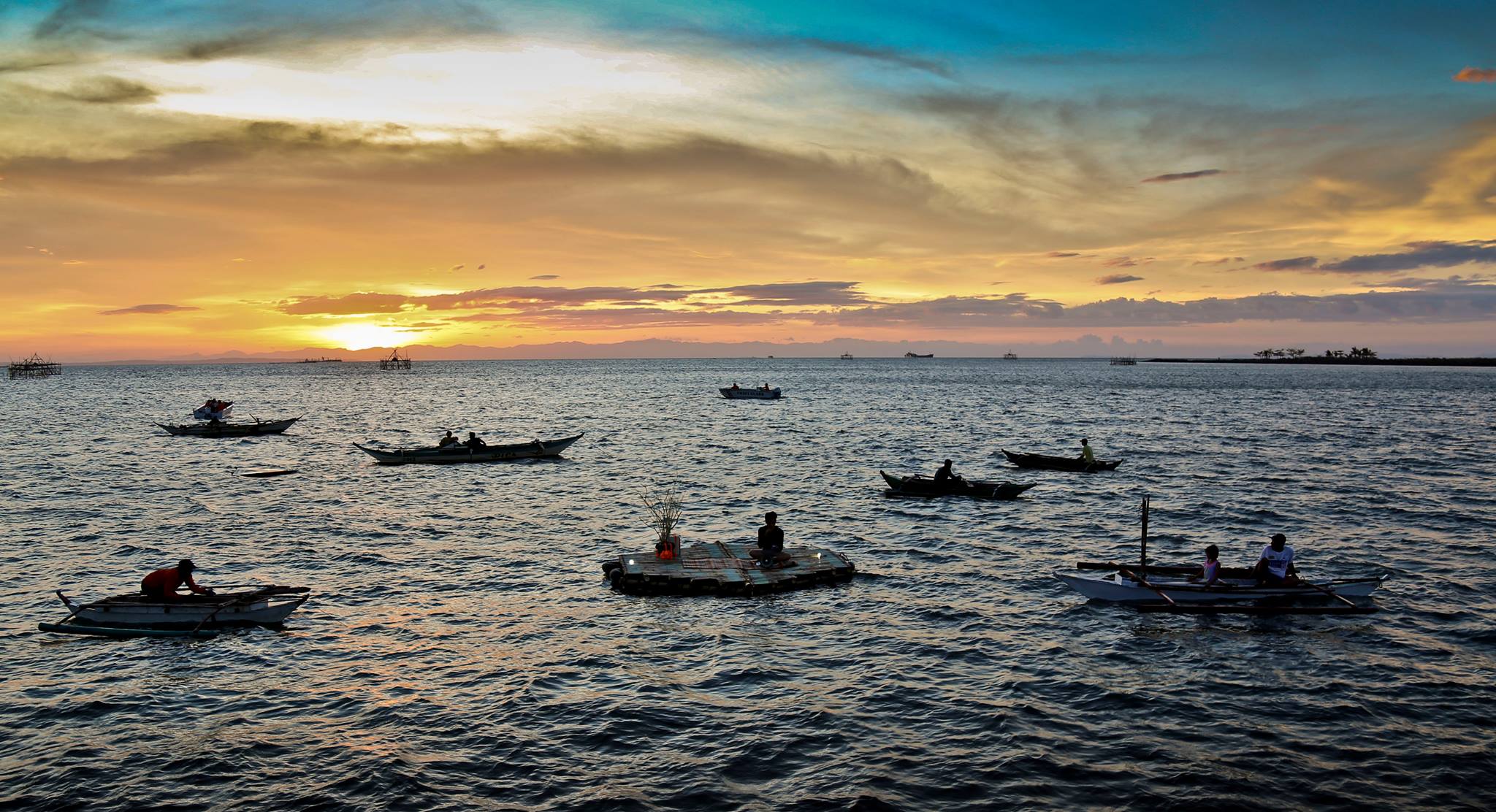
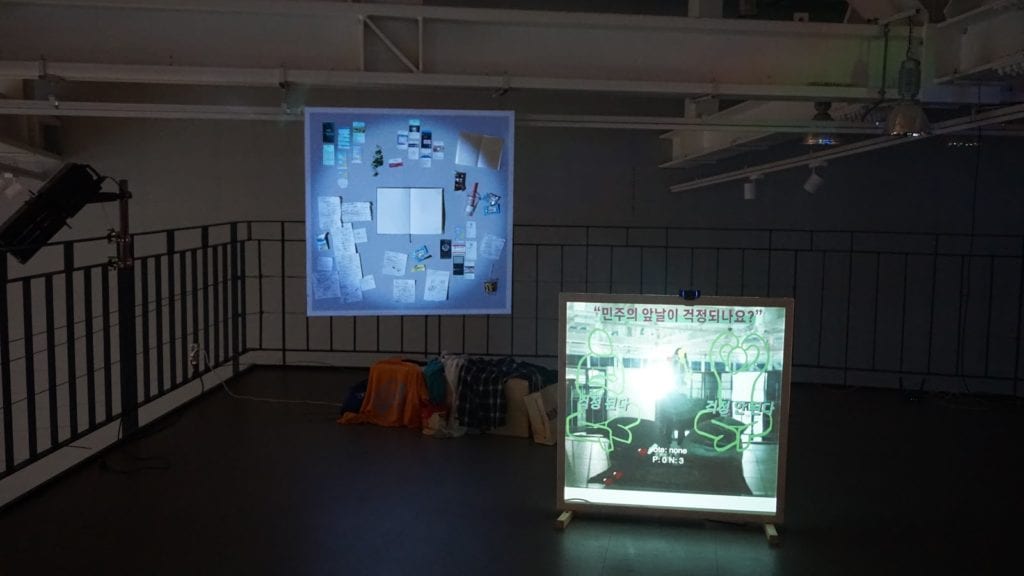
Kitae Park, Minju Do, and Yonghyun Lim’s project How to Understand Your Daughter took on the smaller society known as the “family.” As they put it, “Home is a place where two different social roles collide: between what parents want their children to act like (as a member of the family) and what the children want to act and live like (as a member of a society).” In the middle of the installation is a diary by Minju, one of the team members, onto which a pre-recorded video of her day and her artworks are projected. The audience was invited to react to Minju’s day, experiencing it from her mother’s viewpoint, and respond using their bodies to two options: 1) I am worried about her future, 2) I am not worried about her future. The installation detected the bodily responses and visualized the broader community’s outlook on Minju’s future.
Together, the four works came together into one larger installation that offered our own “Smarter Home / 더 똑똑한 집.” A panel review and open house involving the public wrapped up everything up.
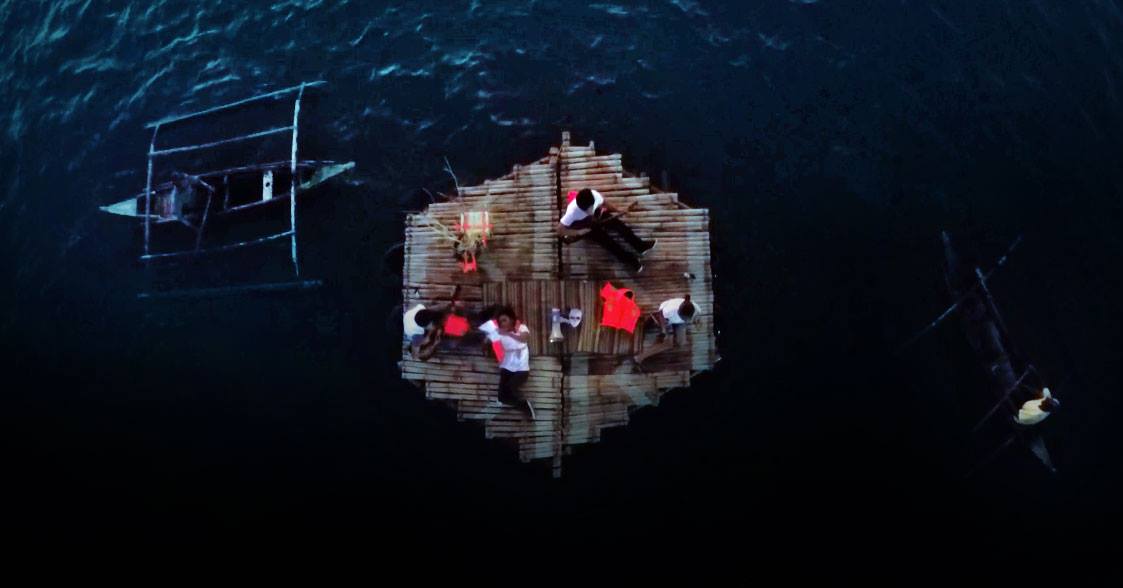
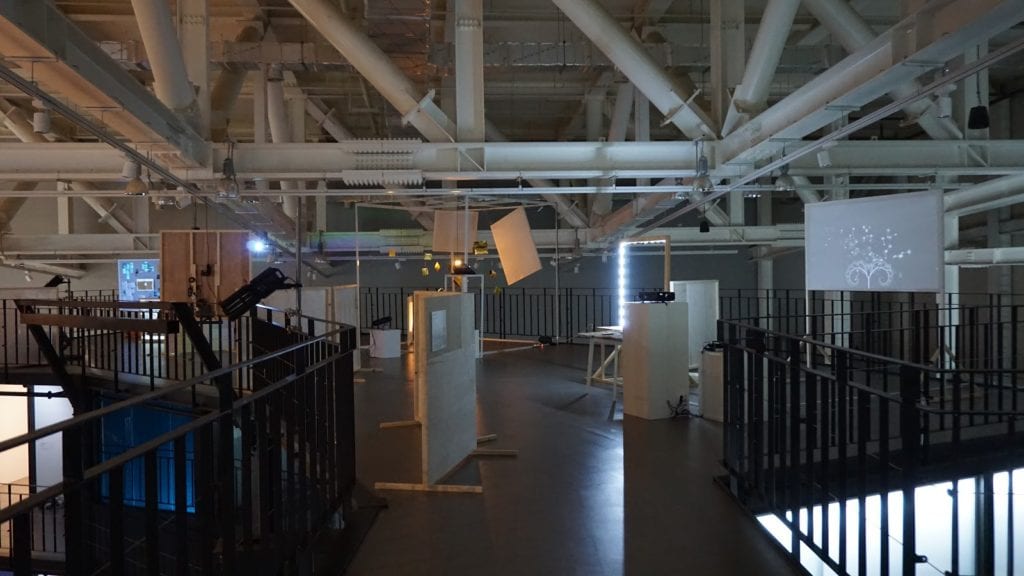
Earlier this month, we had the opportunity to stage a new iteration of this work as part of the International Symposium on Electronic Art (ISEA) exhibition that will be held at the Asia Culture Center. The installation was developed significantly to adapt to a new site, audience, and ongoing goals of the participants.
This exchange taught me a lot about communication, which I think is at the core of feeling like you are home. As we navigated language differences, I found my definition of “understanding” expanding. I realized that though we may have different interpretations of what was being said, we could still find places to connect and build together. In some ways, it offered a wider, more forgiving and creative way of collaborating. Each of us were able to bring our individual realities into a loose framework that created something bigger.
I must say many thanks to Inhwa Yeom, our amazing production assistant, interpreter, and team member, the whole team at Gwangju Cultural Foundation, including Yong Soon, JinKyung Jeong, and Jinsil Choi, Shamsher Virk and Maya Holm who provided so much support from afar at ZERO1, the US Department of State for supporting this work, and all the participants who were so creative, committed, and generous with their energy.
What an exhilarating and whirlwind of a month in Istanbul! 16 participants (across a wide range of disciplines) and I explored gender equity and women’s empowerment through participatory design, movement, writing, drawing, skill-building workshops employing different technologies, professional development, and group project development. The month culminated in a spectacular open house and panel review to showcase prototypes we developed together in under ten days. Below, I capture some of the colorful details of the experience…
When I first arrived to Istanbul, it was a rainy day, and the traffic was intense. It took nearly two hours to get over the Bosphorus, passing many billboards with candidates’ faces along the highway. When we finally arrived to Ataşehir, the driver was completely lost amidst the futuristic construction sites of the up-and-coming area where the DasDas Theater and InogarArt is located. It might have been my sleep-deprived state, but the high-rise where I was eventually deposited reminded me of Soylent Green, and was a puzzle to get in.
I woke at dawn to the sound of a loudspeaker calling people to prayer. Starving, I peered out my window to see if any store lights were on before I ventured out bleary-eyed to grab a proper Turkish breakfast. I found one restaurant open with a colorful polka-dot décor, mirrors placed every which way, serving spicy sausage, eggs, and bread.

Restored, I popped into DasDas Theater to meet with my host organization, InogarArt. I was greeted warmly by my amazing team, Esra, Dila, Ayca, and Dodo. We shared some pizza (I didn’t mention I had just ate) and chatted about digital art, materials I needed for the workshops, and they gave me a tour of their beautiful new space. What a gift to be the inaugural project in this incredible facility!
The next day, Senay (my point of contact at the U.S. Consulate) picked me up in a taxi bright and early, and we headed over to the consulate, which was a foreboding building with a mausoleum vibe. We had a lovely talk about the power of pop culture to transform hearts and minds, her time living in New York City, and she introduced me to my first Turkish tea.

We then discussed the logistics for the upcoming artist talk and the program run-down with the founders of InogarArt as well as Keavy and Stephanie from the consulate team, while nibbling on some delicious sweets, and of course, more tea. I also met Ezgi, my amazing translator. We went over my presentation (which I discovered might be slightly controversial given my views on immigration), but freedom of expression was encouraged.
The following day, I gave the artist talk in call-and-response style. I shared some of my past social justice work along with my current networked theatre and dance projects, which was followed by a reception with some delicious tapas prepared by an organization that supports refugee resettlement. I also met many of the participants, who appeared very shy, yet excited about the program.

The next morning, we kicked off the workshops after sharing breakfast (Menemen) together informally.

During the first workshop, I started with some ice-breakers and the “5 Whys” to create an intimate and safe space, and I took the participants through a participatory design practice I invented called “play as process” which allowed us to map the social challenge to an art, technology and performance project, to better balance message with engagement.
The process moved participants from the rational to the emotional, then onward to the visual, spatial, and temporal unpacking of the social challenge through systems thinking. In the final stage, participants applied all the accrued knowledge and documentation from the first three stages to the design of a paper and physical prototype.
During the process, participants identified and humanized their target audiences, defined the core values, problems, solutions, and actions associated with gender equity & women’s empowerment, then translated it into a simple narrative with characters and a clear message frame.
Next, through four discrete “imprinting sessions” drawn from French psychologist Clotaire Rapaille, they deconstructed the “culture code” of their issue, which allowed them to see the inherent resistance and challenges in communicating their issue.
Then, they explored mapping, diagramming, and cataloging their issue to begin visualizing the causal systems at play in their issues. With these three prismatic ways of looking at the social challenge, participants possessed all the ingredients for designing an experience using art, technology, and performance.


In addition, I also gave them an overview of the history of art, technology, and performance, and we examined case studies of contemporary projects to build a toolbox of technologies, UX/UI mechanics, and narrative strategies we could use for our concepts.
During the second workshop, I took the group through a multi-modal movement exercise, which involved a series of movement prompts, starting with reconnecting with our own bodies, then doing paired work, and eventually examining the whole ecosystem. The movement exercises were interspersed with drawing and writing exercises, which were intended to locate where our personal relationship to gender equity and women’s empowerment lives in our bodies, and to transform the script. At the end of the day, each participant gave a micro-performance based on their individual relationship to the social challenge.


During the third and fourth workshops, participants were asked to bring personal objects that connected to the issue. We then used these as a starting point for stories, which were recorded and edited. We took 360° photographs of the objects, and brought them into a photogrammetry software to generate a digital 3D model for printing. Next, we moved onto building custom electronics with microcontrollers and sensors to create a “storied object” which triggered the narrative through touch.

During the fifth workshop, I provided the participants with professional development training. I guided them through the process of writing a design document (a standard in the field) and developing a pitch deck. We used these to formulate a proposal and budget. At the end of the session, participants practiced pitching their projects in preparation for the public panel review.


The following day, I met with each of the four teams for 45-60 minutes to map out their technology spec and implementation plan for the remaining 10-day prototyping phase, and assigned tasks to group members. This is when I discovered there were significant skills gaps.
To address this, I met again with each team at SALT (following our field trip to learn about the archive) and elsewhere to enable participants to fully realize their projects by doing individual demos on specific technology.
For example, Group 4 needed to use Unity, a game engine and Microsoft Kinect, so I went over these tools. Group 3 needed a system for generating augmented reality, so I taught them how to create markers and targets using Vuforia. Group 1 wanted to use motion capture technology, so we had a night where we captured movements inside Notch and went over the pipeline for re-targeting to a 3D model, and Group 2 wanted to use IMU data to trigger sound and visuals, so we revisited how to solder and connect various sensors, firmware and deconstructed examples of Arduino & Processing sketches.


And then they were off. During the weekend and following week, I held office hours to tackle specific areas in which each group was stuck, and we went full-force into developing, troubleshooting tech, and installing physical structures in the DasDas Theater. I played a larger role in supporting the development process than I envisioned. And we stayed up until 3 a.m. many nights for the final push. But we pulled it off — the open house and panel review were a huge success!
I was incredibly proud of how much the participants accomplished in a short period of time, considering they possessed little to no technology skills coming in, and they learned in the process of doing. Each night as I walked down the dark steps towards my apartment, I had that positive-productive exhausted sensation.
I was equally surprised that while I had consciously shaped the workshop process around performance, none of the projects evolved into a performance, though I would argue that each work positioned the audience as the performer, and their body as essential to the experience. I also found it fascinating to see how each project was uniquely informed by the interdisciplinary mix of the group.
More information about each of the projects can be found on the AAI Turkey exchange page.
After the opening, where both the public and panelists were able to experience each of the four prototypes, we ushered everyone into the large theater at DasDas for a panel review where the participants pitched the full vision of their projects to an esteemed cross-sector panel of judges: Ahmet Kenan Bilgiç: musician, composer & producer; Melih Akdoğan: GM of D-Park, a tech incubator; Sanem Oktar: serial entrepreneur; Sertaç Taşdelen: founder of tech startup; Şengül Akçar: founder of KEDV (Foundation for the Support of Women's Work); and Duygu Şengünler: co-curator of the Istanbul Biennial. The feedback was generous and incisive.

During the final day, I met again with each group to go over their next steps and a sustainability plan. I recommended that each team bring a programmer and/or creative technologist on board in my absence and created a task list for their development sprints. There were plans to refine the prototypes to participate in a Street Festival when I left. We also discussed having some additional mentorship opportunities for grant writing and pitch training facilitated by InogarArt.
Then I had a lovely lunch (and a chicken dessert!) with Senay on Bagdat Street, and received a beautiful gift from the U.S. Consulate, which is now hanging on the door to my apartment in New York City as protection. And I shared a final meal with my new family to close out our time together where much excitement emerged around certificates of completion.

While I did not see much of Istanbul because our work schedule was intense, and the participants required extra assistance, I did manage to try a wide variety of foods (I fell in love with Tatuni), experience some art, and several of the participants took me on small tours of different neighborhoods.
I witnessed the grandeur of Sophia Hagia, visited the Museum of Innocence followed by a serendipitous tea and wonderful performance in the Beyoğlu neighborhood, enjoyed a midnight hamburger and stroll up to Taksim Square and through the transgender red light district, took the ferry to Kadıköy where I had shared a tea and a lovely conversation via Google Translate with an air traffic controller before giving a talk for the UNHCR, and even managed to get on Turkish TV and squeeze in Hamam after an evening of parkour (I will spare you the video of my Webster!).

I feel as though I was not simply a cultural envoy imparting new knowledge, but a nurturer who quietly cultivated a new family. It was one of the most fulfilling and positive experiences I’ve encountered in my life, and we created a very special bond. The participants even plan to meet monthly as a full group, and have ideas for other collaborative projects.
I left Istanbul with a full heart, appreciative for the experience and all the hidden labor that goes on behind the scenes by Shamsher and Maya to make American Arts Incubator such a unique experience. Teşekkürler!
American Arts Incubator Opening at KZNSA Gallery. Photo by Niamh Walsh-Vorster.
After running a month-long incubator in Durban, South Africa, I realized that augmented reality is still magic to people who experience it for the first time. During the month of April 2019, I worked with some extraordinary and talented South African artists at KZNSA Gallery located in Glenwood. As the gallery’s marketing suggested, we “took over” the space and had to quickly create four different works of art that dealt with social challenges and used augmented reality. The opening was held on May 2, 2019 to a packed audience.

The hectic pace and spirit of collaboration along with learning a new technology compelled everyone to be hyper-creative and energized. For many of the participants, this was their first foray into augmented reality, and we used the Artivive platform and APP to design the AR experience.
The art projects dealt with some hard-hitting social challenges in South Africa — from lack of clean water in rural communities to drug abuse in the cities. All of the artists incorporated interviews and real-life stories from people affected by these problems which made the artwork relevant and imperative. Some of the video interviews were embedded into the AR, which allowed viewers to understand the inspiration of the work.

One team painted a large mural of an astronaut reaching for the stars. The image represented the hopes and dreams many drug addicts have while going through the recovery process. When the AR is activated, the astronaut floats through the room as the background is transformed into the infinite vastness of space. This beautiful rendition of AR was such a powerful experience that it convinced Durban resident and street artist EWOK Robinson to use it in his murals.

The opening night ended with a spectacular dance performance organized by Portia Ncwane. She was part of the “Nomvula” AR comic book team that showcased their prototype at the Cape Town FanCon Comic Book Convention. The team plans to further develop their work for a big launch in Fall 2019 so stay tuned!
I think the incubator and the use of AR taught the participants and audiences how to add a digital layer that brings their artwork to life. The real and digital world can now co-exist and be experienced at the same time.
Durban has one of the most vibrant street art scenes in South Africa, and at the center of it is KZNSA Gallery located in Glenwood. The district has an eclectic mix of cultures and economic diversity, as well as dynamic youth culture. The gallery has become the artistic hub for the community with an ethos of “transformation, incubation, and activation.”

Street artist Iain EWOK Robinson at KZNSA Gallery. Photo by Niamh Walsh-Vorster.
On the Culture Trip website, Angela Shaw, the curator of the gallery, guides us through some of the emerging South African street artists in the city. What is clear from the article is that KZNSA’s ethos is all over the city. The artists reflect the community in their murals, and in turn the community supports public art. KZNSA Gallery dedicates their outdoor wall space to street artists, and new work is created on a regular basis. I am excited to experiment with their “activation” ethos and play around with augmented reality and street art, and work with local artists to make their murals come to life.

Priya on a Tiger mural in Mumbai. Photo by Tushar Prakash.
When I was creating the comic book series, “Priya’s Shakti” featuring India’s first female superhero who is a rape survivor, I was trying to figure out how to make the work popular and accessible. I discovered the power of public art through the work of Diego Rivera. He created massive murals in public spaces that showed regular people enduring and transforming history. His work was both a powerful artistic and political statement. Using his philosophy, I decided to take the iconic image of “Priya on a Tiger” and put it in public spaces in India. I think those murals have been seen by over 3 million people.
Throughout Durban, there are dozens of murals consciously (or subconsciously) influenced by Diego Rivera. The artists are painting regular people from their community on enormous walls or bridge columns, thus transforming the mundane into something beautiful and sublime.

Priya on a Tiger mural in Mumbai. Photo by Tushar Prakash.
Later, I discovered how to activate these murals and make them come to life through augmented reality. This emerging technology has the potential to change how we perceive and engage with the real world through a digital layer. Artists can create a monologue or physical version of their art and then re-imagine it through a digital transparency over the original without altering it. AR is a new toolkit for artists and for groups of artists to collaborate on new ideas. Even though the painting or mural remains consistent -- the digital layer can change instantly and react to the viewer’s perception of it. I am looking forward to exploring Durban’s street art scene with local artists and instill a spirit of adventure and play into the artwork.
[/et_pb_text][/et_pb_column][/et_pb_row][/et_pb_section]